
Most people with high blood pressure need more than one pill to get their numbers under control. That’s not a failure - it’s science. About 70-80% of hypertensive patients require two or more medications to reach target blood pressure levels, according to guidelines from the 2003 JNC 7 report. That’s why doctors now routinely prescribe antihypertensive combination generics - single pills that pack two or even three blood pressure drugs into one. They’re not new, but their availability, cost, and insurance coverage are still confusing for most patients.
What Are Antihypertensive Combination Generics?
These are called Single-Pill Combinations (SPCs) or Fixed-Dose Combinations (FDCs). They’re not fancy new drugs - they’re just cheaper versions of brand-name combos that have been around since the 1980s. The first one, Uniretic (enalapril + hydrochlorothiazide), got FDA approval in 1987. Today, you can buy generic versions of combinations like:
- Amlodipine + benazepril (Lotrel)
- Losartan + hydrochlorothiazide (Hyzaar)
- Amlodipine + valsartan (Exforge)
- Amlodipine + valsartan + hydrochlorothiazide (Triamterene combo)
- Lisinopril + hydrochlorothiazide (Zestoretic)
Some even come as triple combos - three drugs in one tablet. The FDA requires these generics to match the brand-name version’s effectiveness within a strict 80-125% range of absorption. That means your body gets the same amount of medicine, just for a fraction of the cost.
Why Do These Combinations Matter?
It’s not just about convenience. Taking three separate pills every day is hard. People forget. They get overwhelmed. Studies show that switching to a single pill improves adherence by 15-25%. In the STRIP trial, patients on combination pills hit their blood pressure goal 68% of the time - compared to just 45% for those taking pills separately.
One Reddit user, HypertensionWarrior87, wrote: “Switched from three pills to one. My BP dropped from 155/95 to 122/80 in two months. I actually remember to take it now.” That’s the real win.
But here’s the catch: cost doesn’t always favor the combo pill. In the early 2000s, SPCs were cheaper than buying two separate brand-name pills. But now? Many individual blood pressure meds are dirt cheap as generics. Amlodipine costs about $4.50/month. Valsartan? Around $7.80. Together, that’s $12.30. But the generic Exforge combo? Still $18.75. So if your insurance covers the individual pills, buying them separately can save you money.
What Combinations Are Actually Available?
Not every mix is made. Manufacturers only produce certain doses. If you need amlodipine 2.5mg and valsartan 160mg, you’re out of luck - that combo doesn’t exist as a pill. You’d have to take two separate tablets. Here’s what’s commonly stocked in U.S. pharmacies:
| Combination | Common Dosages (mg) | Brand Equivalent | Monthly Cost (GoodRx, 2023) |
|---|---|---|---|
| Amlodipine + Benazepril | 5/10, 5/20, 10/20, 10/40 | Lotrel | $17.55 |
| Losartan + HCTZ | 50/12.5, 100/12.5, 100/25 | Hyzaar | $10.60 |
| Lisinopril + HCTZ | 10/12.5, 20/12.5, 20/25 | Zestoretic | $12.10 |
| Amlodipine + Valsartan | 5/80, 5/160, 10/160 | Exforge | $18.75 |
| Amlodipine + Valsartan + HCTZ | 5/160/12.5, 10/160/12.5 | Exforge HCT | $32.40 |
Notice something? The cheapest option is often losartan/HCTZ. It’s widely available, stable, and effective. But if your doctor wants to increase your amlodipine to 10mg but keep valsartan at 80mg? You can’t. That combo doesn’t exist. You’d need to take two pills. That’s the biggest limitation of SPCs: no flexibility.

Insurance and the Cost Trap
Here’s where things get frustrating. Many insurance plans treat combination pills as “brand-name” even when they’re generic. One PatientsLikeMe user wrote: “My insurance covers each generic pill for $5 - but charges $45 for the combo. It makes zero sense.”
Why? Because insurers often have contracts with pharmacies that pay more for SPCs. They assume the combo is “easier” so they charge more. But the pharmacy cost is nearly the same. The difference is profit margin - not medicine.
Always ask your pharmacist: “Can you price this as two separate generics?” Sometimes, they can override the system. Other times, you’ll need to pay cash. GoodRx coupons can drop the price of a combo from $45 to $20 - but only if you’re paying out-of-pocket.
Availability Around the World
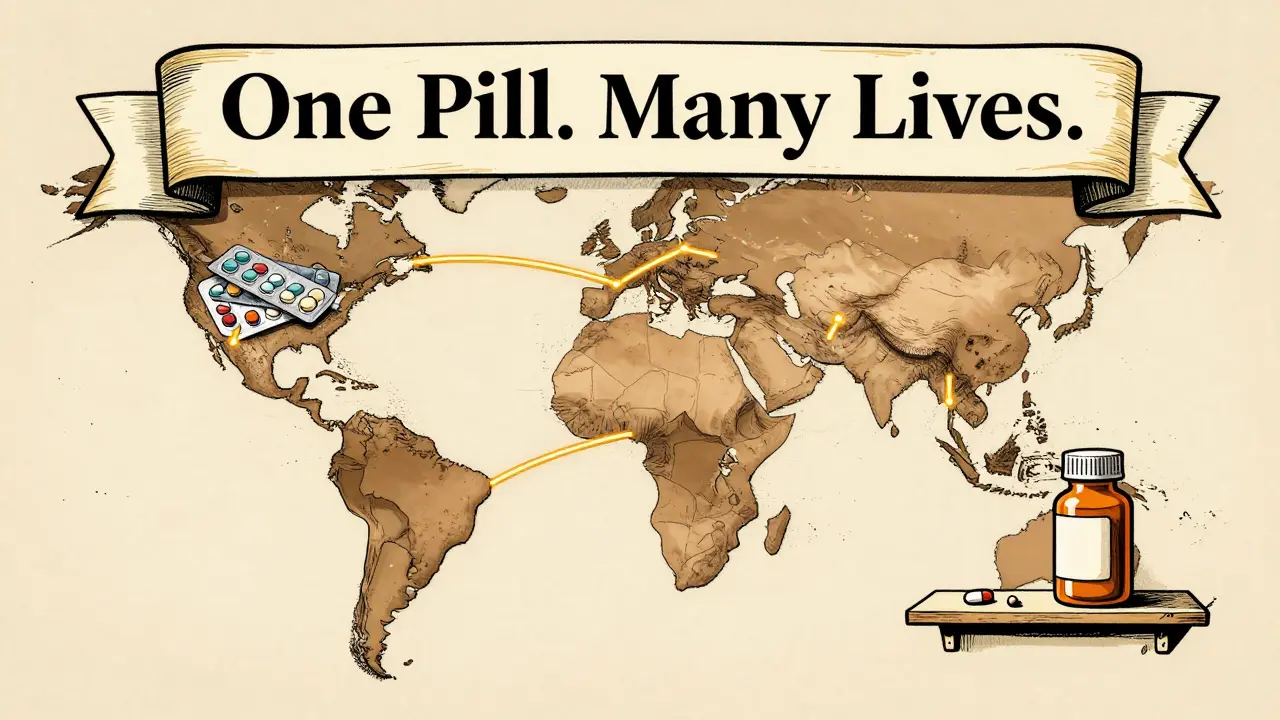
In the U.S., 85% of antihypertensive combination prescriptions are generic. But globally? It’s a different story. In low- and middle-income countries, only 15% of patients have access to these pills - even though 95% need them.
Studies from Ethiopia, Afghanistan, and Morocco show that even when the pills are technically available, they’re not stocked in local clinics. Supply chains break down. Doctors don’t know which ones to prescribe. Guidelines don’t include them. The WHO says 46% of low-income countries have less than 50% access to essential hypertension meds.
That’s not a medical problem. It’s a systems problem. And it’s why hypertension kills 10 times more people in poor countries than in rich ones.
When Should You Use a Combination Pill?
Doctors are encouraged to start patients on SPCs if their blood pressure is above 140/90. Why? Because it gets control faster. The ALLHAT trial showed that patients who started on combo pills reached target BP quicker than those who got one drug at a time.
But here’s the practical rule:
- If your BP is significantly high (like 160/100), start with a combo. It’s faster and simpler.
- If your BP is only slightly elevated and you’re on two separate generics that work, stick with them - especially if they’re cheaper.
- If you’re struggling to remember pills, switch to a combo - even if it costs a bit more. Adherence matters more than a few dollars.
- If you need a dose that doesn’t exist (like 2.5mg amlodipine + 160mg valsartan), you’ll need two pills. No workaround.
There’s no one-size-fits-all. But the goal is simple: get your BP under control - and keep taking your pills.
What’s Changing in 2026?
The FDA released new draft guidance in late 2023 to make it easier to approve new generic combinations. That means more triple combos could hit the market soon. A 2022 study predicted that if triple-combo generics became widely available in poor countries, they could cut the hypertension treatment gap by 35%.
But the real challenge isn’t making the pills - it’s getting them into the hands of people who need them. In Bristol, where I live, you can walk into any pharmacy and find five different SPCs. In rural Kenya? You might need to travel 50 miles. That’s the real gap.
What to Do Next
If you’re on multiple blood pressure pills:
- Ask your pharmacist: “Is there a generic combo for what I’m taking?”
- Use GoodRx or SingleCare to compare cash prices for combo vs. separate pills.
- If your insurance won’t cover the combo, ask for a prior authorization - or switch to separate generics.
- Don’t assume the combo is better. Sometimes, two pills are cheaper and just as effective.
- If you miss doses often, try the combo - even if it costs more. Your blood pressure will thank you.
High blood pressure doesn’t care if you take one pill or three. It only cares if you take it.
Are antihypertensive combination generics as effective as brand-name versions?
Yes. The FDA requires generic combination pills to prove they deliver the same amount of medicine into your bloodstream as the brand-name version - within a strict 80-125% range. Studies show they lower blood pressure just as effectively. The only difference is cost.
Why is my insurance covering my separate pills but not the combo?
Insurers sometimes pay more for combo pills because they’re coded as “brand” even when generic. They may also have contracts with pharmacies that make the combo more profitable for them. Always ask your pharmacist to price the combo as two separate generics - sometimes the system can be overridden.
Can I take two pills instead of one combo pill?
Yes - and sometimes it’s cheaper. If your individual generic pills cost less than the combo, taking them separately is perfectly safe and often more cost-effective. The only downside is remembering to take two pills instead of one.
What if I need a dose that doesn’t exist in a combo?
Many combinations don’t offer every possible dose. For example, there’s no pill with 2.5mg amlodipine + 160mg valsartan. In that case, you’ll need to take two separate pills. Your doctor can adjust your prescription accordingly.
Are triple-combination generics available in the U.S.?
Yes. Amlodipine/valsartan/hydrochlorothiazide (like Exforge HCT) is available as a generic. It’s usually prescribed for patients who haven’t reached target BP on two-drug combos. These are more expensive, but they reduce pill burden significantly.
Lily Steele
January 30, 2026 AT 21:50I switched to a combo pill last year after forgetting my three separate ones too many times. My BP dropped from 158/96 to 124/82 in 6 weeks. Honestly? Worth every extra dollar. I sleep better knowing I’m not risking a stroke because I was too tired to count pills.
Beth Beltway
February 1, 2026 AT 05:17Stop glorifying combo pills. This is pure pharmaceutical marketing masquerading as patient care. If you can’t manage two pills, you shouldn’t be managing your own BP at all. People are lazy, not sick. The real problem is that doctors prescribe too many drugs in the first place.
Kelly Weinhold
February 2, 2026 AT 19:31OMG I love this post so much!! I’ve been on losartan/HCTZ for years and just found out the combo is cheaper than buying them separate? I’ve been paying $28 for two pills and didn’t even realize I could’ve been paying $10?? I’m gonna call my pharmacy tomorrow and beg them to switch me. Also-triple combos?? I didn’t even know those existed. My doctor never mentioned it. This is life-changing info. Thank you for sharing the real deal, not just the sales pitch.
Kimberly Reker
February 3, 2026 AT 07:25For anyone reading this: always ask your pharmacist to price the combo as separate generics. I did this last month and saved $32 a month on my amlodipine/valsartan. The pharmacy system is broken, but they can override it if you ask nicely. Also, GoodRx coupons work wonders-even for combos. Don’t assume the combo is cheaper. Always check.
calanha nevin
February 4, 2026 AT 08:06The FDA’s bioequivalence standards for generic combination products are rigorously enforced. The 80–125% confidence interval for AUC and Cmax ensures therapeutic equivalence. Clinical outcomes in multiple randomized trials, including the ALLHAT and STRIP studies, confirm no difference in efficacy between generic SPCs and their branded counterparts. Cost savings are substantial and should not be sacrificed for perceived convenience. Adherence remains the primary determinant of outcome, and SPCs demonstrably improve it.
Lisa McCluskey
February 5, 2026 AT 16:23My dad’s in his 70s and takes three pills a day. He mixes them up. I got him on the losartan/HCTZ combo. He hasn’t missed a dose in 8 months. He says it’s like having one less thing to worry about. Sometimes the simplest fix is the best one.
owori patrick
February 7, 2026 AT 07:45Here in Nigeria, we don’t even have the single combos. We get one pill at a time, and sometimes the pharmacy runs out. I had to walk 12km last week just to get my amlodipine. If someone could make these combos available here, it would save so many lives. We don’t need fancy stuff-just the basics, in one pill.
Claire Wiltshire
February 7, 2026 AT 21:26Thank you for such a thoughtful, well-researched breakdown. I’m a nurse and I’ve seen patients struggle with adherence daily. The data on SPCs improving compliance is undeniable. I always encourage patients to compare cash prices with GoodRx-many are shocked to find separate generics are cheaper. But if they’re forgetting doses, I never hesitate to push for the combo. It’s not about convenience-it’s about survival.
Russ Kelemen
February 8, 2026 AT 00:42It’s funny how we treat medicine like a puzzle. We think if we take more pills, we’re doing more. But the body doesn’t care how many pills you swallow-it cares if you swallow them. The real question isn’t ‘Which pill?’ It’s ‘Will you still be taking this in six months?’ That’s the only metric that matters.
Sheila Garfield
February 8, 2026 AT 15:12Just got prescribed the triple combo last week. $32 a month? I paid $18 cash with a GoodRx coupon. My doctor didn’t even mention it-I had to ask. So glad I did. I feel like I’ve unlocked a secret level in my health game.
Shawn Peck
February 9, 2026 AT 00:34Combos are a scam. The FDA is in bed with Big Pharma. They want you to take one pill so you don’t question it. I took my two pills separately for 3 years and my BP was perfect. Now they’re pushing combos because they make more money. Don’t fall for it.