
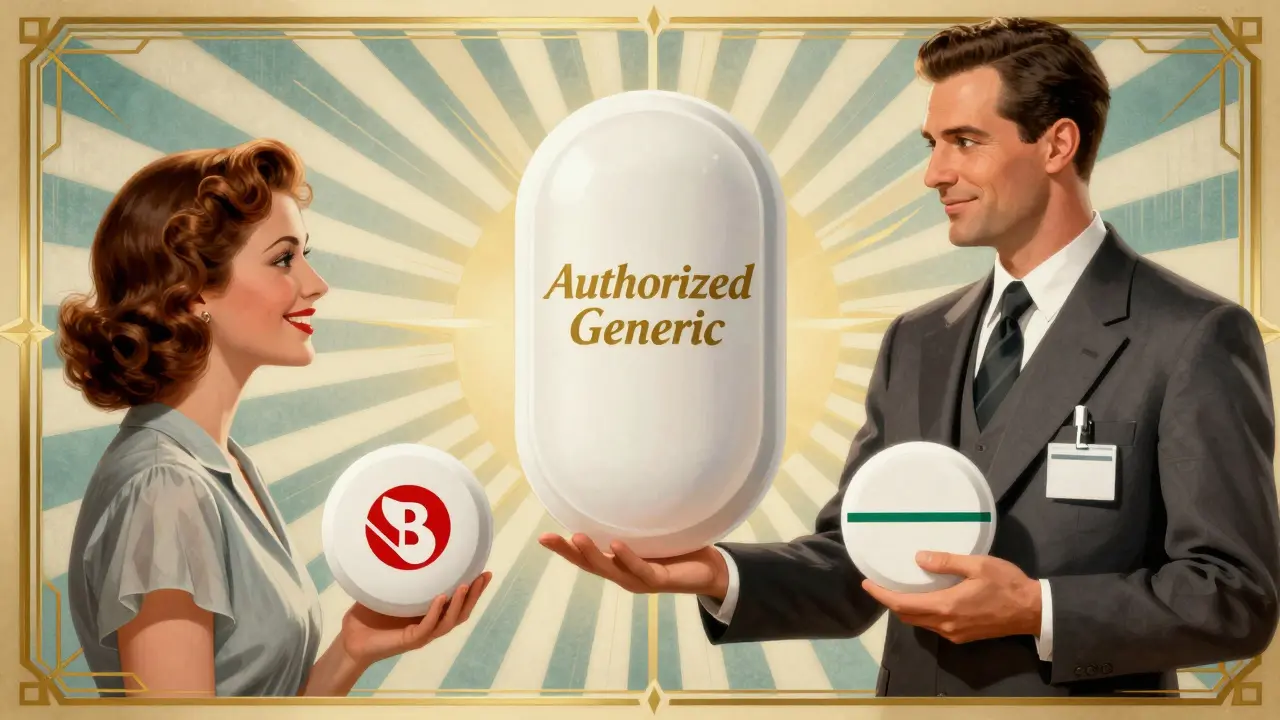
When a brand-name drug loses its patent, it doesn’t just fade away. Instead, the company that made it often launches something you’ve probably never heard of: an authorized generic. It looks like the original drug. It works like the original drug. Even the pills might be identical. But there’s no brand name on the bottle. And it’s usually cheaper. This isn’t a loophole. It’s a calculated move - one that changes how generics enter the market and who ends up paying less.
What Exactly Is an Authorized Generic?
An authorized generic is not a copy. It’s the exact same drug, made by the original brand company, but sold under a different label. No fancy name. No flashy packaging. Just the active ingredient, the same inactive ingredients, the same manufacturing process - everything. The FDA calls it "the same drug." That’s not marketing speak. It’s regulatory fact.
Unlike regular generics, which must prove they’re bioequivalent through an Abbreviated New Drug Application (ANDA), authorized generics skip all that. They’re produced under the brand’s original New Drug Application (NDA). That means no extra testing. No delay. No guesswork. If you’ve ever taken a brand-name drug and then got a generic that didn’t seem to work the same way, it might have been because of differences in fillers or coatings. Authorized generics avoid that entirely.
For example, when Pfizer’s drug Celebrex lost its patent, its authorized generic - made by Greenstone Pharmaceuticals (Pfizer’s own generic arm) - had the exact same chemical makeup. Same tablet. Same color. Same markings. Only the label changed. The same thing happened with Concerta, Colcrys, and Unithroid. Patients got the same medicine. Just a different name on the bottle.
Why Do Brand Companies Do This?
Patent expiration is a financial earthquake. Once generics flood the market, prices can drop 80% or more. Brand companies don’t just sit back and watch their profits vanish. They fight back - and authorized generics are their most powerful weapon.
The key is timing. Under the Hatch-Waxman Act, the first generic company to file gets 180 days of exclusivity. During that time, no other generic can enter. That’s a huge advantage. But if the brand company launches its own authorized generic during that window, it takes the spotlight off the first generic. Suddenly, there are two low-cost versions. Prices drop faster. And the brand company still gets a piece of the action.
Between 2010 and 2019, over 850 authorized generics hit the U.S. market. The peak? 2014. That wasn’t random. That was when dozens of top-selling drugs lost patent protection. Companies like Teva, AbbVie, and Johnson & Johnson all used this tactic. A 2022 study in Health Affairs found that in markets where authorized generics were introduced, prices were 15-20% lower than in markets without them. Consumers won. The brand company didn’t lose everything. And the first generic? They still got their 180 days - but now they’re competing against their own maker.
How Is This Different From Regular Generics?
Here’s where things get confusing - and why patients and pharmacists often mix them up.
- Regular generics: Made by a different company. Must prove they work the same. Can use different fillers, dyes, or coatings. May look different. Listed in the FDA’s Orange Book.
- Authorized generics: Made by the brand company. Same exact formula. Same look. Same everything. Not listed in the Orange Book. Often labeled "generic version of [brand name]."
That last point is critical. Because authorized generics aren’t in the Orange Book, pharmacists can’t automatically substitute them. If your prescription says "Celebrex," and the pharmacy has the generic, they might assume they can switch. But if the generic is an authorized one - made by Pfizer - it’s not listed as interchangeable. So they have to call your doctor. That creates delays. And confusion.
Pharmacists report that 68% of patients ask, "Is this really a generic? It looks just like the brand." One pharmacist on Reddit shared a story: a patient on Concerta switched to the authorized generic and said, "I feel worse." Turns out, the patient thought the pill looked different - but it was the same drug. The pill just had a different imprint. That’s not a medical issue. That’s a perception issue.
Who Benefits? Who Loses?
Let’s break it down.
Patients: Most win. Prices drop. You get the same medicine. For drugs with a narrow therapeutic index - like levothyroxine or warfarin - where tiny changes in dosage can cause serious side effects, authorized generics are safer than traditional generics because they’re identical.
Pharmacies and PBMs: They like them too. Express Scripts and OptumRx report higher usage of authorized generics because they’re trusted. One 2021 analysis found 28% more prescriptions filled for authorized generics than for regular generics in their formularies.
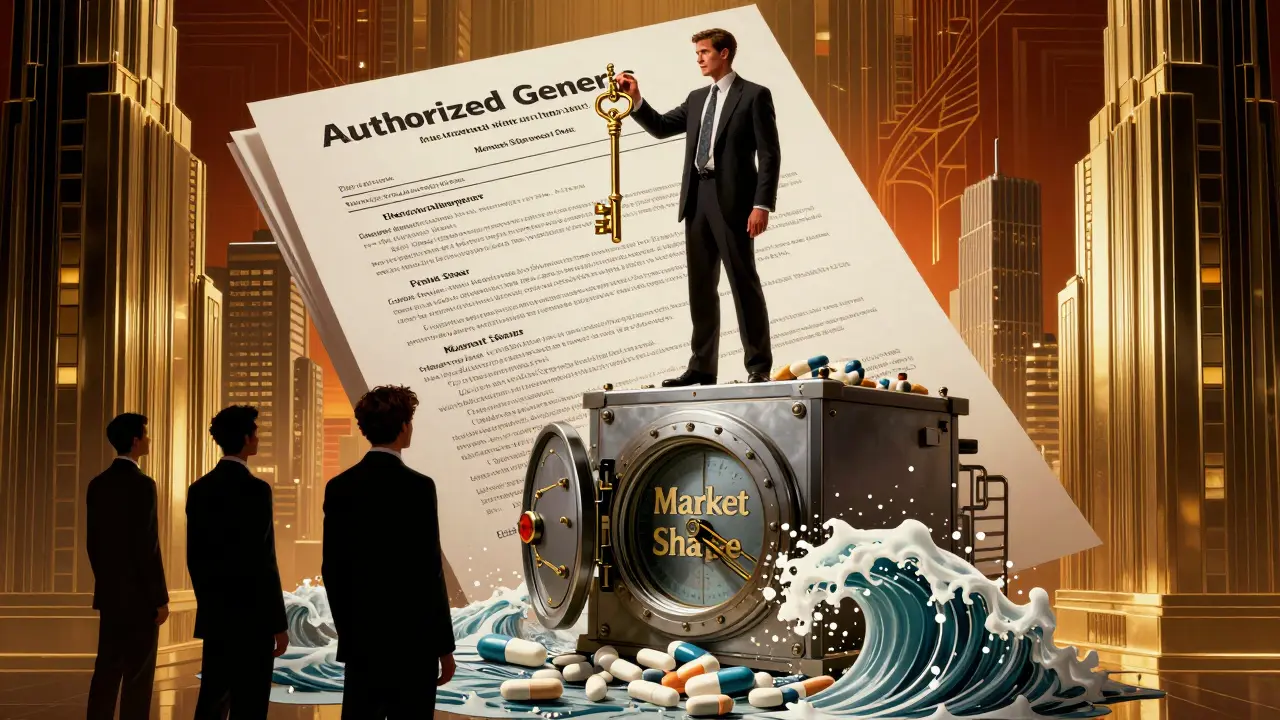
Brand companies: They win big. They keep revenue. They control quality. They delay full generic competition. A 2018 analysis by Sonecon showed that 42% of top-selling drugs had an authorized generic within six months of patent expiry. That’s not coincidence. That’s strategy.
Independent generic manufacturers: They lose. When the brand company drops its own generic into the market during the 180-day exclusivity window, it fragments the market. The first generic still gets their exclusivity - but now they’re not the only low-price option. Their pricing power shrinks. The Generic Pharmaceutical Association (GPhA) has argued this tactic slows down broader competition. Critics like Dr. Jerry Avorn from Harvard call it "market manipulation."
What’s Changing Now?
The FDA updated its official list of authorized generics in October 2025 - and it now includes 1,247 products. That’s up from just over 800 in 2019. The trend is clear: more brands are using this tactic.
But pressure is building. In 2023, Congress introduced the "Promoting Competition in Pharmaceutical Markets Act," which would block brand companies from launching authorized generics during the first generic’s 180-day exclusivity period. If it passes, the strategy could change overnight.
The FTC is also re-examining the whole system. Preliminary findings expected in mid-2026 could lead to new rules. Right now, the data shows authorized generics lower prices. But they also keep the brand company in control. Is that good for competition? Or just good for profits?
What Should You Do as a Patient?
If you’re on a drug that just went generic:
- Ask your pharmacist: "Is this a regular generic or an authorized generic?"
- Check the label. If it says "generic version of [brand name]" and has no company logo, it’s likely authorized.
- Don’t assume it’s different just because it looks different. Authorized generics can have different colors or markings - but they’re still the same medicine.
- If you’ve had issues with regular generics before, ask if an authorized version is available. It might be more stable for you.
Many patients don’t realize they’re already using one. In a 2005 survey, over 80% of Americans said they’d prefer a version of their brand drug that was identical - just cheaper. That’s what authorized generics offer. The problem isn’t the product. It’s the confusion around it.
Why This Matters Beyond the Pharmacy
Authorized generics aren’t just a pharmacy trick. They’re a window into how drug markets really work. The system is designed to encourage competition - but big companies found a way to compete with themselves. And in doing so, they’ve reshaped pricing, access, and trust.
As more drugs lose patents in the next five years - especially in areas like diabetes, heart disease, and mental health - this tactic will only grow. Evaluate Pharma predicts that by 2027, 45% of major branded drugs will have authorized generics. That’s up from 32% in 2022.
For patients, it means more options. For insurers, it means lower costs. For regulators, it means tougher questions. And for the companies that make these drugs? It means they get to keep the money - even as the world moves on.
Kenzie Goode
February 22, 2026 AT 17:04Dominic Punch
February 24, 2026 AT 05:07Christina VanOsdol
February 24, 2026 AT 22:41Brooke Exley
February 25, 2026 AT 16:43Alfred Noble
February 26, 2026 AT 23:50Matthew Brooker
February 27, 2026 AT 14:28Emily Wolff
February 28, 2026 AT 18:41Jacob Carthy
March 1, 2026 AT 05:26Cory L
March 1, 2026 AT 14:33Bhaskar Anand
March 1, 2026 AT 22:09William James
March 3, 2026 AT 09:39