
When you pick up a generic pill, you assume it works just like the brand-name version. That’s the whole point of bioequivalence - it’s the legal and scientific promise that the generic delivers the same medicine, the same way. But what if the batch of generic you’re holding isn’t even close to the batch used in the study that proved it was ‘equivalent’? That’s not a hypothetical. It’s a real problem hiding in plain sight.
Why Batch Variability Matters More Than You Think
Pharmaceutical companies don’t make one batch of a drug and call it done. They make hundreds, sometimes thousands, of batches over time. Each one is slightly different. Not because of poor quality - but because manufacturing isn’t perfect. Temperature, mixing time, raw material source, even humidity can shift the final product just enough to change how the body absorbs it. The problem? The current bioequivalence system only checks one batch of the generic against one batch of the brand-name drug. That’s it. If that one generic batch happens to match that one brand batch, regulators say they’re equivalent. But what if the next batch of the generic is 15% slower to absorb? Or the one after that is 20% faster? That’s not rare. A 2016 study found that between-batch variability accounts for 40% to 70% of the total error in bioequivalence studies. That means most of the ‘noise’ in the data isn’t from people’s bodies - it’s from the drugs themselves.How Bioequivalence Is Currently Measured (and Why It’s Flawed)
The standard test for bioequivalence looks at two numbers: AUC (how much drug gets into your bloodstream over time) and Cmax (how high the peak concentration goes). The rule? The ratio of the generic to the brand must fall between 80% and 125%. That’s it. If it’s inside that box, it’s approved. This approach, called Average Bioequivalence (ABE), ignores everything else. It doesn’t care if the brand drug’s own batches vary by 10% from each other. It doesn’t care if the generic’s batches vary by 15%. It just compares one to one. And that’s where things go wrong. Imagine you’re testing two different batches of the same brand-name drug against each other. You’d expect them to be identical. But studies show they’re not. Sometimes, one batch of the brand is 110% of another. If you tested that against a generic, you could easily get a result that says the generic is ‘not bioequivalent’ - even though it’s perfectly fine. Or worse, you could get a result that says it’s equivalent, when it’s actually drifting outside safe limits. This isn’t theory. It’s been proven. In controlled studies, researchers found that using different batches of the same reference drug changed the bioequivalence outcome by more than 20% in some cases. That’s not statistical noise - that’s a systemic flaw.The Hidden Risk: False Calls and Public Health
When bioequivalence studies get it wrong, people pay the price. A false negative means a perfectly safe, effective generic gets rejected. That drives up costs and delays access. A false positive? That’s worse. It means a generic that doesn’t perform like the brand gets approved. For drugs with narrow therapeutic windows - like warfarin, lithium, or levothyroxine - even a 10% difference in absorption can cause serious side effects or treatment failure. Dr. Robert Lionberger, former head of the FDA’s Office of Generic Drugs, called this one of the biggest statistical oversights in modern drug regulation. He warned that ignoring batch variability leads to both false approvals and false rejections - a dangerous double-edged sword. The European Federation for Pharmaceutical Sciences put it bluntly in 2021: current guidelines are outdated and risky. They called for immediate action. And they’re not alone.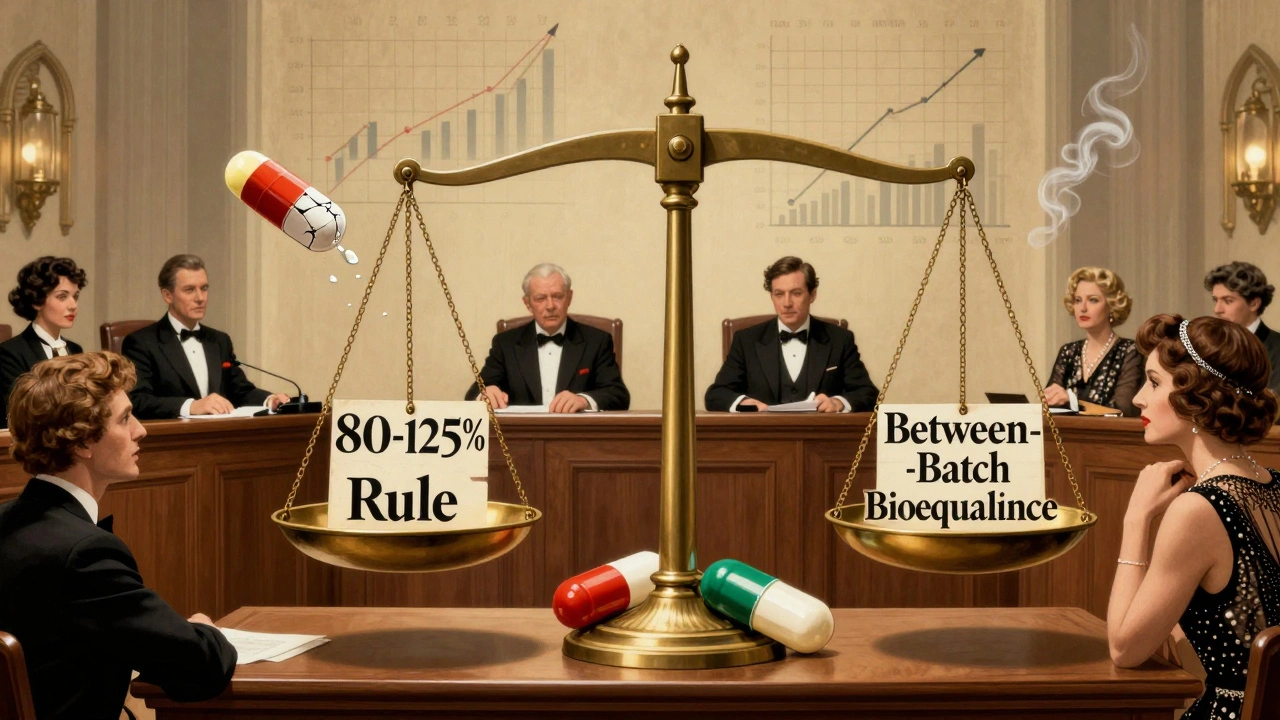
What’s Changing: The Rise of Between-Batch Bioequivalence (BBE)
A new approach is gaining traction: Between-Batch Bioequivalence (BBE). Instead of comparing just two batches, BBE asks: how much do the brand’s own batches vary? Then it says: the generic must be within that same range. Here’s how it works. If the brand’s batches vary by ±12% from each other, then the generic is considered equivalent if it falls within ±12% of the brand’s average - not the rigid 80-125% rule. This makes sense. If the brand itself isn’t perfectly consistent, why demand perfect consistency from the generic? Simulations show BBE works better. With just three reference batches, the success rate of correctly identifying true bioequivalence jumps from 65% to over 85% when you use BBE instead of ABE. And you don’t need more people in the study. You just need more batches. This isn’t science fiction. The FDA already uses a version of this for nasal sprays and inhalers - products where tiny manufacturing differences have big effects. In 2022, they started requiring applicants to test at least three batches of both the test and reference products. That’s a major shift.What Manufacturers and Regulators Are Doing Now
The industry is catching up. In 2018, only 32% of major generic manufacturers tested multiple batches for complex products. By 2022, that number had jumped to 78%. Why? Because regulators are asking for it. The FDA’s 2023 draft guidance on batch variability is a clear signal: the old way is ending. Final rules are expected in 2024. The EMA is holding public consultations on similar changes. The International Council for Harmonisation (ICH) is drafting new guidelines for continuous manufacturing - which inherently deals with batch consistency. For complex products - inhalers, nasal sprays, injectables, topical creams - the future is clear: multi-batch testing isn’t optional. It’s mandatory. Even for simpler pills, regulators are starting to ask for batch characterization data. That means manufacturers must prove their batches are consistent - not just once, but across production runs.
What This Means for You
If you’re a patient: your generic drug is safer than it was five years ago. But don’t assume perfection. If you notice a change in how a generic works - side effects, lack of effect, different timing - talk to your pharmacist or doctor. It could be a batch change. If you’re in the industry: the bar is rising. Testing one batch won’t cut it anymore. You need to plan for multiple batches, use mixed-effects models in your stats, and document everything. The days of ‘one batch, one study’ are numbered. If you’re a regulator: the data is in. The 80-125% rule was a good start. But it’s not enough. The future belongs to methods that account for real-world variability - not pretend it doesn’t exist.What’s Next: The 2025 Standard
By 2025, if you’re submitting a generic drug application for a complex product, you’ll need to show:- At least three production-scale batches of the reference product
- At least two batches of the test product
- Statistical analysis that separates within-subject variability from between-batch variability
- Proof that your generic’s performance falls within the reference product’s own natural variation
What is bioequivalence and why is it important for generic drugs?
Bioequivalence means a generic drug delivers the same amount of active ingredient to the body at the same rate as the brand-name version. It’s the legal standard that allows generics to be approved without repeating expensive clinical trials. Without bioequivalence, generics couldn’t be sold as safe and effective alternatives.
Why does batch variability affect bioequivalence results?
Manufacturing isn’t perfect. Small differences in ingredients, temperature, or mixing can cause one batch of a drug to be absorbed faster or slower than another. If a bioequivalence study only tests one batch of the generic and one batch of the brand, the result might reflect those random batch differences - not the true performance of the products. This can lead to false conclusions: approving a bad product or rejecting a good one.
What are the current acceptable limits for bioequivalence?
The standard limit is a 90% confidence interval for the ratio of the generic to brand drug’s AUC and Cmax falling between 80.00% and 125.00%. This applies to most oral tablets and capsules. For highly variable drugs, regulators may allow wider limits for Cmax only - but this still doesn’t account for batch-to-batch differences.
Is the 80-125% rule outdated?
Yes, for many products. The 80-125% rule was designed for simple, low-variability drugs. It doesn’t consider that even the brand-name product varies between batches. For complex products like inhalers, nasal sprays, or extended-release pills, this rule can be misleading. New methods like Between-Batch Bioequivalence (BBE) are being adopted because they use the brand’s own variability as the benchmark - making results more realistic and reliable.
What should patients do if they notice a change in their generic medication?
If you notice new side effects, reduced effectiveness, or different timing of effects after switching to a new generic or refill, talk to your pharmacist or doctor. It could be a batch change. Ask if the manufacturer or batch number changed. Keep track of what you’re taking - your health depends on consistency, especially for critical medications like blood thinners or thyroid drugs.
Will all generic drugs soon need multi-batch testing?
By 2025, multi-batch testing will be required for complex generics - like inhalers, nasal sprays, injectables, and extended-release tablets. For simple oral pills, it’s not mandatory yet, but regulators are pushing for it. Major manufacturers are already doing it because it reduces the risk of rejection and ensures product consistency. It’s becoming the industry standard, even before it’s officially required.
Vincent Soldja
December 2, 2025 AT 02:43Generic drugs work fine. Stop overthinking it.
Makenzie Keely
December 3, 2025 AT 01:52Let’s be crystal-clear: the 80–125% bioequivalence rule was never meant to be a permanent solution-it was a pragmatic compromise for a pre-digital era. We now have the tools to measure batch-to-batch variance with laser precision; why are we still pretending that one pill from one batch represents the entire universe of a drug’s behavior? The science has moved on. The regulations haven’t. And patients are the ones holding the bag.
Between-Batch Bioequivalence (BBE) isn’t just smarter-it’s ethically mandatory. If the brand-name drug’s own batches vary by ±12%, then demanding that the generic be locked into an arbitrary 80–125% box is like judging a chef’s soup based on one spoonful, while ignoring that the pot itself fluctuates in temperature, salt, and simmer time. It’s not just flawed-it’s negligent.
And let’s not pretend this only matters for 'complex' drugs. Even a simple levothyroxine pill can send someone into arrhythmia if the absorption shifts by 10%. That’s not a 'rare' case-it’s a ticking time bomb in every pharmacy shelf. The FDA’s 2022 move for inhalers? Brilliant. The EMA’s consultations? Long overdue. The ICH’s new guidelines? Necessary.
Manufacturers who resist multi-batch testing aren’t protecting profits-they’re gambling with lives. And regulators who cling to outdated thresholds aren’t being cautious-they’re being cowardly. The data is here. The models are proven. The only thing missing is the political will.
Patients: if your generic suddenly feels 'off,' don’t blame your body. Don’t assume it’s 'all in your head.' Ask for the batch number. Track it. Report it. Your vigilance is the last line of defense. Industry: start testing three batches now, not when the FDA mandates it. Regulators: stop waiting for the perfect system. Start enforcing the better one.
This isn’t about innovation. It’s about integrity. And it’s about time we stopped pretending that medicine can be standardized like cereal boxes.
Albert Essel
December 3, 2025 AT 08:05I appreciate the depth of this analysis. The point about using the brand’s own variability as the benchmark is elegant in its simplicity. It’s not about making generics perfect-it’s about making them as consistent as the original, which is a far more realistic and fair standard. The 80–125% rule was a reasonable starting point, but we’ve outgrown it.
One thing that’s often overlooked: this shift also protects manufacturers. If you’re a small generic producer and your one batch happens to fall just outside the 80% threshold due to random noise, you get rejected-despite your product being perfectly safe and effective. BBE reduces that kind of bad luck. It’s not just better science-it’s fairer economics too.
Charles Moore
December 3, 2025 AT 13:14Coming from Ireland, I’ve seen this play out firsthand. A patient on warfarin switched generics and ended up in the hospital with a near-fatal bleed. Turns out, the new batch had a different dissolution profile-slower absorption, higher peak later. The doctor blamed the patient’s diet. The pharmacist blamed the doctor. No one blamed the regulatory gap.
BBE isn’t just a technical upgrade-it’s a cultural shift. We need to stop treating drug batches like interchangeable widgets. They’re biological systems. Even small shifts matter. The fact that this is now standard for inhalers tells us everything: if it’s absorbed through the lungs, we get it. Why not for pills?
I hope regulators don’t wait for another tragedy to act. The data’s been clear for years. Let’s not make the same mistake twice.
Gavin Boyne
December 4, 2025 AT 13:10So let me get this straight: we spend billions developing drugs, then approve generics based on a single pill from a single batch… and we call this 'science'? What’s next? Approving a new car model by testing one bolt? Or evaluating a restaurant by tasting one bite of one dish?
The 80–125% rule is the pharmaceutical equivalent of a 1998 Nokia 3310-functional, durable, and utterly out of touch with reality. Meanwhile, the brand-name companies are quietly laughing all the way to the bank, knowing their own batches vary more than their generic competitors.
And yet, here we are, still pretending that ‘equivalent’ means ‘identical.’ It doesn’t. It means ‘close enough, unless it’s not.’
Thankfully, the industry’s waking up. But I’ll believe it when I see a generic label that says: ‘This batch tested against 3 reference batches. Confidence interval: ±11.2%.’ Until then, I’m keeping my brand-name pills… and my skepticism.
Rashi Taliyan
December 5, 2025 AT 10:52My mother takes levothyroxine-she’s been on it for 15 years. Last year, she switched to a new generic and started having tremors, heart palpitations. We thought it was stress. Then we checked the batch number. It was different. We switched back-and she was fine. This isn’t theoretical. It’s real. It’s personal. It’s happening to families right now.
Please, someone-make this change before someone dies because a regulator refused to update a 40-year-old rule.
Kara Bysterbusch
December 6, 2025 AT 02:04What strikes me most is the profound epistemological dissonance embedded in the current paradigm: we demand that generic drugs demonstrate bioequivalence to a single, arbitrary batch of the reference product-yet we simultaneously acknowledge, through rigorous pharmacokinetic modeling, that biological systems are inherently variable, and that even the originator’s own product exhibits measurable inter-batch heterogeneity.
This is not merely a regulatory oversight; it is a philosophical misstep. We have constructed a statistical framework predicated on the illusion of homogeneity, while the physical reality of pharmaceutical manufacturing is one of controlled stochasticity. The adoption of Between-Batch Bioequivalence (BBE) represents not merely an incremental improvement, but a paradigmatic recalibration-a move from idealized abstraction to empirical realism.
Furthermore, the ethical imperative cannot be overstated. For patients on narrow-therapeutic-index medications, the margin between therapeutic efficacy and toxicological catastrophe is measured in fractions of a percentage point. To persist with ABE in the face of demonstrable, quantifiable, and well-documented inter-batch variance is not merely inefficient-it is morally indefensible.
The FDA’s 2022 guidance for inhalers was a watershed moment. Now, we must extend this rigor to all classes of drugs-especially those administered orally, where batch variability is most insidious and least visible. The time for incrementalism is over. The future of pharmacovigilance demands a foundation built on variability, not denial of it.
vinoth kumar
December 6, 2025 AT 02:41Great post! I work in a pharmacy in India, and we’ve seen patients complain about generics not working after a batch change. We didn’t know why-now we do. We’re starting to track batch numbers and ask patients if they notice changes. Small step, but it matters.
Also, I love that the industry is catching up. More testing = fewer rejections = cheaper drugs in the long run. Win-win.