

Have you ever looked at a prescription bill in the United States and wondered why your neighbor across the border pays less? Or perhaps you are Canadian and have heard that Americans get cheaper generics? The truth is messy. It depends entirely on whether you are looking at the sticker price at the pharmacy counter or the negotiated price paid by insurance plans. The comparison between Canada's generic drug system and the United States reveals a trade-off between market competition and supply stability.
When we talk about generic drugs, we mean medications that contain the same active ingredients as brand-name drugs but are sold under their chemical names after patents expire. In 2021, the average person in the U.S. spent $1,432 on prescription drugs per year, while the average Canadian spent $814. That sounds like a clear win for Canada. But dig deeper, and you find that for many specific generic pills, the U.S. retail price is actually lower. How does that happen? Let’s break down the mechanics of both systems.
The Core Difference: Negotiation vs. Competition
The fundamental difference lies in who sets the price. In the United States, there is no federal government body that caps the price of generic drugs. Instead, the market decides. When a patent expires, multiple manufacturers rush to produce the generic version. This creates intense competition. On average, there are 7.3 generic manufacturers competing for each product in the U.S. market. More competitors mean lower prices. Prices often drop 80% to 90% within six months of a generic entering the market.
Canada operates differently. The country uses a centralized negotiation model led by the pan-Canadian Pharmaceutical Alliance (pCPA). Think of the pCPA as a massive buying club. Provincial health ministries join together to negotiate prices with manufacturers. Because Canada has a population roughly one-tenth the size of the U.S., fewer companies compete-averaging only 3.8 manufacturers per generic product. Less competition usually means higher base prices, but the pCPA tries to offset this through bulk bargaining power.
| Metric | United States | Canada |
|---|---|---|
| Average Manufacturers per Generic | 7.3 | 3.8 |
| Price Setting Mechanism | Market Competition | pCPA Negotiation & Legislation |
| Per Capita Drug Spending (2021) | $1,432 USD | $814 CAD |
| Generic Dispensing Rate | 90% | 83% |
Who Actually Pays Less?
This is where it gets confusing for consumers. If you walk into a pharmacy without insurance, the answer changes depending on which study you read. A 2023 analysis by PharmacyChecker found that 88% of top-prescribed generics were cheaper in the United States than in accredited Canadian pharmacies. For example, a common blood pressure medication might cost significantly less at a U.S. discount pharmacy chain than at a standalone Canadian shop.
However, most people don’t pay cash. They use insurance. In Canada, public drug plans cover about 42% of outpatient spending, with private insurance covering the rest. The pCPA negotiates prices specifically for these public plans. Because of these negotiations, the *reimbursed* price for many generics in Canada is lower than what U.S. insurers pay. The Canadian Generic Pharmaceutical Association (CGPA) reported that recent pricing agreements saved participating drug plans over $4 billion in a decade.
So, if you are an uninsured American, you likely see lower shelf prices. If you are a Canadian with public coverage, your out-of-pocket costs are often managed more effectively through systemic controls. The Fraser Institute noted in 2022 that while some Canadian retail prices are higher, the system’s focus on patented drug control inadvertently leaves generic pricing less regulated, creating this paradox.
The Hidden Cost: Drug Shortages
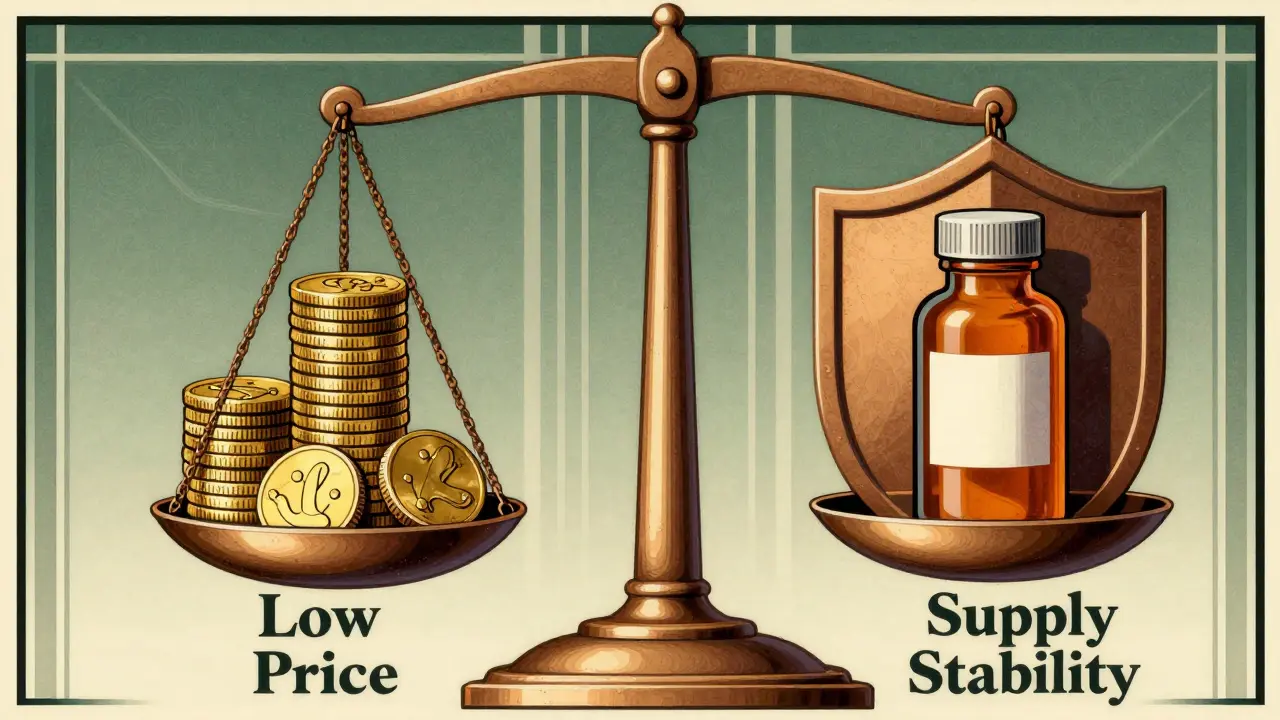
Low prices come with risks. The U.S. system’s reliance on thin profit margins can lead to instability. When manufacturing becomes unprofitable, companies stop producing certain drugs. This leads to shortages. Research published in JAMA Network Open showed that sole-sourced drugs (those made by only one company) had double the risk of shortage in the U.S. compared to Canada.
Canada takes a more proactive approach to supply chain resilience. Health Canada actively tracks supply and demand issues. They work directly with manufacturers to prevent stockouts. During the 2022 albuterol shortage, for instance, Canadian hospitals received priority allocation through government intervention. In contrast, some U.S. hospitals struggled to get supply for weeks. Dr. Steffie Woolhandler from Harvard Medical School noted that while U.S. prices are lower, Canada’s system protects patient access during disruptions that affect 1 in 5 drug products annually.
You might ask, "Is saving money worth risking availability?" For chronic conditions like asthma or heart disease, consistent access is vital. The Canadian system prioritizes stability, even if it sometimes means paying a slightly higher base price to keep factories running. The U.S. prioritizes low cost, accepting the volatility that comes with hyper-competition.
Regulatory Oversight: PMPRB vs. FDA
Another key difference is regulatory scope. In Canada, the Patented Medicine Prices Review Board (PMPRB) controls the prices of patented drugs. However, it explicitly excludes generic drugs from its jurisdiction. This is a structural anomaly. Experts like Dr. Donald J. Willison argue that this lack of oversight on generics allows manufacturers to charge higher prices for non-patented medicines, knowing they won't face the same scrutiny as brand-name drugs.
In the U.S., the Food and Drug Administration (FDA) focuses on safety and efficacy, not price. There is no equivalent to the PMPRB for generics. This freedom allows prices to fluctuate wildly based on market forces. While this drives prices down when competition is high, it can also lead to sudden spikes if a competitor exits the market.

Practical Impact on Patients and Pharmacists
How does this affect your daily life? For pharmacists, the workload differs. Canadian pharmacists spend an average of 5-7 hours a week managing complex tiered pricing frameworks set by the pCPA. They must navigate three pricing tiers based on market competition. U.S. pharmacists spend 3-4 hours dealing with formulary restrictions from various private insurers.
For patients, price shopping is harder in the U.S. GoodRx reports that 63% of American consumers need to check three or more pharmacies to find the lowest generic price. In Canada, standardized pricing reduces this search to an average of 1.7 pharmacies. You know roughly what you will pay, whereas in the U.S., the price can vary drastically from one block to the next.
Future Outlook: Importation and Policy Shifts
Looking ahead, the lines may blur. Several U.S. states, including Vermont and Colorado, have passed laws allowing the importation of drugs from Canada. The goal is to bring lower Canadian prices to American patients. However, the federal Department of Health and Human Services has not yet authorized these programs broadly. Canada has responded by tightening its own supply chains to prevent domestic shortages caused by export demands.
Projections suggest Canadian generic prices may rise by 15-20% through 2025 due to global supply pressures, while U.S. prices could decline by 5-8% annually. This divergence highlights the philosophical split: Canada bets on coordinated stability, while the U.S. bets on market efficiency. Neither system is perfect. Both struggle to balance affordability, access, and innovation.
Are generic drugs cheaper in Canada or the USA?
It depends on how you buy them. For uninsured consumers paying cash, studies show that 88% of top generics are cheaper in the USA due to intense market competition. However, for insured patients, Canada's negotiated prices through the pan-Canadian Pharmaceutical Alliance (pCPA) often result in lower overall healthcare spending per capita ($814 vs $1,432 in the US).
Why do Canada and the USA have different generic drug systems?
The USA relies on free-market competition with no federal price controls, leading to lower prices but higher risk of shortages. Canada uses a centralized negotiation model via the pCPA to control costs and ensure supply stability, resulting in fewer competitors but more predictable access.
Which country handles drug shortages better?
Canada generally handles shortages better. Health Canada proactively monitors supply chains and intervenes during crises. Research indicates that sole-sourced drugs have double the shortage risk in the USA compared to Canada, where government coordination helps maintain steady supplies for essential medications.
Does the PMPRB control generic drug prices in Canada?
No. The Patented Medicine Prices Review Board (PMPRB) only regulates prices for patented (brand-name) drugs. Generic drugs are excluded from its jurisdiction, meaning their prices are determined by market forces and pCPA negotiations rather than direct government caps.
Can Americans legally buy generic drugs from Canada?
While individual states like Vermont and Colorado have passed importation laws, the federal Department of Health and Human Services has not broadly authorized these programs. Currently, cross-border purchasing remains restricted and complex for most consumers.
Annemarie Kautz
June 22, 2026 AT 04:04idk why ppl think canada is so much better lol. i mean sure maybe its cheaper for some stuff but like the lines are forever and you cant just get what you want when you want it :/ also this article has too many big words for me to care honestly
alexander barrera
June 22, 2026 AT 05:58The US system is superior because we don't have socialist bureaucrats telling us what to pay 🇺🇸💪. Canada's 'negotiation' is just theft from innovation. We have freedom, they have mediocrity. The market decides, not some committee in Ottawa. Stop whining about prices and start appreciating liberty. #USA #Freedom
Charlotte Stuart
June 23, 2026 AT 22:26It is quite amusing how Americans cling to their 'market efficiency' while simultaneously complaining about the outcomes of said market. The data presented here is elementary, yet clearly beyond the comprehension of those who prioritize ideological purity over basic economic literacy. The pCPA model is not 'theft'; it is a rational exercise of monopsony power that corrects for the externalities of unregulated capitalism. Your inability to grasp this nuance suggests a profound deficit in critical thinking skills.
Dale Simpson
June 25, 2026 AT 21:00hey guys! lets not fight! i think both sides have good points! we should all try to understand each other more! its cool that we can talk about this! keep being nice to each other please! :)
Tucker Brown
June 27, 2026 AT 11:06They want you to believe it's about 'competition' or 'negotiation'. It isn't. It's about control. The shortages aren't accidents; they're engineered scarcity to keep populations dependent on the system. Health Canada 'monitoring' supply is just surveillance. Wake up.
Hema Khimasia
June 28, 2026 AT 13:31The dichotomy between utilitarian price optimization and existential security of supply represents a fundamental philosophical divergence in societal values. One prioritizes the immediate economic utility of the individual agent, while the other prioritizes the collective resilience of the social fabric. This is not merely a pharmaceutical issue; it is an ontological question regarding the nature of risk distribution in modern civilization.
krystal Live
June 29, 2026 AT 12:00you guys are stressing out way too much! just do your best and stay positive! health is wealth so take care of yourself! dont let the politics get you down! smile! :)
Alyssa Smith
June 29, 2026 AT 14:54I actually lived in Toronto for a few years before moving back to Ohio, and the difference was striking. In Canada, I never had to check three different apps to see which pharmacy had my blood pressure meds in stock. There was a calmness to the healthcare experience that I miss. It wasn't perfect, but the anxiety of 'will I be able to afford this refill?' was largely absent. It’s interesting to see the data backing up what I felt personally. Maybe there’s something to learn from our neighbors up north without having to abandon everything we hold dear.
Frank Polster
July 1, 2026 AT 11:56Oh, look at Alyssa, playing tourist in the land of free healthcare. Sure, it's 'calm' until you wait six months for a specialist appointment. But hey, at least the generic pills are slightly less volatile in price. Oh wait, no they aren't, as the article says. Whatever. Keep dreaming.
Stephanie Cree
July 2, 2026 AT 07:07You are completely missing the point!! It is not about waiting times for specialists!!! It is about basic human dignity!!! How dare you mock someone for seeking stability??? You are selfish and ignorant!!! 🙄😡
ankit agarwal
July 4, 2026 AT 04:19Let us analyze the macroeconomic implications of these divergent strategies. The U.S. model leverages hyper-competition to drive down marginal costs, creating a Pareto improvement for cash-paying consumers but introducing systemic fragility through oligopolistic consolidation in sole-source markets. Conversely, the Canadian pCPA model utilizes centralized procurement to achieve economies of scale, effectively internalizing the negative externality of supply chain volatility. While the U.S. approach maximizes short-term allocative efficiency, the Canadian framework prioritizes long-term productive stability. Both models exhibit significant trade-offs in terms of consumer surplus versus producer sustainability. The key takeaway is that neither system achieves global optimality; rather, they represent local optima within different constraint sets.
Jake Kitzmiller
July 4, 2026 AT 11:51As a pharmacist, I can tell you the reality is messy. In the US, I spend half my day calling patients because their insurance formulary changed again, or because one manufacturer stopped making the pill and now it's $200 instead of $5. In Canada, the pricing tiers are complex, yes, but at least I know the drug will be there next month. The article mentions pharmacists spending 5-7 hours on tiered pricing in Canada vs 3-4 on formularies in the US. That seems low for both. We're drowning in administrative work regardless of the system. What we need is simpler rules, not just cheaper pills.