
What if the reason you’re exhausted at 10 a.m. isn’t laziness - it’s biology? And what if your boss’s 8 a.m. meeting is literally fighting against your body’s natural clock? This isn’t about willpower. It’s about your chronotype.
What Exactly Is a Chronotype?
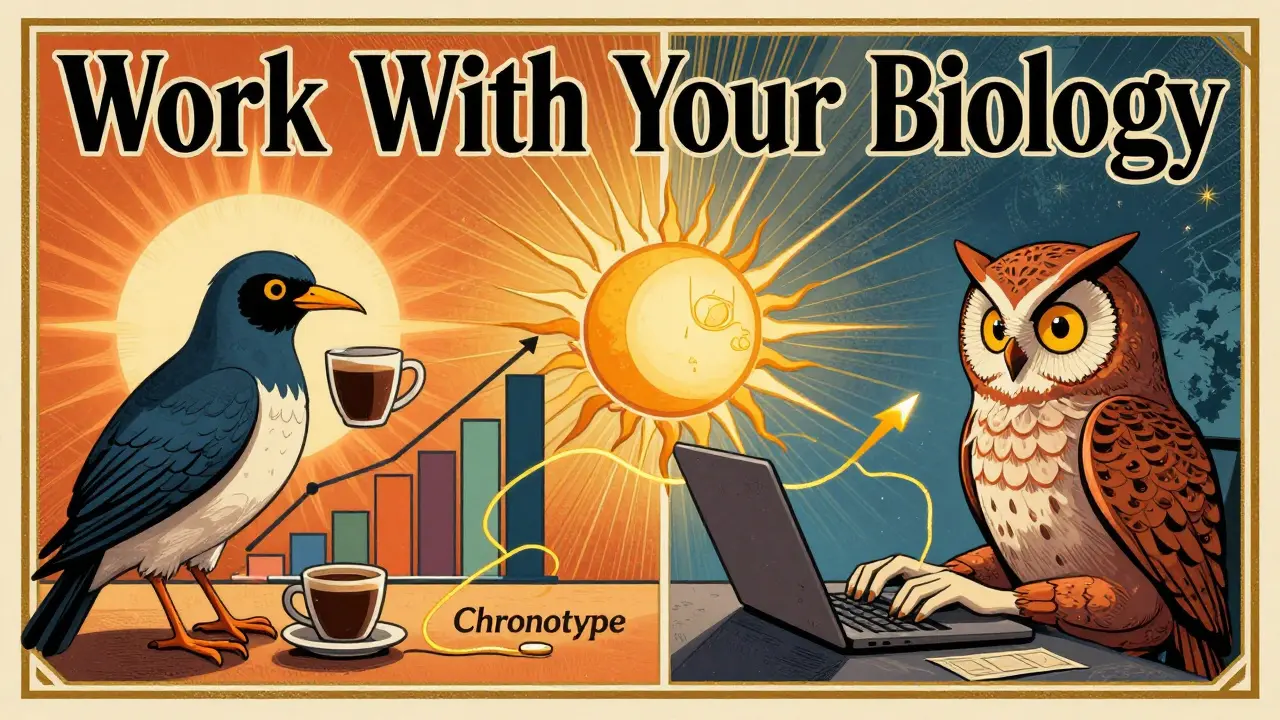
Your chronotype is your body’s internal schedule. It’s not a preference. It’s not a habit you picked up from binge-watching Netflix. It’s your biological rhythm - the time of day your brain naturally wakes up, peaks in focus, and crashes into sleep. Scientists have known this since the 1970s, but it wasn’t until Till Roenneberg’s Munich ChronoType Questionnaire in the 2000s that we could measure it accurately.There are three main types: morning larks, night owls, and everyone in between. About 40% of people are larks - they wake up early, feel sharp by 7 a.m., and are ready for bed by 9:30 p.m. Around 30% are owls - they don’t really wake up until after noon, hit their stride after 8 p.m., and often don’t feel sleepy until 2 a.m. The rest? They’re somewhere in the middle, but even they have a clear biological sweet spot.
Here’s the kicker: your chronotype is mostly genetic. A mutation in the PER2 gene, discovered by the University of Utah in 2001, can make someone wake up at 4:30 a.m. without trying. That’s not discipline. That’s DNA. And if you’re an owl, you didn’t choose this. Your body just runs on a later cycle.
The Real Cost of Ignoring Your Chronotype
Most workplaces and schools are built for larks. Doors open at 8 a.m. Meetings start at 9. Emails pile up before sunrise. But for night owls, that’s not just inconvenient - it’s harmful.Research from Baylor University shows evening-type college students who are forced into early classes average just 6.2 hours of sleep per night. Morning types? They get 7.5. That’s not a small gap. That’s chronic sleep deprivation. And it shows up in grades. Students who stayed owls through the semester saw lower GPAs. Those who shifted toward morning hours? Their grades jumped by 0.45 points on average.
It’s not just school. A 2018 study of over 430,000 people found night owls had a higher risk of early death. They were 27% more likely to be obese, 30% more likely to develop type 2 diabetes, and 29% more likely to suffer from depression. Why? Because forcing your body to operate on a schedule it didn’t sign up for creates constant stress. Your hormones get out of sync. Your metabolism slows. Your immune system weakens.
And it’s not just health. Cognitive performance changes with age. A 2023 study from Imperial College London found that among older adults, night owls actually outperformed larks on memory and reaction tests. That flips the old assumption that morning people are smarter. The truth? It depends on your age, your schedule, and whether you’re fighting your biology.
Why You’re Not Sleeping Well (Even If You Think You Are)
You might think you’re a night owl because you like staying up late. But here’s what’s really happening:- You’re exposed to blue light from screens until 1 a.m. That tricks your brain into thinking it’s still daytime.
- You drink coffee at 4 p.m. because you’re tired - but caffeine stays in your system for 6-8 hours.
- You sleep in on weekends to “catch up,” which throws your rhythm off even more.
SleepWatch analyzed over 10,000 users and found larks get 48 more minutes of sleep per night than owls. They also have 7% more consistent sleep patterns. Why? Because they’re not fighting the system. They go to bed when their body says to, and wake up naturally.
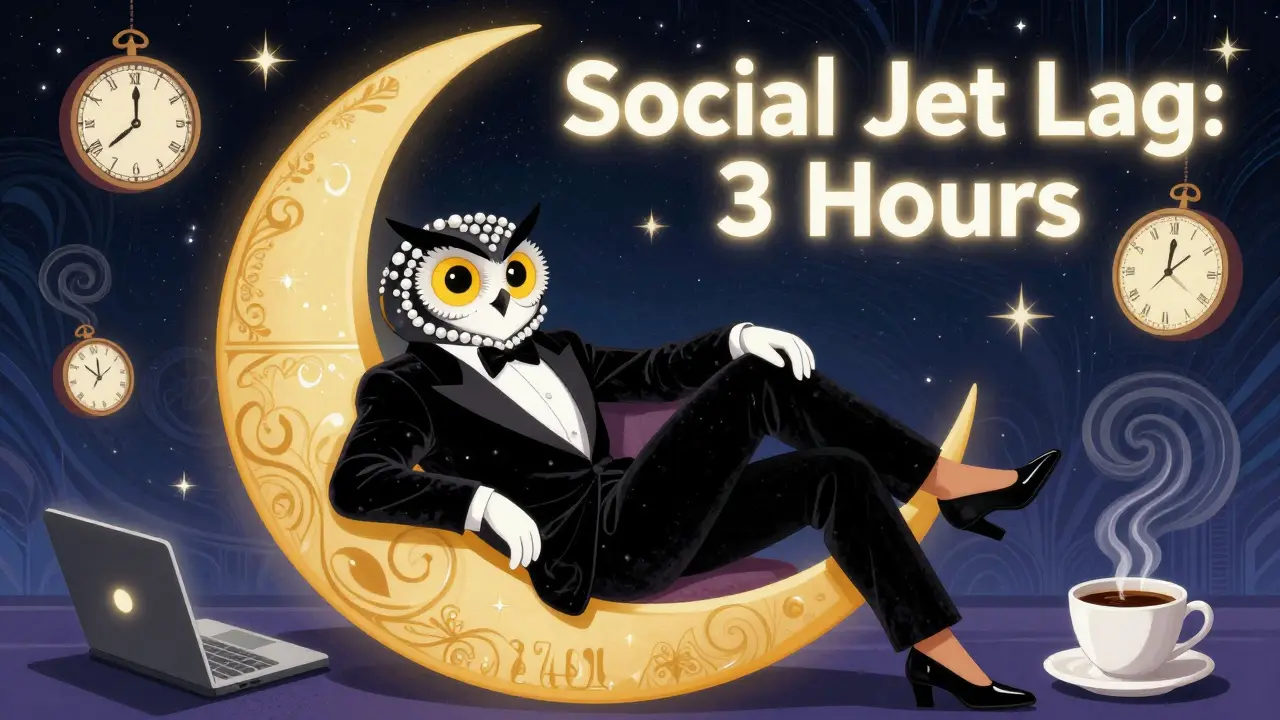
Owls? They’re stuck in what Roenneberg calls “social jet lag.” That’s the gap between your biological clock and your social obligations. For many, it’s 2-4 hours. That’s like living in a different time zone every day. No wonder you’re tired.
Can You Change Your Chronotype?
Short answer: yes - but it’s not easy, and it takes time.For years, scientists thought chronotype was fixed. But Baylor’s 2023 study showed 28% of students shifted their chronotype over a single semester. How? Not by willpower. By behavior.
Here’s what actually works:
- Get morning light within 30 minutes of waking. Natural sunlight is best. If it’s dark, use a 10,000-lux light box for 30 minutes. This tells your brain it’s time to be awake.
- Stop screens 90 minutes before bed. Blue light suppresses melatonin. Your body needs darkness to fall asleep. Use night mode, but don’t rely on it. Put the phone in another room.
- Cut caffeine after 2 p.m. If you’re an owl, you might think you can handle coffee at 5 p.m. You can’t. Your body processes it slower than you think. Try switching to herbal tea after 3 p.m.
- Wake up at the same time every day. Even on weekends. Your body loves consistency. If you sleep in on Saturday, you’ll feel worse on Monday.
These aren’t tips. They’re biological triggers. Do them for 2-4 weeks, and your sleep midpoint will shift. SleepWatch data shows 68% of people who followed at least three of these steps saw measurable changes in their chronotype within a month.
How to Work With Your Chronotype, Not Against It
You can’t always change your job. But you can change how you use your time.If you’re a lark:
- Do your hardest work before noon. That’s your peak.
- Save emails, admin tasks, and meetings for the afternoon.
- Go to bed by 10 p.m. Don’t tempt yourself with late-night scrolling.
If you’re an owl:
- Push meetings to the afternoon if you can. Say, “I’m more focused after 2 p.m.” Most managers will respect that.
- Work from home if possible. Remote work is the biggest ally for owls - 67% of remote-first companies now offer flexible hours.
- Use your evening energy. That’s when you’re sharp. Schedule creative work, coding, writing, or deep thinking after 8 p.m.
- Don’t apologize for needing to sleep in. You’re not lazy. You’re just wired differently.
And if you’re in the middle? You’re lucky. You have more flexibility. But don’t assume you’re “normal.” Everyone has a rhythm. Find yours.
Why Companies Are Starting to Care
A 2023 Gartner survey found 42% of global companies now offer flexible scheduling based on chronotype. That’s up from 28% in 2020. Why? Because it works.Companies that let employees choose their hours report up to 18% higher productivity. In one case, a tech firm in Berlin shifted its core meeting hours from 9 a.m. to 11 a.m. and saw a 30% drop in sick days. Employees who were night owls? They stopped quitting.
Gen Z is more likely to be an owl than any previous generation - 52% compared to 31% of Baby Boomers. And they’re not going to tolerate 8 a.m. standups if they’re not wired for it. The future of work isn’t about who’s in the office. It’s about who’s at their best.
By 2030, the National Sleep Foundation predicts 65% of knowledge-based workplaces will use chronotype-informed scheduling. That’s not a trend. It’s a necessity.
What to Do Today
You don’t need a fancy app or a sleep tracker to start. Just ask yourself:- When do I naturally wake up without an alarm?
- When do I feel most alert during the day?
- When do I feel sleepy, even if I’ve had coffee?
That’s your chronotype. Don’t fight it. Adapt to it.
Start tomorrow with one change: get 10 minutes of morning sunlight. No phone. No coffee. Just light. Do it for a week. Notice how you feel.
Your body isn’t broken. It’s just telling you the truth. Listen to it.
Can you change your chronotype permanently?
Yes, but not overnight. Chronotype is mostly genetic, but behavior can shift it. Exposure to morning light, consistent wake times, and cutting evening screen time can move your sleep midpoint by 30-60 minutes over 2-4 weeks. It’s not about becoming a lark if you’re an owl - it’s about aligning your schedule closer to your natural rhythm. Most people can shift by one category (e.g., from late owl to intermediate), but extreme changes are rare.
Are night owls less productive?
No - but they’re less productive during traditional 9-to-5 hours. Night owls often outperform larks in the evening and late at night. Their focus, creativity, and problem-solving peak later. The problem isn’t ability - it’s timing. Forcing an owl to work at 8 a.m. is like asking a sprinter to run a marathon in flip-flops. They’re capable, but the conditions are wrong.
Is being a morning person healthier?
On paper, yes - but only if they’re actually sleeping enough. Many larks are healthy because they sleep 7-8 hours and wake naturally. But if a lark is forcing themselves to sleep at 9 p.m. and waking at 5 a.m. because they think they should, they might be sleep-deprived too. Health isn’t about being a lark. It’s about matching your schedule to your biology. Owls who sleep well and avoid social jet lag have the same health outcomes as larks.
Why do I feel awful on Monday mornings?
That’s social jet lag. If you sleep in on weekends, your body shifts its clock by an hour or more. Then Monday rolls around and you’re trying to reset it in one day. That’s like jet lag without flying. The fix? Keep your wake time within an hour of your weekday schedule - even on weekends. You’ll feel better all week.
Does caffeine affect owls and larks differently?
Yes. Owls tend to consume caffeine later in the day - often after 4 p.m. - because they’re not awake enough before then. But caffeine stays in the system for 6-8 hours. For an owl who goes to bed at 2 a.m., that 5 p.m. coffee is still active at midnight. Larks usually stop by 2 p.m. because they’re winding down earlier. Cutting caffeine after 2-3 p.m. helps both types, but it’s especially critical for owls trying to fall asleep.
Ademola Madehin
December 24, 2025 AT 07:55bro i swear my body is on a different planet. i was awake at 3am scrolling through memes like it was my job, then passed out at 7am and woke up at 1pm like nothing happened. my boss thinks i’m lazy. nah. my dna is just a night owl with a grudge.
suhani mathur
December 26, 2025 AT 07:22oh wow. so you’re telling me my 4am coding sessions aren’t ‘unproductive’ - they’re *biologically optimized*? i’ve been apologizing for my schedule for 12 years. time to stop. also, coffee after 3pm? never. i’m not a lark. i’m a caffeinated phoenix.
Jeffrey Frye
December 28, 2025 AT 02:12lol the study says owls have higher death risk? cool. so what’s the solution? kill the owls? nah. let’s just blame the system. also, ‘morning light’? i live in seattle. it’s dark for 14 hours in december. your ‘biological triggers’ are just capitalism with a glowstick.
Andrea Di Candia
December 28, 2025 AT 17:52it’s wild how we’ve spent centuries forcing people to fit into rigid schedules like they’re widgets on an assembly line. your body isn’t broken - it’s just been told it’s wrong for too long. if you’re tired at 8am, it’s not because you lack discipline. it’s because your circadian rhythm is being treated like a suggestion. i’m not here to fix you. i’m here to say: you’re not the problem. the clock is.
bharath vinay
December 30, 2025 AT 13:14you think this is about biology? nah. it’s a corporate psyop. they want you tired so you’ll consume more caffeine, antidepressants, and productivity apps. the ‘morning light’ fix? it’s a distraction. the real issue? 9-to-5 was invented by factory owners in 1850. your chronotype? a tool of control. wake up.
Dan Gaytan
January 1, 2026 AT 03:36this hit me right in the soul 🥹 i’m an owl who got yelled at for being ‘unprofessional’ because i didn’t reply to emails before 8am. now i work remote, push meetings to 2pm, and actually sleep. my brain feels like it’s been unplugged from a 12-volt battery and plugged into a solar panel. thank you for saying what so many of us feel.
Usha Sundar
January 2, 2026 AT 10:04my mom says i’m lazy. i say i’m a night owl. she says ‘everyone else wakes up early.’ i say ‘everyone else is wrong.’
Andy Grace
January 4, 2026 AT 05:52the 27% higher obesity risk for owls? that’s not the chronotype. that’s the result of eating junk food at 2am because you’re bored, stressed, and the fridge is the only thing that doesn’t judge you. fix the environment, not the biology.
Delilah Rose
January 4, 2026 AT 19:16i’ve been thinking about this for weeks now - like, really deeply. it’s not just about sleep, you know? it’s about how we assign moral value to productivity. if you’re up at 5am and crushing your goals, you’re ‘disciplined.’ if you’re up at 1pm and writing a novel, you’re ‘lazy.’ but what if the novel is better? what if your brain just needs the quiet of midnight to breathe? what if the real tragedy isn’t that owls are out of sync - it’s that society refuses to make space for anyone who doesn’t fit the 8am mold? i don’t want to be a lark. i want to be me. and maybe, just maybe, the world needs more of that.
Spencer Garcia
January 6, 2026 AT 03:39try the morning light thing for 3 days. no phone. just walk outside. you’ll be shocked how much better you feel. small change. big effect.
Abby Polhill
January 8, 2026 AT 03:10the chronotype framework is a beautiful lens, but let’s not romanticize it. systemic inequity still exists - if you’re a night owl in a shift job or a single parent, you don’t get to ‘optimize your schedule.’ your biology doesn’t care about your rent. so while this is great for knowledge workers, let’s not pretend it’s universal. equity > optimization.