

Not all generic drugs are created equal. While most generics are simple copies of brand-name pills - same active ingredient, same dose, same pill shape - a growing number of drugs are far more complicated. These are called complex generic drugs. They include things like liposomal injectables, long-acting injectables, inhalers that combine drugs with devices, and peptide-based therapies. And they’re incredibly hard to get approved by the FDA.
Why? Because copying a simple tablet is one thing. Copying a drug that stays in your body for weeks, or one that’s delivered through a precise inhaler device, is like trying to rebuild a jet engine from scratch using only a photo. Even tiny differences in how it’s made can change how it works in your body. And the FDA has to be absolutely sure it’s safe and effective before letting it hit the market.
What Makes a Generic Drug "Complex"?
The FDA defines complex generic drugs by five key features: complex active ingredients, complex formulations, complex dosage forms, complex routes of administration, or drug-device combinations. These aren’t just buzzwords - they represent real scientific barriers.
- Peptides and polymeric compounds - These are large molecules that behave differently than small-molecule drugs. They’re prone to immune reactions, hard to characterize, and degrade easily. Think of them like protein chains that must fold perfectly to work - and even a slight change in manufacturing can ruin them.
- Liposomal formulations - These are tiny fat bubbles that carry drugs to specific parts of the body. The size, thickness, and composition of these bubbles affect how the drug is released. If the generic’s liposomes are even 5% different, the drug might not work the same way.
- Long-acting injectables - These are shots that release medicine over weeks or months. A generic version must match the release profile exactly. But measuring how a drug releases over 30 days is far harder than measuring how quickly a pill dissolves in 30 minutes.
- Drug-device combinations - Inhalers, auto-injectors, and nasal sprays are not just drugs - they’re devices too. If the generic inhaler’s nozzle is slightly wider than the brand-name version, patients might inhale less medicine. The FDA treats these as two products in one, and both must be identical.
These aren’t rare exceptions. By 2028, complex generics are projected to make up 25% of the global $250 billion generic drug market. But right now, they’re a tiny fraction of approvals.
The Approval Process Is Built for Simple Pills
The standard path for generic drugs is called the Abbreviated New Drug Application, or ANDA. It’s designed for simple, small-molecule drugs. The process relies on bioequivalence studies - proving the generic absorbs into the bloodstream at the same rate and level as the brand-name drug.
That works fine for a pill you swallow. But for a liposomal injectable? Blood levels don’t tell the whole story. The drug might be absorbed the same amount, but if it’s delivered too slowly or to the wrong tissue, it won’t work as intended. That’s why the FDA can’t rely on traditional bioequivalence for complex generics.
In 2017, the FDA updated its rules under GDUFA II to better handle complex generics. They created the Pre-ANDA Meeting Program, where manufacturers can meet with FDA scientists months before submitting an application. By 2023, over 1,200 of these meetings had been held. That’s progress - but it’s still a bottleneck. Many companies don’t know what the FDA wants until they’re already deep into costly development.
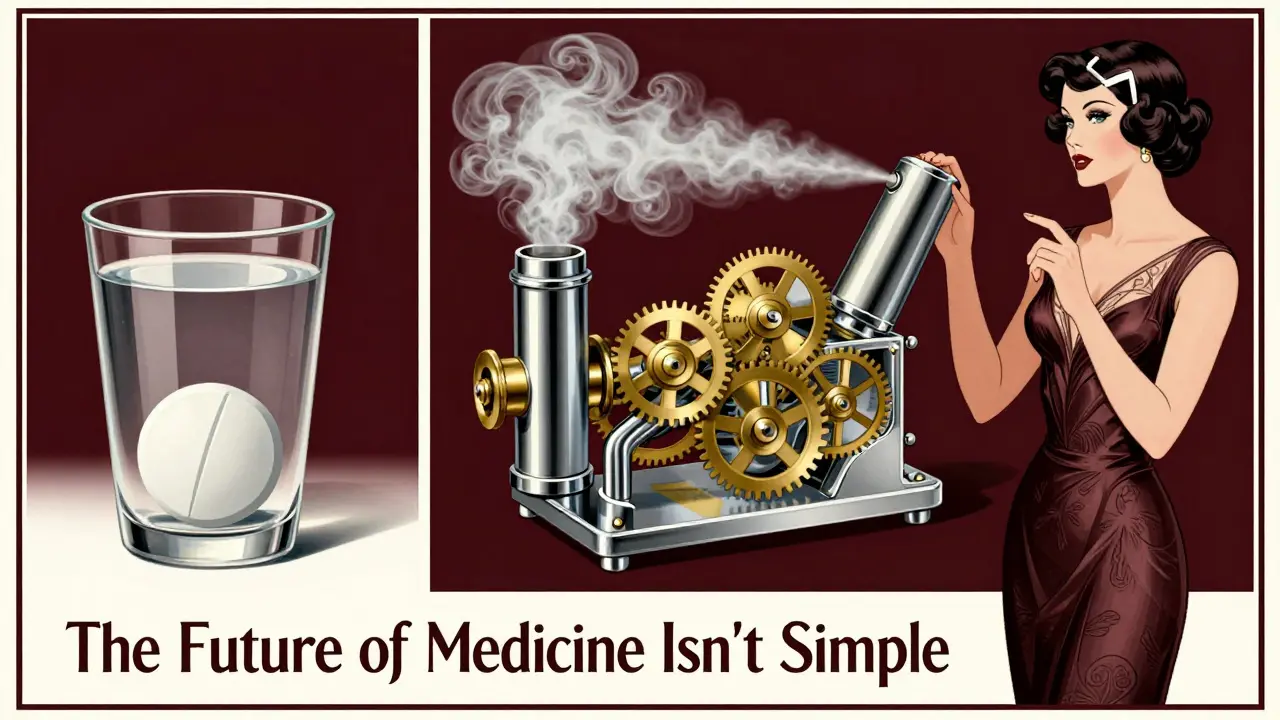
Why Approval Rates Are So Low
Between 2015 and 2023, the FDA approved just 15 complex generic drugs. In the same period, it approved over 1,000 conventional generics. Why such a gap?
First, the science is hard. A 2021 systematic review of 24 studies found that analytical challenges - measuring the drug’s properties accurately - were cited in 19 out of 24 papers. Formulation challenges appeared in 17. Regulatory uncertainty showed up in 21. In other words, manufacturers don’t just struggle with making the drug - they struggle to prove they made it right.
Second, the cost is staggering. Developing a conventional generic can cost $5 million to $10 million and take 2-3 years. A complex generic? $20 million to $50 million and 5-7 years. That’s a huge risk for companies, especially when the market might still be small.
Third, regulatory pathways are unclear. For many complex products, the ANDA route is dead ends. Companies often have to use the 505(b)(2) pathway - a hybrid route that requires new clinical data. That’s more expensive and slower than a true generic path. One industry expert put it bluntly: "Without specific guidance, FDA’s expectations are unclear and appear to be continuously evolving."
Even small differences matter. A 2022 FDA analysis found that inhaler generics were rejected not because they were less effective, but because the device’s button shape or airflow pattern differed slightly from the original. Patients might not notice. But regulators had to.
What the FDA Is Doing About It
The FDA isn’t ignoring the problem. In fact, it’s trying hard to fix it.
- Product-Specific Guidance (PSG) - As of 2023, over 1,700 PSGs exist. These are detailed documents that tell manufacturers exactly what data they need for each drug. In 2022-2023 alone, more than 200 new or revised PSGs were published - most targeting complex products.
- Pre-ANDA Meetings - The program has become a lifeline. Companies now meet with FDA scientists early, often multiple times, to avoid costly missteps. The agency has hired 128 new reviewers since 2023 to handle the growing volume.
- New Science - The FDA’s FY 2025 plan includes developing better tools to measure bioequivalence for complex products. They’re exploring advanced imaging, AI-driven modeling, and machine learning to predict how a drug behaves without relying on traditional blood tests.
The 2019 approval of the generic version of bupivacaine liposome injectable was a turning point. It took years of back-and-forth. The manufacturer had to develop a brand-new way to prove bioequivalence - one that didn’t rely on blood levels at all. The FDA approved it. And now, that method is being used as a template for other liposomal drugs.

Global Differences Make It Harder
The U.S. isn’t the only place struggling. In China, the National Medical Products Administration (NMPA) often requires local clinical trials and a local legal agent. That can add 12-18 months to the timeline. Brazil’s ANVISA demands certification of every lab and clinical site, and insists on strict ICH guidelines - a hurdle many smaller manufacturers can’t clear.
Even within the EU, regulatory expectations vary. Some countries accept data from the U.S. FDA. Others demand their own bioequivalence studies. That means a company might spend millions developing one product - only to have to start over for another market.
What’s Next?
Progress is slow, but it’s happening. AI and machine learning are expected to cut development times by 20-30% by 2027. Quality-by-design approaches - where manufacturers build quality into the process from day one, rather than testing for it at the end - could reduce review cycles by 35-45%.
But the biggest change needed isn’t scientific - it’s cultural. The FDA, manufacturers, and even patients need to accept that complex generics aren’t just "copies." They’re new medicines in their own right, requiring new science, new standards, and new patience.
For patients, the delay means higher prices. For manufacturers, it means risk. For regulators, it means balancing safety with speed. The system is slowly adapting. But until the path to approval becomes clearer, cheaper, and more predictable, complex generics will remain rare - even when patients need them most.
Why are complex generic drugs harder to approve than regular generics?
Complex generic drugs involve advanced formulations like liposomes, long-acting injectables, or drug-device combinations. Unlike simple pills, their effectiveness depends on precise physical and chemical properties - such as particle size, release rate, or device performance. The FDA can’t rely on traditional bioequivalence tests (like blood concentration) to prove they work the same. Instead, they require specialized testing methods, which are harder to develop, validate, and standardize. This leads to longer reviews, higher costs, and more rejection risk.
What is the ANDA pathway, and why doesn’t it work for complex generics?
The Abbreviated New Drug Application (ANDA) is the standard path for generic drug approval. It allows manufacturers to prove their product is bioequivalent to the brand-name drug using blood level measurements. But for complex drugs - like those that release slowly over weeks or are delivered through inhalers - blood levels don’t reflect how the drug behaves in the body. A generic might have the same amount in the blood but deliver it too slowly or to the wrong tissue. That’s why the ANDA pathway often fails for complex products; regulators need more detailed evidence than just pharmacokinetics.
How much does it cost to develop a complex generic drug?
Developing a complex generic typically costs between $20 million and $50 million, compared to $5 million-$10 million for a conventional generic. The timeline is also much longer - 5 to 7 years versus 2 to 3 years. This is because complex products require advanced manufacturing equipment, specialized analytical testing, multiple rounds of regulatory feedback, and sometimes entirely new clinical studies. Many companies avoid these projects because the financial risk is too high.
What role do Product-Specific Guidelines (PSGs) play in approval?
Product-Specific Guidelines (PSGs) are detailed documents issued by the FDA that outline exactly what data a generic manufacturer must submit for a specific drug. For complex products, PSGs are critical because they clarify what tests are needed - whether it’s particle size distribution, release profile, or device performance. Before PSGs existed, companies often submitted applications only to be rejected because they missed a key requirement. Since 2017, the FDA has published over 1,700 PSGs, with over 200 new ones in 2022-2023 alone - most targeting complex generics.
Why do inhaler generics get rejected even if they work the same?
Inhalers are classified as drug-device combination products. Even if the drug inside is identical, the FDA requires the device - the canister, valve, nozzle, or actuator - to match the brand-name product exactly. A slightly wider nozzle, a different button pressure, or a change in airflow pattern can alter how much medicine reaches the lungs. Because patients rely on consistent delivery, the FDA treats these differences as potential safety risks - even if clinical studies show no difference in outcomes. This makes approval extremely difficult.
Is the FDA making progress on approving complex generics?
Yes, but slowly. Since 2015, only 15 complex generics have been approved, compared to over 1,000 conventional ones. But the FDA has taken real steps: it’s hired 128 new reviewers, held over 1,200 Pre-ANDA meetings, and published hundreds of new Product-Specific Guidelines. The approval of the generic bupivacaine liposome injectable in 2019 proved that complex generics can be approved - if regulators and manufacturers work together. The agency now has a dedicated science program for complex products, and AI tools are being tested to speed up analysis. Progress is real, but it’s not fast enough to meet patient demand.
Complex generics are not just a regulatory puzzle - they’re a public health opportunity. When these drugs finally reach patients, they can cut costs dramatically. But until the path to approval becomes less uncertain, fewer will get made - and more patients will pay more for less.
Sean Callahan
March 8, 2026 AT 07:18phyllis bourassa
March 9, 2026 AT 13:56Ferdinand Aton
March 10, 2026 AT 19:55William Minks
March 12, 2026 AT 03:32Jeff Mirisola
March 13, 2026 AT 00:59Susan Purney Mark
March 14, 2026 AT 11:42Ian Kiplagat
March 14, 2026 AT 16:34Amina Aminkhuslen
March 15, 2026 AT 09:52amber carrillo
March 17, 2026 AT 05:44Tim Hnatko
March 17, 2026 AT 08:13Aaron Pace
March 17, 2026 AT 10:57Joey Pearson
March 19, 2026 AT 06:27Roland Silber
March 21, 2026 AT 02:00