
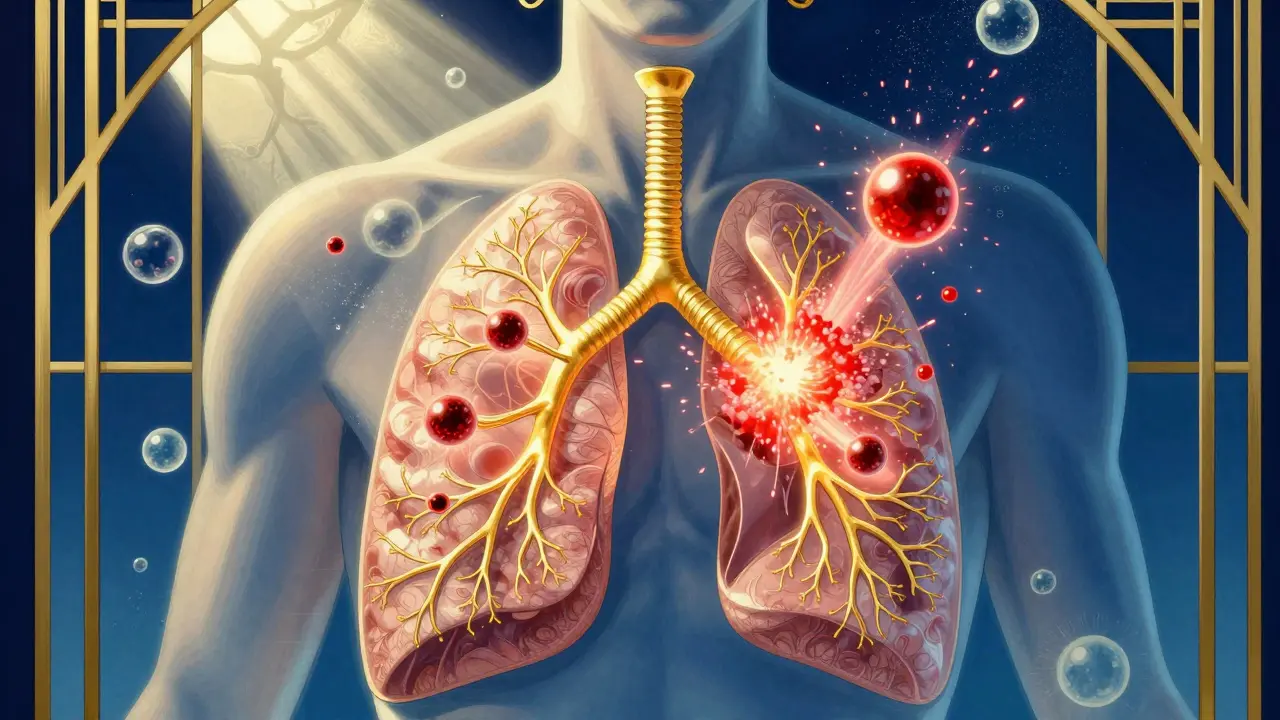
When the virus first hit, most people thought if you survived the acute phase, you were done. But for many, the real fight started after the fever broke. Even if you didn’t need a ventilator, your lungs might still be struggling months later. This isn’t just fatigue or anxiety. It’s real, measurable damage - and it’s more common than you think.
What’s Actually Happening in Your Lungs After COVID?
Most imaging tests - like chest X-rays or standard CT scans - come back normal after COVID. That doesn’t mean your lungs are fine. The real damage happens in the tiniest airways, the alveoli, where oxygen swaps into your blood. That’s where traditional scans can’t see.
Research from the Centre for Heart Lung Innovation in 2025 found that a type of immune cell called a neutrophil keeps firing off inflammatory signals long after the virus is gone. Think of them like tiny dirty bombs: they were meant to fight the infection, but now they’re stuck in overdrive, attacking healthy lung tissue. This persistent inflammation scars the small airways and blocks oxygen transfer. It’s not pneumonia. It’s not asthma. It’s something new - and it’s called pulmonary long COVID.
One in eight people who were hospitalized with COVID-19 develop post-COVID pulmonary fibrosis (PCPF). That’s permanent scarring. Even among those who weren’t hospitalized, over a third still report ongoing breathlessness six months later. And here’s the kicker: you can have all the symptoms - gasping for air climbing stairs, feeling tightness in your chest - but your lung function test still looks normal. That’s because the damage is too small for standard tests to catch.
Who’s Most at Risk for Lasting Lung Damage?
It’s not just the sickest patients. But yes, if you were hospitalized, your risk jumps. People who needed oxygen or ICU care are 2.6 times more likely to have lasting breathing problems than those who recovered at home. And it doesn’t matter if you were on a ventilator or not - the level of acute care didn’t predict how bad your long-term lung function would be.
But there’s another group at higher risk: people who already had lung disease. If you had COPD before catching COVID, your chance of dying from it went up 4.6 times. You also had more flare-ups - nearly double the number of acute episodes each year. Your lungs were already worn down. COVID didn’t just add stress - it broke the last bit of reserve.
And then there’s the mystery group: younger, otherwise healthy people who never needed hospitalization but still can’t catch their breath. Their lung scans look clean. Their spirometry is normal. But they’re exhausted after walking to the mailbox. That’s the neutrophil inflammation at work - invisible to old tools, real to them.
How Do Doctors See What’s Really Going On?
Traditional lung tests measure volume - how much air you can blow out. But they can’t measure how well oxygen moves from your lungs into your blood. That’s where hyperpolarized xenon MRI comes in. It’s not widely available yet, but it’s changing everything.
This special kind of MRI uses a harmless gas you breathe in. It glows on the scan, showing exactly where oxygen is getting stuck. Researchers at the HLI in Canada used it to identify four distinct patterns of gas exchange failure in long COVID patients. Some had trouble getting oxygen into the blood. Others had trouble moving it out. Each pattern needs a different approach.
It’s like having a map of your lungs instead of just a blurry photo. And it’s not just for research anymore. Hospitals in the U.S., Canada, and Australia are starting to use it to guide rehab. If your oxygen transfer is 40% below normal, your rehab plan looks different than if it’s only 15% off.

Rehabilitation: What Actually Works
Rest won’t fix this. Neither will just waiting it out. But structured pulmonary rehab? That’s where real recovery happens.
Most programs start after four weeks - once the acute phase is over. They run for 8 to 12 weeks, with sessions two or three times a week. Each one includes:
- Breathing retraining - learning how to use your diaphragm, not your neck muscles, to breathe. This reduces the feeling of air hunger.
- Aerobic training - walking on a treadmill or cycling at low intensity, slowly increasing as tolerance improves. It’s not about speed - it’s about endurance.
- Strength training - light weights or resistance bands for arms and legs. Stronger muscles mean less effort to move.
- Education - understanding what’s happening in your body so you don’t panic when you feel short of breath.
Studies show clear results. After completing rehab, patients gain an average of 50 meters in their 6-minute walk distance. Their FEV1 (how much air they can force out in one second) improves. Their diffusion capacity - how well oxygen enters the blood - goes up. And most importantly, their breathlessness score on the mMRC scale drops.
The mMRC scale? It’s simple. It asks: “Do you get breathless when walking up a hill?” “When walking at your own pace?” “When dressing?” A score of 2 or higher at one month after infection means you’re at high risk for long-term problems. That’s your signal to start rehab - don’t wait.
What About Medications? Can Drugs Help?
There’s no magic pill yet. But some drugs show promise - and others might make things worse.
In a Korean study of nearly 6,000 patients, those who got remdesivir during their hospital stay were less likely to develop pulmonary fibrosis. That’s encouraging. But those who got baricitinib - an anti-inflammatory drug used in severe cases - had a higher risk. Researchers think it might suppress the immune system too much, letting inflammation fester later.
But here’s the catch: these studies can’t prove cause and effect. People who got remdesivir were often sicker and got it earlier. Those who got baricitinib were in the ICU. So it’s not clear if the drugs themselves caused the difference - or if it was the severity of the illness.
What’s coming next? Clinical trials are already planned. The RECOVER Initiative is testing drugs that specifically target neutrophils - the cells causing the damage. The goal? Stop the dirty bombs before they scar your lungs for good.

What to Expect Over Time
Recovery isn’t linear. You’ll have good days and bad days. But the data shows most people improve - slowly.
For those with moderate to severe infections, lung function typically gets better over six months. Forced vital capacity - how much air you can exhale after a full breath - rises from around 2.03 liters to 2.56 liters in many patients. That’s a big jump. But not everyone catches up. About 12.6% of hospitalized patients end up with permanent fibrosis. For them, rehab isn’t a cure - it’s management.
And if you had pre-existing lung disease? Your recovery is slower. You’ll need longer rehab. You’ll need to avoid triggers like smoke, cold air, and infections. You might need ongoing oxygen or inhalers. But you can still get stronger. You can still walk further. You can still live well.
One thing’s clear: the sooner you start rehab, the better your outcome. Waiting six months to see if you “get better on your own” means you lose precious time for tissue repair.
Functional Tests You Can Track at Home
You don’t need a hospital to know if you’re improving. There are simple, reliable tests you can do yourself.
The 30-second sit-to-stand test (30STS) - how many times can you stand up and sit down in 30 seconds? People with very burdensome long COVID symptoms do fewer than 10 reps. Someone recovering well might hit 18 or more. It’s a direct measure of leg strength, endurance, and breathing control - all tied to lung function.
The 6-minute walk test - walk as far as you can in six minutes. Don’t run. Just keep going. Record the distance. Do it every 4 weeks. Even a 20-meter increase is meaningful.
The mMRC scale - rate your breathlessness on a scale from 0 to 4. Write it down. If your score drops from 3 to 1 over three months, you’re on the right path.
These aren’t fancy tools. But they’re real. They’re measurable. And they’re yours.
What’s Next for Long COVID Lung Care?
Big changes are coming. The American Thoracic Society and the European Respiratory Society are finalizing official diagnostic criteria for pulmonary long COVID. They’ll be released later this year. That means doctors will finally have a clear way to diagnose it - not just rule everything else out.
Specialized rehab programs are being rolled out across the UK, U.S., and Australia. Insurance companies are starting to cover them. Hospitals are hiring respiratory physiotherapists trained specifically in long COVID.
And the research? It’s accelerating. Xenon MRI is becoming more accessible. Blood tests to detect neutrophil markers are in development. Clinical trials for targeted anti-inflammatory drugs will begin in early 2026.
This isn’t just about lungs anymore. People with pulmonary long COVID are also at higher risk for kidney problems, heart rhythm issues, and brain fog. Your lungs are the canary in the coal mine. Fix them, and you fix more.
You’re not broken. Your body just needs the right support to heal. And that support is here - if you know where to look.
Josh josh
January 25, 2026 AT 02:51bro i had covid in 2021 and still cant run up the stairs without feeling like my lungs are made of wet cardboard
Aurelie L.
January 25, 2026 AT 18:07They say it’s just fatigue. But when you’re gasping after opening a window? That’s not fatigue. That’s betrayal.
Joanna Domżalska
January 26, 2026 AT 23:56So let me get this straight. You’re saying the government lied about lung damage because the scans looked normal? That’s just science being science. You’re mad because the system didn’t give you a trophy for suffering.
SWAPNIL SIDAM
January 27, 2026 AT 00:32I am from India. My uncle had covid. He never went to hospital. Now he walks only 10 steps and stops. Breath like broken bellows. Doctors say nothing wrong. But his body knows. We need help. Not just scans.
Geoff Miskinis
January 27, 2026 AT 21:44Let’s be honest - this whole ‘pulmonary long COVID’ framework is just a rebranding of post-viral dysautonomia with fancy MRI jargon. The real issue is that we’ve outsourced medical authority to tech bros with hyperpolarized xenon machines and zero bedside manner.
Sally Dalton
January 28, 2026 AT 05:24i just wanted to say thank you for writing this. i’ve been feeling so alone with this breathlessness thing. i thought i was just being dramatic. knowing it’s real and measurable… it means i’m not crazy. i started rehab last week and already walked 10 extra meters. small wins, right?
Betty Bomber
January 30, 2026 AT 00:01my cousin did the 6-minute walk test at home. went from 240 to 275 meters in 2 months. no meds. just walking. slow. every day. it’s not magic. it’s just showing up.
Mohammed Rizvi
January 30, 2026 AT 00:06They call it a dirty bomb. I call it the lungs’ silent mutiny. Neutrophils don’t care if you survived. They just keep fighting a war that ended three years ago.
eric fert
January 30, 2026 AT 05:13Look, I get that people are suffering. But let’s not pretend this is some new disease. We’ve seen this exact pattern after every major viral outbreak - SARS, H1N1, even the 1918 flu. The lungs are slow to heal. The science isn’t ‘new’ - it’s just now being funded because the media finally noticed rich people are affected. Also, hyperpolarized xenon MRI? That’s a $500,000 machine. Most of us will die before we ever see one. This is just luxury medicine wrapped in compassion.
Curtis Younker
January 30, 2026 AT 20:43you are not broken. you are rebuilding. every step you take, even if you have to stop after 5 feet, is a victory. your lungs remember how to breathe. they just need time and patience. i started with 3 sit-to-stands. now i do 20. you can too. don’t compare your day 1 to someone else’s day 100. your journey is yours. keep going. you’ve got this.
Shawn Raja
January 31, 2026 AT 19:24the real tragedy isn’t the neutrophils. it’s that we’ve turned healing into a productivity metric. 50 meters more? improved FEV1? we’re measuring recovery like a spreadsheet. what about the nights you cry because you can’t tie your shoes without gasping? what about the grief for the body you lost? no scan sees that. no rehab fixes that. we need more than data. we need mourning.
Ryan W
February 1, 2026 AT 04:06So we’re spending billions on xenon MRI to diagnose what was always just deconditioning? Meanwhile, the VA is still denying VA benefits to veterans with identical symptoms because ‘no objective evidence.’ This is pure performative medicine. You want to help? Fund basic pulmonary rehab in rural clinics. Not fancy scanners for coastal elites.
bella nash
February 2, 2026 AT 06:12It is imperative to underscore that the physiological alterations observed in the post-acute phase of SARS-CoV-2 infection constitute a distinct pathophysiological entity, which, while phenomenologically overlapping with conventional interstitial lung disease, exhibits unique immunological biomarkers that necessitate a paradigmatic shift in therapeutic protocol design. The current standard of care remains insufficiently granular to account for microstructural gas exchange inefficiencies, thereby precluding the efficacy of empiric interventions. A multidisciplinary, biomarker-guided approach is not merely advisable - it is epistemologically obligatory.