

Taking your meds every day isn’t just about following a doctor’s order-it’s about staying alive, avoiding hospital trips, and keeping your life running. Yet, medication adherence is one of the biggest hidden problems in healthcare. Half of people with chronic conditions like high blood pressure, diabetes, or heart disease miss doses regularly. And it’s not because they’re lazy or forgetful. It’s because the system doesn’t fit their life.
Think about it: if you’re supposed to take three different pills at three different times, some with food, some without, and you’re juggling work, kids, or a second job, it’s easy to slip up. Miss one dose, and your blood pressure spikes. Miss two, and you’re back in the ER. The good news? You don’t need to be perfect. You just need a routine that actually works for you.
Start with the simplest thing: link it to something you already do
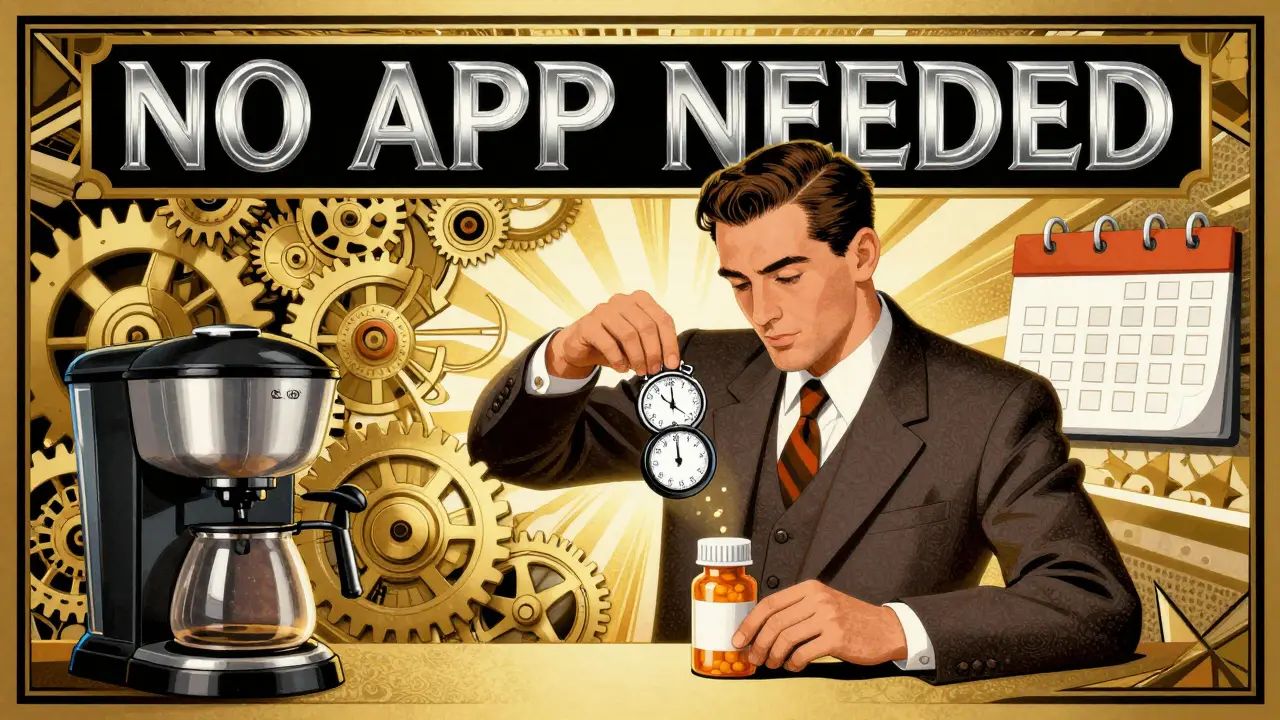
The most effective way to remember your meds isn’t a fancy app or a buzzing alarm. It’s tying them to a habit you already have. Brush your teeth every morning and night? That’s your cue. Eat breakfast at 8 a.m.? That’s when you take your pill. Feed the dog at 7 p.m.? That’s your evening dose.
Stanford Medicine tracked over 1,200 patients who linked their meds to daily routines. Those who paired pills with brushing teeth or eating meals had a 72% success rate in sticking to their schedule. Why? Because habits run on autopilot. You don’t think about brushing your teeth-you just do it. Your meds should work the same way.
Here’s how to do it:
- Check with your pharmacist: Some pills need an empty stomach. Others work better with food. Don’t guess-ask.
- Match the timing: If you take a pill in the morning, pair it with your first meal or your morning coffee. Evening doses? Link them to dinner or turning off the TV.
- Keep it simple: If you have four different times to take meds, ask your doctor if you can consolidate. One study found that reducing daily doses from four to two cut missed pills by 40%.
Use a pill organizer-no tech needed
Pill organizers aren’t old-fashioned. They’re the most reliable tool out there. A weekly organizer with AM/PM compartments reduces missed doses by up to 35%, according to the American Heart Association. And it’s not just for seniors. A 2023 Reddit survey of over 1,200 people with chronic illness found that 68% said their pill box cut missed doses from 30% to under 5%.
Here’s how to make it work:
- Buy a seven-day organizer with separate slots for morning, afternoon, evening, and bedtime. No need for fancy ones with alarms-just a simple plastic box.
- Fill it once a week. Friday night after dinner is the best time for most people. It’s quiet, you’re home, and you’re not rushing.
- Use color-coded labels: Blue for morning, red for afternoon, yellow for night. A 2021 study showed this helped patients get their doses right 28% more often.
- Keep it visible. Put it next to your toothbrush, coffee maker, or car keys. Out of sight? Out of mind.
And if you’re worried about over-dosing? Try the flip bottle trick. After you take a pill, turn the bottle upside down. If you see it right side up later, you know you missed it. ProMedica’s data shows this cuts double-dosing by 22%.
Forget the app-unless it fits your life
Smartphone alarms seem perfect. But here’s the catch: 45% of people over 75 miss their phone reminders because they silence them accidentally, can’t set them right, or just don’t use their phone much. A 2020 MedStar Health study found smartphone reminders worked great for people under 65-75% adherence-but dropped hard for older adults.
That doesn’t mean ditch tech. It means pick the right kind:
- If you use a phone daily: Set two alarms-one 15 minutes before your usual time, one right at your time. Label them clearly: “AM BP Med” or “Night Heart Pill.”
- If you’re not tech-savvy: Use a timer cap. These screw onto pill bottles and beep when it’s time to take your dose. They work for all ages and don’t need batteries or apps. ProMedica found they kept 62% of users on track.
- If you’re worried about travel: Get a travel pill case with a built-in timer. Some even light up when it’s time.
The real problem isn’t the tech-it’s assuming everyone should use it. If you hate your phone, don’t force it. Stick with the pill box. It’s cheaper, simpler, and just as effective.
Track it visually-no journal required
You don’t need to write down every pill you take. But you do need to see it. A simple calendar on the fridge, with a big checkmark for each dose, makes a huge difference. A 2011 study published in PMC found people who checked off their doses had 32% fewer missed pills.
How to set it up:
- Print a monthly calendar. Or just draw one on a sticky note.
- Put it next to your pill box.
- Every time you take your meds, mark an X or fill in a box.
- At the end of the week, look at it. If you’ve missed two or more, ask yourself why. Was it a busy day? Did the pill box run out? Did you feel fine and think you didn’t need it?
AdventHealth’s 2023 survey of 5,000 patients found that 76% who used this method kept their adherence above 90%. Memory isn’t reliable. But your eyes? They never lie.
Ask for help-don’t suffer in silence
Many people stop taking meds because of side effects. Nausea. Dizziness. Fatigue. They think, “I feel fine now, so maybe I don’t need it.” But skipping doses makes things worse long-term.
Instead of quitting, talk to your doctor. There are usually alternatives. Maybe a different pill. Maybe a lower dose. Maybe a time change. One patient I know switched from a morning blood pressure pill to an evening one-and suddenly stopped feeling dizzy all day.
Also, ask about simplifying your regimen. If you’re taking five pills a day, ask: “Can we cut this down?” A 2020 review in the Journal of the American Pharmacists Association found that reducing daily doses by even one cut missed pills by 40%.
And don’t be afraid to use the buddy system. Pair up with a friend or family member who also takes meds. Text each other: “Took my pills!” It’s not about control-it’s about connection. Studies show this method works 58% of the time, as long as the buddy is reliable.

What breaks routines-and how to fix it
Life happens. You travel. You get sick. You change jobs. Your routine shatters. That’s normal. The key isn’t perfection-it’s recovery.
Here are the top three things that derail people-and how to bounce back:
- Travel: 63% of patients miss doses when they’re on the go. Solution: Pack your pill box with extra doses. Bring a small travel case. Set a phone alarm for your new time zone.
- Complex regimens: 57% of people struggle with too many pills at different times. Solution: Ask your doctor to consolidate. Some meds can be switched to once-daily versions. Others can be combined into one pill.
- Side effects: 49% stop because they feel bad. Solution: Don’t quit. Call your doctor. There’s almost always a way to adjust.
And if you miss a dose? Don’t panic. Don’t double up. Just take it as soon as you remember. If it’s close to your next dose, skip it. Your pharmacist can tell you what’s safe.
It’s not about willpower. It’s about design.
The biggest myth about medication adherence is that it’s about discipline. It’s not. It’s about design. Your routine should fit your life-not the other way around.
Forget the pressure to be perfect. You don’t need to take every pill at exactly 8:03 a.m. You just need to take it most days. Even 80% adherence cuts hospital visits in half.
Start small. Pick one habit. One pill box. One checkmark on the fridge. Build from there. You’re not just taking medicine. You’re rebuilding your health-one dose at a time.
What if I forget to take my medication one day?
If you miss a dose, take it as soon as you remember-unless it’s almost time for your next one. In that case, skip the missed dose and go back to your regular schedule. Never double up unless your doctor says it’s safe. Always check with your pharmacist about specific meds, as some can be dangerous if taken too close together.
Can I use a pill organizer for all my medications?
Most can, but not all. Some pills need to stay in their original bottles because they’re sensitive to light, moisture, or air. Others, like nitroglycerin or certain antibiotics, can lose effectiveness if moved. Always check with your pharmacist before transferring pills into an organizer. If in doubt, keep them in their original packaging and use the box only for stable meds.
Why do I keep forgetting even with alarms and pill boxes?
If you’re still missing doses despite using tools, it might be because your routine doesn’t match your real life. Are you traveling often? Working late? Feeling side effects? The tools help, but they won’t fix a mismatched schedule. Talk to your doctor about adjusting timing, reducing doses, or switching to once-daily options. Sometimes, the problem isn’t memory-it’s the regimen itself.
Are smartphone apps better than pill boxes?
For younger people who use phones daily, apps can help-especially with refill reminders and refill tracking. But for most people over 65, pill boxes are more reliable. A 2022 AARP survey found 78% of seniors prefer physical organizers. Apps require tech skills, battery life, and attention. Pill boxes work without Wi-Fi, power, or memory. Simplicity wins.
How often should I refill my pill organizer?
Weekly is best. Friday evenings are the most popular time among patients because it’s after work, before the weekend, and gives you time to get refills if needed. Set a recurring calendar reminder. If you’re on monthly prescriptions, fill it once a month-but make sure you have enough pills to last the whole time. Never leave empty compartments-it defeats the purpose.
Pankaj Gupta
March 2, 2026 AT 01:47Linking medication to existing habits is brilliant-simple, evidence-based, and deeply human. I’ve seen patients in rural India who can’t afford phones or apps, but they all brush their teeth. Pairing pills with that ritual cuts adherence gaps by half. No tech needed, just consistency. Also, the flip-bottle trick? Genius. Works better than any alarm I’ve ever set.
And yes-consolidating doses saves lives. One patient I worked with went from six daily pills to two. Her HbA1c dropped 1.8% in three months. The system isn’t broken; we just haven’t designed it for real life.
Pharmacists are the unsung heroes here. Always talk to them. They know which meds can be swapped, combined, or taken with food. Most doctors don’t have the time. But pharmacists? They live this stuff.
Renee Jackson
March 3, 2026 AT 23:12Thank you for this thoughtful, compassionate, and meticulously researched piece. Medication adherence is not a personal failing-it is a systemic design flaw. The fact that 50% of individuals with chronic conditions miss doses is not a reflection of discipline, but of how poorly our healthcare infrastructure accommodates human behavior.
I commend the emphasis on habit-stacking and visual tracking. These are not ‘hacks’-they are behavioral science in practice. The fridge calendar, in particular, is a low-cost, high-impact intervention that requires zero digital literacy.
To clinicians reading this: please stop prescribing regimens without considering the patient’s daily rhythm. A once-daily alternative is not a compromise-it is a clinical imperative. And to patients: you are not lazy. You are navigating an unjust system. You are doing better than you think.
RacRac Rachel
March 5, 2026 AT 15:23OMG YES. This is literally the best thing I’ve read all year 🥹
I’ve been on 5 meds for 8 years. Used to miss 3 days a week. Then I got a pill box (blue = AM, red = PM), filled it every Friday, and put it next to my coffee maker. Now I’m at 98% adherence. I even started checking off a little 🟩 on my fridge calendar. It’s stupid simple. But it WORKS.
Also, the flip bottle trick? I’m stealing that. My cat already judges me for forgetting stuff. Now she’ll judge me for forgetting to flip the bottle 😂
Also also-don’t be afraid to ask your doc to simplify. I did. They switched my BP med to a combo pill. One pill instead of three. My life changed. You deserve that peace. 💪❤️
Jane Ryan Ryder
March 6, 2026 AT 17:02Callum Duffy
March 7, 2026 AT 12:16While the practical advice presented here is largely sound, I must emphasize the importance of context. In the UK, access to pharmacists is far more integrated into primary care than in many other nations. The suggestion to consult a pharmacist is not merely prudent-it is often a structural advantage many do not possess.
Furthermore, while pill organizers are effective, their utility is contingent upon stable housing, consistent routines, and absence of cognitive impairment-all of which are not universal. The one-size-fits-all approach, even when well-intentioned, risks excluding those most vulnerable.
Perhaps the next step is not refining the tools, but rethinking the delivery of care itself.
Chris Beckman
March 8, 2026 AT 22:31Levi Viloria
March 10, 2026 AT 14:39As someone who moved from rural Philippines to the U.S., I’ve seen how cultural assumptions about ‘adherence’ misfire. In my village, we didn’t have pill boxes. We had grandmothers who reminded us at mealtime. The real innovation isn’t the organizer-it’s community. In the U.S., we treat health like an individual responsibility. But in many cultures, it’s collective. A sister checking in. A neighbor asking if you took your pills. That’s not ‘buddy system’-that’s just how people live.
The article’s advice is solid, but it misses the deeper truth: we don’t need more tools. We need more connection. And that’s something no pill box can give you.
Richard Elric5111
March 11, 2026 AT 14:21One must interrogate the metaphysical underpinnings of adherence itself. Is the act of ingesting pharmaceuticals an assertion of autonomy, or a surrender to biopolitical governance? The prescribed routines-whether via pill organizers or habit-stacking-function not merely as tools of compliance, but as technologies of normalization.
The individual, in their attempt to ‘stick to a routine,’ becomes enmeshed in a disciplinary apparatus that equates bodily regulation with moral virtue. The ‘checkmark on the fridge’ is not a triumph of self-care-it is a quiet capitulation to the medical-industrial complex.
True liberation, then, lies not in optimizing adherence, but in dismantling the systems that render health a transactional, daily chore. Perhaps the most radical act is not taking the pill-but refusing to be defined by it.