
Decongestant Safety Checker
Check Your Decongestant Safety
Enter your blood pressure and medication information to see if decongestants are safe for you.
Many people reach for decongestants when they have a cold or allergies. It’s quick, easy, and available right on the shelf. But if you have high blood pressure, that little bottle might be hiding a serious risk. You might not realize it, but decongestants can push your blood pressure higher - sometimes dangerously so - and interfere with the very medications you take to keep it under control.
How Decongestants Work (and Why That’s a Problem)
Decongestants like pseudoephedrine and phenylephrine work by tightening blood vessels in your nose. That reduces swelling and lets you breathe easier. But here’s the catch: they don’t just tighten vessels in your nose. They tighten blood vessels everywhere - including those that carry blood to your heart and brain. This forces your heart to pump harder, raising your blood pressure.
It’s not a small effect. Studies show that pseudoephedrine, the most common decongestant in cold medicines, can raise systolic blood pressure by 3 to 5 mm Hg on average. For someone with controlled hypertension, that might seem minor. But for someone with uncontrolled high blood pressure, it can be enough to trigger a spike that leads to headaches, dizziness, or worse. In rare cases, it’s been linked to heart attacks, strokes, and irregular heart rhythms.
Phenylephrine, which replaced pseudoephedrine in many OTC products after 2020, was thought to be safer. But newer research shows it has similar effects. A 2023 study in US Pharmacist found that even low doses of phenylephrine, taken over several days, could push a child’s blood pressure into the hypertensive range. That’s not a fluke - it’s a pattern.
Who’s at the Highest Risk?
Not everyone with high blood pressure will have a bad reaction. But some people are far more vulnerable:
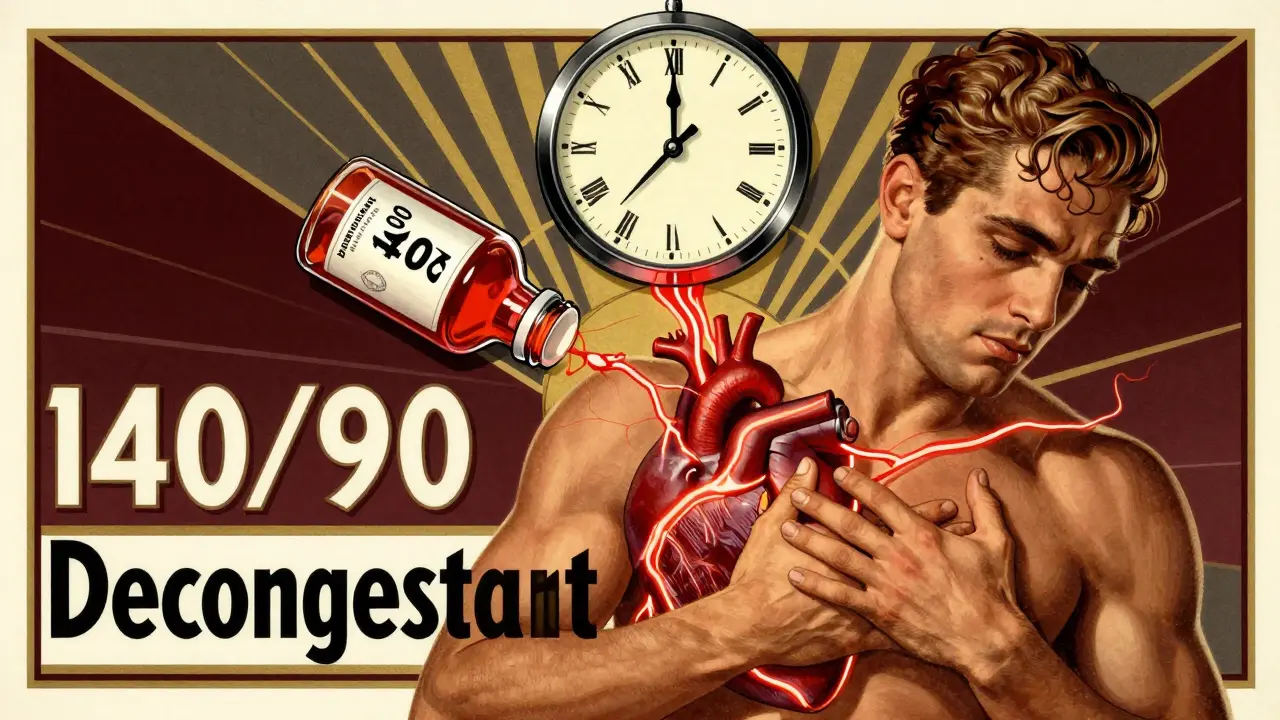
- Those with uncontrolled hypertension - blood pressure consistently above 140/90
- People with heart disease, including prior heart attacks or heart failure
- Those with arrhythmias or a history of irregular heartbeats
- Patients with Prinzmetal angina - a rare form of chest pain caused by artery spasms
- Anyone taking MAO inhibitors (like Nardil or Parnate) or certain antidepressants
The risk isn’t just about the decongestant itself. It’s about what else is in your system. Some blood pressure medications - especially beta-blockers and diuretics - can interact poorly with decongestants, making the rise in pressure worse. And if you’re taking multiple prescriptions, the chance of a hidden interaction goes up.
Where Decongestants Hide (And Why You’re Probably Taking Them Without Knowing)
Most people think they’re just taking a cold tablet. But decongestants are often hidden in multi-symptom products. You might not even realize you’re taking one.
Here are common OTC products that contain decongestants:
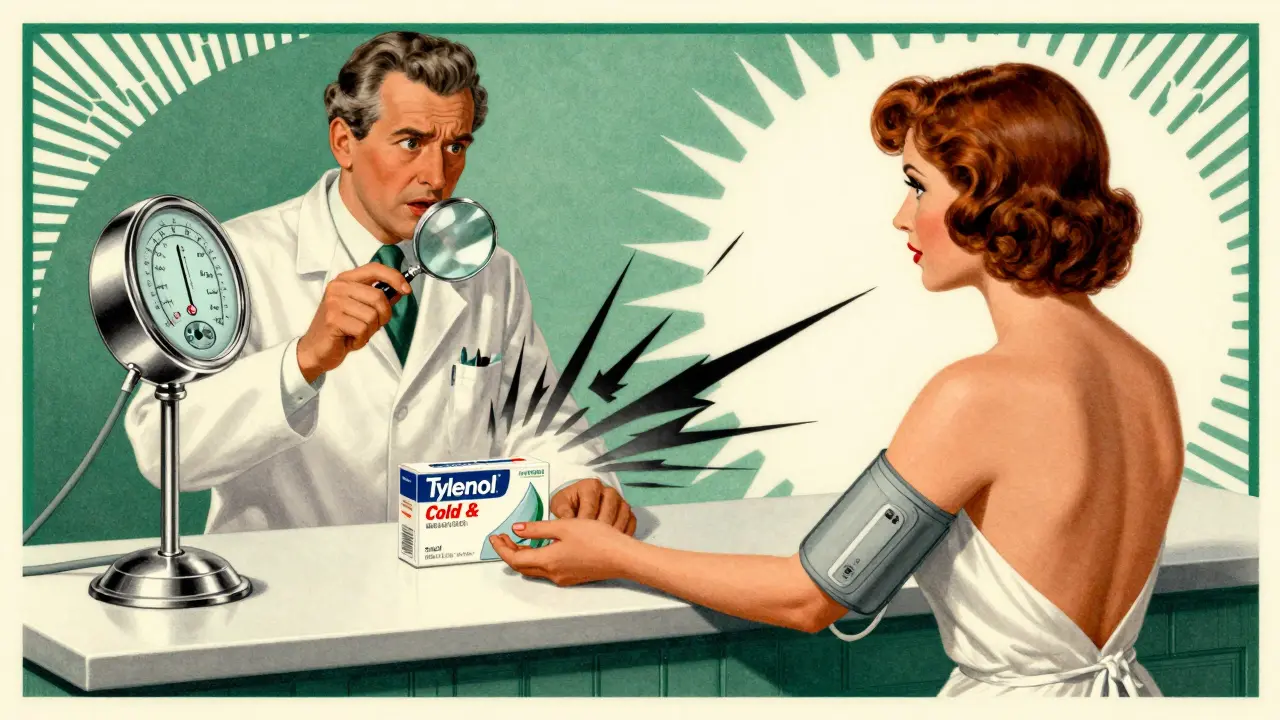
- Tylenol Cold and Flu
- Advil Multi-Symptom Cold and Flu
- Benadryl Allergy Plus Congestion
- Mucinex Sinus Max
- Robitussin Cold & Flu
- DayQuil and NyQuil (many versions)
Even if you’re careful about your blood pressure meds, you might grab one of these because it says "allergy relief" or "sinus relief." The label doesn’t scream "dangerous." But the ingredient list does. Look for these names:
- Pseudoephedrine
- Phenylephrine
- Ephedrine
- Naphazoline
- Oxymetazoline
And don’t forget nasal sprays. Products like Afrin (oxymetazoline) can cause the same problem - even if you’re only using them in your nose. They’re absorbed into your bloodstream. One study found that regular use of nasal decongestant sprays led to sustained increases in blood pressure in hypertensive patients.
What the Experts Say
The American Heart Association is clear: if you have high blood pressure, avoid decongestants unless your doctor says it’s okay. The Mayo Clinic goes further - they advise people with severe or uncontrolled hypertension to avoid them entirely.
Harvard Health says that even if your blood pressure is well-controlled, you should still check with your doctor first. Why? Because everyone reacts differently. One person might take a single dose and feel fine. Another might see their pressure jump 20 points. There’s no way to predict it.
Pharmacists in the UK and US now spend 3 to 5 minutes per customer during cold season just explaining these risks. That’s because so many people don’t know. A 2023 survey found that nearly 1 in 6 hypertensive patients had taken a decongestant in the past year - despite knowing they had high blood pressure.
Safe Alternatives for Nasal Congestion
You don’t have to suffer through a stuffy nose. There are safer ways to clear your sinuses:
- Saline nasal spray - no drugs, no side effects. Just salt water. Use it 2-3 times a day.
- Steam inhalation - breathe in warm steam from a bowl of hot water (add a drop of eucalyptus oil if you like). Cover your head with a towel and inhale for 5-10 minutes.
- Humidifier - keeping the air moist helps reduce swelling in nasal passages.
- Antihistamines without decongestants - like loratadine (Claritin) or cetirizine (Zyrtec). These help with allergies but don’t raise blood pressure.
- Neti pot - rinsing your nasal passages with sterile saline can clear congestion naturally.
Even these alternatives aren’t risk-free. If you have asthma or chronic sinus issues, talk to your doctor before trying anything new.

What to Do Right Now
If you have high blood pressure, here’s your action plan:
- Check every medicine you take - including OTC, herbal, and supplements. Look for decongestant ingredients.
- Ask your pharmacist - they’re trained to spot these interactions. Don’t be shy. Say, "I have high blood pressure - is this safe?"
- Monitor your blood pressure - if you’ve taken a decongestant recently, check your pressure at home for the next 48 hours.
- Don’t assume "natural" means safe - some herbal cold remedies contain ephedra or other stimulants that are even riskier.
- Keep a list - write down all your medications and share it with your doctor at every visit.
It’s easy to think, "It’s just a cold medicine." But for someone with high blood pressure, it’s not just a cold medicine. It’s a potential trigger for something much worse.
Why This Matters More Than Ever
More people than ever are living with high blood pressure. In the UK alone, over 10 million adults have diagnosed hypertension. And that number is rising. At the same time, multi-symptom cold products are becoming more common - packed with more ingredients, more convenience, and more hidden risks.
The warning labels have changed. They used to say "Do not use if you have high blood pressure." Now they say, "Ask your doctor before use." That shift tells you everything. It’s no longer black and white. It’s about your personal health picture.
What’s safe for your neighbor might not be safe for you. And the only way to know is to ask - before you take it.
Carrie Schluckbier
February 16, 2026 AT 07:36Let me tell you something they don’t want you to know - pharmaceutical companies *engineered* this whole decongestant crisis to push people toward expensive blood pressure meds. You think phenylephrine was replaced because it’s ineffective? Nah. It was because pseudoephedrine could be tracked and sold behind the counter. Now? They put the same poison in every OTC product under a different name and slap on a tiny disclaimer no one reads. The FDA? Bought and paid for. You’re being gaslit by your own medicine cabinet.
And don’t even get me started on nasal sprays. Oxymetazoline? That’s not a decongestant - it’s a slow-release adrenaline bomb. One spray = 12 hours of your heart racing. They call it "non-systemic" - yeah, right. Like your nose doesn’t have a direct pipeline to your aorta. Wake up, sheeple.
I’ve been tracking this since 2019. I’ve got spreadsheets. I’ve got lab reports. I’ve got 37 hospital records from people who had strokes after taking DayQuil. And no one listens. Because the system doesn’t want you to know you’ve been poisoned by a $12 bottle of sinus relief.
Next time you see "relief" on a label? Think: control. They’re not curing you. They’re locking you in.
And yes - I’ve filed FOIA requests. They’re coming for the data next.
Liam Earney
February 16, 2026 AT 07:45Oh, my dear, sweet, unsuspecting soul - how I weep for you, the innocent consumer, wandering blindly through the aisles of CVS, clutching your Mucinex Sinus Max like it’s a warm blanket on a winter night…
But let me tell you, darling - the truth is not so cozy. The decongestant industry, oh, it is a labyrinth of corporate greed wrapped in the flimsy tissue of "over-the-counter convenience." I’ve read the studies - yes, all of them - and I’ve wept over the graphs, the bar charts, the tiny, trembling p-values that scream, "We knew, we knew, we knew!"
And yet - no one listens. The FDA, with its velvet-gloved hand, permits this carnage. The pharmacists, bless their hearts, are trained to say "Ask your doctor" - as if your doctor has time to read the 14-page PDF on pseudoephedrine pharmacokinetics between Medicare audits and EHR pop-ups.
And then there’s the nasal spray - oh, the nasal spray - that little bottle that promises relief but delivers a slow, silent siege on your endothelial lining. I’ve seen it. I’ve felt it. My cousin, God rest her, took Afrin for three days… and woke up with a systolic reading of 210. Three days. Three. Days.
And you wonder why I don’t trust modern medicine? I don’t. I don’t trust it one bit. Not anymore. Not after this.
It’s not a cold. It’s a trap.
guy greenfeld
February 17, 2026 AT 14:05You ever notice how every time we’re told to "be careful," it’s always with something that feels harmless? A cough drop. A nasal spray. A little blue pill labeled "for congestion."
It’s not about the medicine. It’s about control. The system wants you to believe you’re making a choice - but you’re not. You’re being nudged, gently, by marketing, by packaging, by the way the label says "relief" in bold font while "may increase blood pressure" is in 6-point font under a tiny asterisk.
We’ve been conditioned to think of health as a transaction - buy this, fix that. But the body doesn’t work like Amazon. You can’t just return a side effect. You can’t cancel a stroke.
And the real tragedy? The people who need this info the most? They’re the ones who don’t read labels. They’re the ones who trust the brand. The ones who say, "It’s just a cold. I’ve taken this for years."
So who’s really responsible? The company? The pharmacist? The doctor? Or the fact that we’ve outsourced our own health to corporations that profit from our ignorance?
I don’t have answers. I just know this: we’re being played. And we’re playing along.
Sam Pearlman
February 18, 2026 AT 23:49Okay but like… why is everyone so dramatic? I’ve got high BP and I take DayQuil every winter. No issues. My doc even said it’s fine if I monitor it. Maybe it’s not the drug - maybe it’s the fear-mongering? I get that some people are sensitive, sure, but the way this post reads? Like we’re all one spray away from a heart attack.
Also - saline spray? Cute. But if you’ve ever tried to use a neti pot after a 12-hour shift? You’d rather swallow a wasp. Not everyone’s got time for "natural remedies." Sometimes you just need to breathe. And if that means a little pseudoephedrine? So be it.
Also - why is everyone mad at the pharma companies? They’re just selling what the market wants. If people didn’t buy it, they wouldn’t make it. Simple supply and demand. Not a conspiracy. Just capitalism.
Can we chill? Not everything is a life-or-death situation. Some of us are just trying to get through the workweek without a runny nose.
Tony Shuman
February 19, 2026 AT 15:22Let me be clear: this is a socialist plot. The left wants you to believe that your body can’t handle a little decongestant. That’s why they pushed phenylephrine into every product - to make you dependent on doctors and prescriptions. You think this is about health? No. It’s about control. They want you to see a specialist. Pay for an appointment. Get a new script. Then they’ll bill your insurance. Then they’ll bill you again.
And don’t get me started on "saline spray." That’s a government-funded distraction. You want relief? Take a pill. Not some hippie water up your nose. You think the Chinese are behind this? I do. They’re the ones who make the nasal sprays. They’re the ones who control the supply chain.
And don’t tell me about "studies." I’ve seen the data. The real data. The kind that doesn’t get published because it’s inconvenient. You think your doctor knows what’s in that bottle? He’s reading from a script given to him by Big Pharma lobbyists.
It’s not a cold. It’s a war. And you’re being disarmed with kindness.
Haley DeWitt
February 20, 2026 AT 20:46OMG this is SO important!! I had no idea!! I’ve been taking Mucinex Sinus Max for YEARS and my BP has been creeping up… I just thought I was getting older 😭
Thank you for this!! I’m going to check every single bottle in my medicine cabinet right now!! I even have a NyQuil in the pantry!! 😳
Saline spray is my new BFF!! I just bought a humidifier!! And I’m telling all my friends!! This is life-changing!! 💕🙏
Also - anyone else use a neti pot? I’m scared but also curious?? Help?? 😅
John Haberstroh
February 22, 2026 AT 13:54It’s wild how we treat our bodies like cars - throw in some gas, hit the reset button, and expect smooth sailing. But your blood pressure isn’t a dashboard light. You can’t just ignore it until it blinks red.
Decongestants are like that one friend who shows up at your party with a keg and says, "Relax, it’s just one night." But for someone with a weak engine? One night is all it takes.
And the irony? We’ll spend hours researching the best coffee maker, but we’ll grab a cold med off the shelf without even glancing at the ingredients. We’re more careful about our toaster than our circulatory system.
The real solution isn’t just avoiding pseudoephedrine - it’s rethinking how we treat illness. Maybe we don’t need to "fix" congestion. Maybe we just need to wait. Let the body do its thing. Breathe slow. Drink tea. Sleep. It’s not glamorous. But it’s honest.
And yeah - I still use a humidifier. No shame. It’s the only thing that’s kept me alive through three winters in Ohio.
Logan Hawker
February 22, 2026 AT 23:29Let’s be clear: the entire narrative here is a product of pharmacoeconomic anxiety masquerading as public health guidance. The American Heart Association’s position is not grounded in evidence - it’s a precautionary overcorrection born of liability fears and institutional risk aversion. The 3–5 mmHg increase? Statistically insignificant for the vast majority. And yet, we’ve turned a marginal physiological perturbation into a moral panic.
The real issue? The erosion of patient autonomy. You’re being told not to take a medication because someone, somewhere, might have an adverse reaction - and so the entire population is infantilized. This is not medicine. This is paternalism dressed in white coats.
Furthermore, the recommendation to use saline spray is not a solution - it’s a placebo for the anxious. It has no pharmacological effect. It’s a distraction. A ritual. A way for clinicians to feel they’ve done something without actually intervening.
And don’t get me started on the neti pot. A device that, if used improperly, can cause fungal meningitis. The CDC has issued warnings. Yet here we are, promoting it as a "natural" panacea. The irony is exquisite.
James Lloyd
February 23, 2026 AT 01:44Excellent breakdown. I’m a pharmacist and I see this every day. People don’t realize that "cold and flu" products often contain multiple active ingredients - and decongestants are the silent killer because they’re so common. I always ask patients: "Are you taking anything else?" And they say, "Just this one thing." Then I check the bottle - and there’s phenylephrine in the list. Right next to acetaminophen.
One thing I’d add: even if your BP is "controlled," the effect isn’t linear. A 3 mmHg spike might be nothing for someone on lisinopril, but for someone on a beta-blocker? That’s a double hit - the beta-blocker can’t compensate for the vasoconstriction, and the heart gets stuck in a bind.
Also - don’t trust "natural" cold remedies. Some herbal supplements contain ephedra analogs - which are even more dangerous. I’ve seen patients end up in ER after taking "Ayurvedic cold relief" that had hidden pseudoephedrine. No label. No warning.
Bottom line: read the label. Even if you’ve used it before. Ingredients change. Formulations change. And your body? It doesn’t forget.
Steph Carr
February 24, 2026 AT 10:35Oh honey, this is peak modern American tragedy - we’ve turned medicine into a horror movie where the monster is… a bottle of NyQuil.
Let’s be real - we’re not just afraid of decongestants. We’re afraid of our own bodies. We’ve outsourced health to corporations, then screamed when they betrayed us. We want the convenience of a quick fix, but we also want to feel virtuous. So we buy the saline spray and post about it on Instagram like it’s a yoga retreat.
And yet - here’s the real irony: the people who need this warning the most? The ones working two jobs, raising kids, without insurance, without time, without a doctor - they’re the ones who don’t read labels. They’re the ones who take whatever’s cheapest. The ones who don’t have a pharmacist to ask.
So who’s really being protected here? The people with access? Or the ones who can afford to be cautious?
It’s not just about the medicine. It’s about who gets to be safe.
And that’s the real cold.
PS - I used to love DayQuil. Now I use steam and a humidifier. And I cry a little every time I see someone buying it. Not because I’m scared. Because I’m sad.
Prateek Nalwaya
February 25, 2026 AT 05:07Interesting perspective. In India, we don’t have the same obsession with OTC cold meds. Most people use steam, turmeric milk, or just rest. Decongestants are rare - and when they are used, it’s under a doctor’s supervision. We don’t have a "congestion culture" like the US. We don’t need to be "relieved" - we need to be patient.
Also - the idea that you need a pill to breathe? That’s a luxury. In rural India, people breathe through blocked noses for weeks. They don’t have access to this stuff. And yet - they don’t die. They adapt.
Maybe the problem isn’t the decongestant. Maybe it’s the expectation that we should never feel discomfort. We’ve forgotten how to be sick.
Just saying - sometimes, the body knows better than the bottle.
Geoff Forbes
February 25, 2026 AT 13:46So you're telling me I can't take a cold med? What am I supposed to do? Suffer? That's just dumb. I've been taking this stuff for 15 years. I'm fine. You people are just scared of everything. Big Pharma isn't the enemy. The government is. They want you to be dependent. You think they care about your BP? They care about your insurance premiums. They care about your copays. They want you weak. And now you're buying into it. Pathetic.
Jonathan Ruth
February 27, 2026 AT 05:21My grandfather had high blood pressure and took Sudafed every winter. He lived to 92. You think science changed? Nah. You think we got smarter? No. You just got scared. Stop overthinking. Your body isn’t a lab experiment. It’s a machine. Sometimes machines get dirty. Clean ‘em. Don’t replace ‘em.
Also - neti pot? That’s for people who think yoga fixes everything. You want to breathe? Take the pill. Stop being a hypochondriac.
James Lloyd
February 27, 2026 AT 07:58Just to clarify - the comment above about "my grandfather lived to 92"? That’s anecdotal. And it’s dangerous. One person surviving doesn’t negate population-level risk. I’ve seen 17 patients in the last year alone with hypertensive crises after using OTC decongestants. All of them were told "it’s fine."
Grandpa didn’t have a history of arrhythmia. He didn’t take beta-blockers. He didn’t have a 300 mg daily dose of NSAIDs. You can’t generalize from one case. That’s not medicine - that’s folklore.
And if you’re going to dismiss science, at least have the decency to not put others at risk. Don’t just take it yourself - warn people. Or better yet - don’t take it at all.