
Medication Overuse Headache Risk Checker
Assess Your Risk
This tool checks if your headache medication use exceeds safe thresholds for medication overuse headache (MOH), based on guidelines from the American Headache Society and International Headache Society.
Medication Types
>10 days/month
>10 days/month
>15 days/month
>15 days/month
Results
Ever taken a painkiller for a headache, only to feel another one coming on just a few hours later? If you’ve been reaching for pills more than a few days a week, you might not just have bad luck-you could be caught in a cycle called medication overuse headache (MOH). It’s not in your head-it’s in the medicine. And it’s more common than you think.
What Exactly Is a Drug-Related Headache?
Medication overuse headache isn’t a new type of pain. It’s what happens when the drugs you take to stop headaches end up causing them instead. This isn’t rare. Around 1-2% of people in the UK and US deal with it. And for women, the risk is even higher-up to 80% of cases occur in women, according to the Merck Manual’s 2023 update.
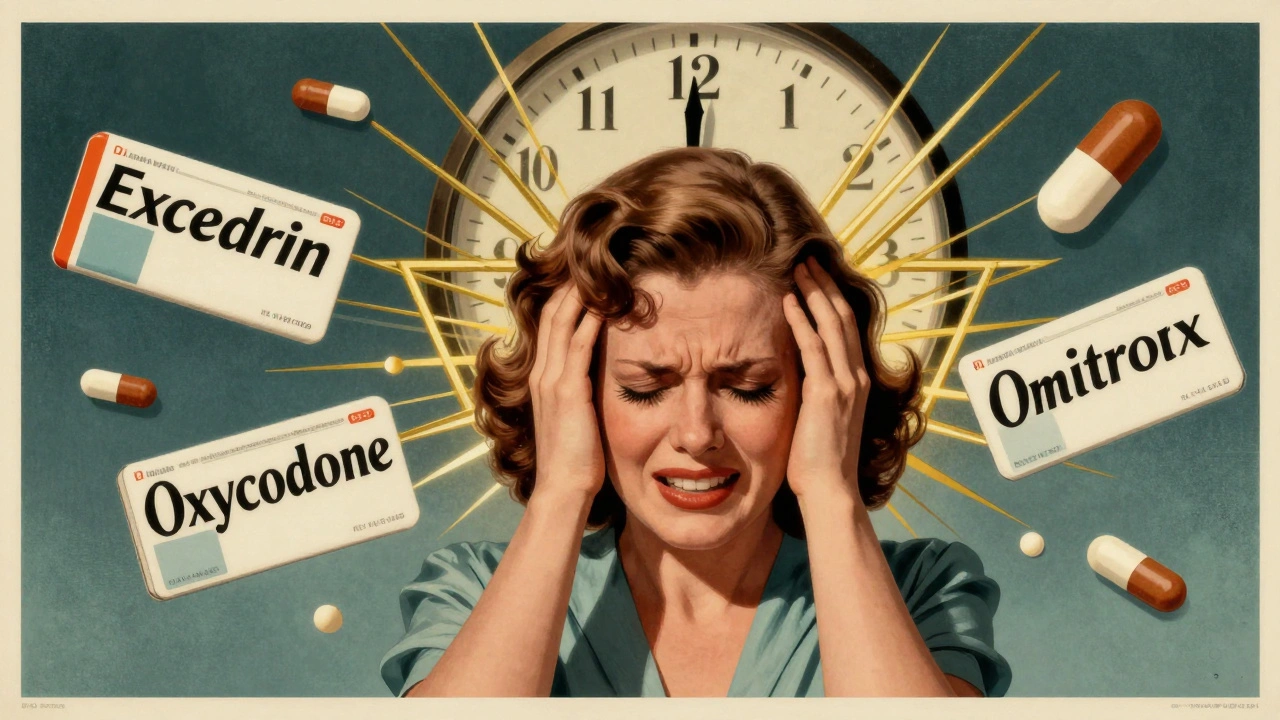
It usually starts with something simple: a migraine or tension headache. You take ibuprofen, Excedrin, or a triptan like Imitrex. It works. So next time, you take it again. And again. Soon, you’re using it 10, 15, even 20 days a month. That’s when your brain changes. The same painkillers that once helped now keep the pain alive.
The science behind it is clear. Studies show that overusing headache meds alters how your nervous system processes pain. Your brain becomes hypersensitive. It starts firing pain signals even when there’s no real trigger. This isn’t addiction in the drug-seeking sense-it’s a biological rewiring. The International Headache Society confirmed this in its 2018 guidelines, calling MOH a distinct condition, not just a side effect.
Which Medications Cause the Most Problems?
Not all pain relievers are created equal when it comes to triggering MOH. Some are far more dangerous than others.
- Opioids (like oxycodone, tramadol) and butalbital (found in Lanorinal, Butapap) are the worst offenders. Just 10 days a month of use can flip the switch. These aren’t just risky-they’re high-risk.
- Triptans (Imitrex, Zomig) are common migraine treatments. But if you use them 10 or more days a month, you’re in danger. Many patients don’t realize this-they think triptans are “safe” because they’re prescription-only.
- Combination pills like Excedrin (which mixes acetaminophen, aspirin, and caffeine) are sneaky. They work fast, so people reach for them often. Overuse starts at 15 days a month.
- NSAIDs like ibuprofen (Advil) and naproxen (Aleve) are lower risk, but not harmless. If you’re taking more than 1,200mg of ibuprofen or 660mg of naproxen daily, you’re pushing your limits. The American Headache Society says 15 days a month is okay. The European Headache Federation says 10. There’s no universal rule-and that confusion leads to overuse.
The FDA’s labeling is clear: these drugs are meant for occasional use. But most people don’t read the fine print. They assume, “If it helps, more must be better.” That’s the trap.
How Do You Know If It’s MOH?
Here’s the checklist doctors use to diagnose medication overuse headache:
- You have headaches on 15 or more days per month.
- You’ve been using acute headache medication (painkillers, triptans, etc.) for more than 3 months.
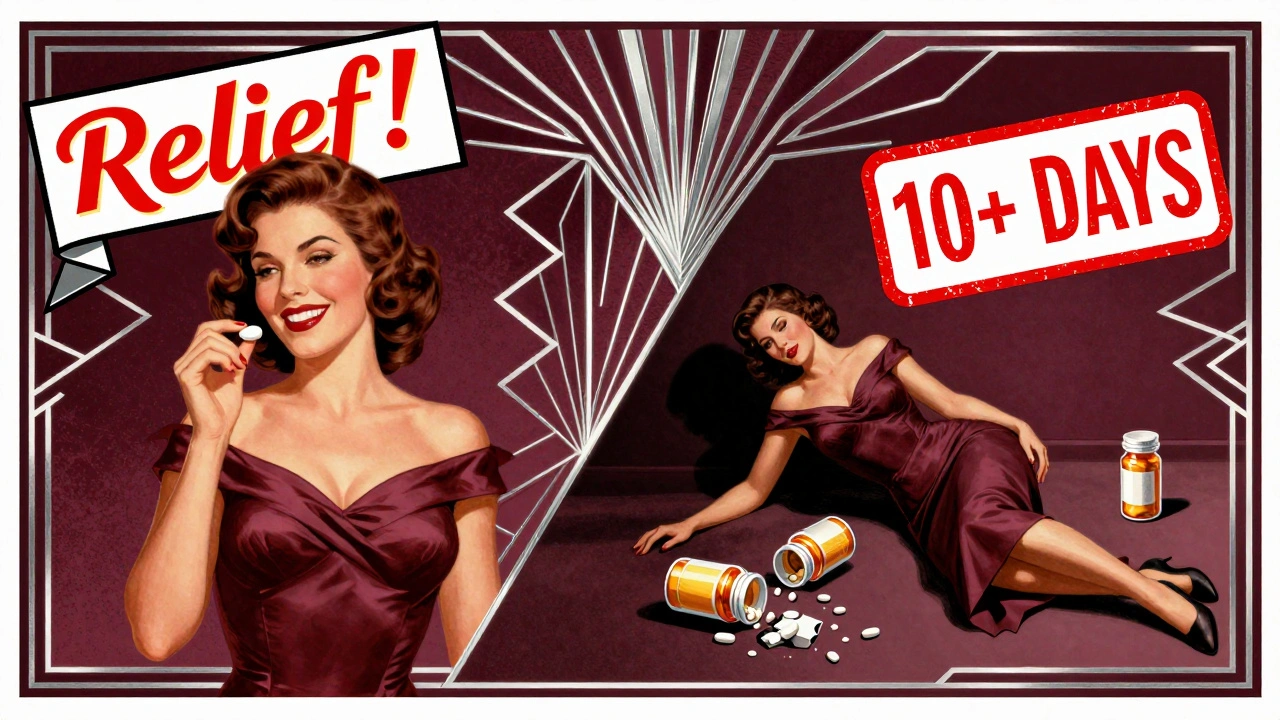
- You’re hitting the daily thresholds: opioids/butalbital ≥10 days/month, triptans ≥10 days/month, combination meds ≥15 days/month, simple analgesics ≥15 days/month.
And here’s the telltale sign: your headaches get worse when you stop taking the meds. That’s not coincidence-it’s withdrawal. Many patients describe it as a “rebound” headache that hits harder than the original. Some report nausea, vomiting, low blood pressure, and even sleeplessness during this phase.
A 2022 Cleveland Clinic study of 350 patients found that 92% experienced intensified headaches when they stopped their usual meds. Sixty-eight percent had nausea. Forty-two percent vomited. These aren’t side effects-they’re symptoms of your brain trying to reset.
Stopping the Meds Isn’t Easy-But It’s Necessary
The only way out is to stop the medication causing the problem. But quitting cold turkey isn’t always safe-or even possible.
For opioids or butalbital, sudden withdrawal can be dangerous. It can trigger seizures, extreme anxiety, or dangerously low blood pressure. In these cases, doctors recommend a slow taper over weeks, sometimes with medical supervision.
For triptans, NSAIDs, or combination pills, abrupt stoppage is usually safe. But the first week? It’s brutal. Headaches spike. You might feel exhausted, irritable, or sick. That’s normal. It’s your brain adjusting.
One Reddit user, u/HeadacheFreeNow, wrote: “After 5 weeks off Excedrin, my headache days dropped from 28 to 9 per month.” That’s the kind of improvement people see-but only after the storm passes.
Here’s what works best:
- Stop the overused drug. Work with your doctor to pick the right approach-taper or quit.
- Use rescue meds sparingly. If you need something during withdrawal, stick to non-overused options like acetaminophen, but only 2 days a week.
- Start prevention immediately. Waiting to start preventive treatment? That’s a mistake. Studies show 78% of people relapse within 3 months if they don’t begin prevention right away.
Preventive options include:
- Topiramate (40-100mg daily)-a seizure drug that also blocks migraine pathways.
- Propranolol (80-160mg daily)-a beta-blocker that reduces blood vessel swelling.
- CGRP monoclonal antibodies (like Aimovig)-monthly injections that block a key migraine trigger. They work for 50-60% of patients.
And here’s a game-changer: gepants like Ubrelvy, Nurtec, and Zavzpret. These newer migraine meds are designed to treat attacks without triggering overuse. Clinical trials show they don’t cause MOH-even when used regularly. That’s huge. They’re expensive-up to $750 a month-but for people stuck in the cycle, they’re life-changing.
Why Do So Many People Miss the Diagnosis?
Because it feels like the meds are working.
Patients often think, “My doctor gave me this. It helped before. Why would it be the problem?” A 2023 Reddit survey of 157 migraine sufferers found that 68% initially blamed themselves-or their stress-for the worsening headaches. They didn’t connect the dots until it was too late.
Dr. Peter Goadsby, a leading headache specialist in London, put it bluntly: “MOH represents a failure of treatment strategy, not patient behavior.” Most people aren’t abusing drugs-they’re following advice that didn’t account for long-term effects.
Doctors, too, can miss it. Headaches are common. MOH is subtle. It creeps in. Without a detailed headache diary, it’s easy to overlook. That’s why tracking matters.

What You Can Do Right Now
You don’t need a PhD to start fixing this. Here’s your action plan:
- Write down every headache and every pill. Use a simple notebook or free app. Note the date, time, intensity, and what you took. Do this for at least 4 weeks.
- Count your days. Are you taking painkillers 10+ days a month? If yes, you’re in the danger zone.
- Don’t panic. Don’t quit cold turkey unless your doctor says so. Especially if you’re on opioids or butalbital.
- Call your doctor. Say: “I think my headache meds might be making things worse. Can we talk about MOH?”
- Ask about preventive options. Don’t wait for the next attack. Start prevention before you stop the overused meds.
And if you’re feeling overwhelmed? You’re not alone. Thousands of people have walked this path. The good news? Most recover. Within 2-4 weeks of stopping the overused meds, 65-70% of patients see a big drop in headache days. That’s better than most medications.
What’s Next for MOH Treatment?
The field is evolving fast. In January 2024, the FDA approved atogepant (Qulipta) for preventing migraines in people with MOH. It’s the first oral drug specifically tested and approved for this group.
Researchers are also exploring non-drug tools. The Migraine Research Foundation is funding $2.5 million in studies on transcranial magnetic stimulation-a non-invasive brain therapy that may ease withdrawal symptoms.
And genetics? Scientists have now identified 12 gene markers linked to higher MOH risk. In the next 5-10 years, we might see genetic tests to predict who’s most vulnerable-so doctors can avoid prescribing risky drugs from the start.
Dr. Richard Lipton, a leading expert, predicts these advances could cut MOH rates by 40-50% in the next decade. That’s not science fiction. It’s science in motion.
Final Thought: It’s Not Weakness-It’s Biology
If you’re reading this because your headaches won’t go away, don’t blame yourself. You didn’t fail. Your brain didn’t break. You just got caught in a loop that even doctors didn’t fully understand until recently.
Medication overuse headache is treatable. But it requires a shift-from treating symptoms to fixing the system. It means stopping the pills that were supposed to help. It means starting something new. It means patience.
The pain will ease. The days will get better. And when they do, you’ll know: you didn’t just survive a headache. You broke its hold.
Shubham Pandey
December 3, 2025 AT 01:35Just stop taking the pills. Done.
ruiqing Jane
December 3, 2025 AT 05:29I was stuck in this cycle for three years-Excedrin every day like clockwork. I thought I was managing my migraines. Turns out, I was breeding them. When I finally quit cold turkey (with my neurologist’s blessing), week one was hell. Nausea, light sensitivity, crying in the shower. But by week five? My headache days dropped from 25 to 7. I’m not saying it’s easy-but it’s possible. And you’re not weak for needing help. Your brain just got trained wrong. Time to rewire it.
Fern Marder
December 3, 2025 AT 13:37OMG YES. 🙌 I took triptans like candy until I hit 18 days a month. Thought I was being proactive. Turns out I was just keeping the pain alive. Stopped. Had a week where I wanted to scream into a pillow. But now? 90% fewer headaches. And no more ‘I need my fix’ guilt. 🤓💊 #MOHRealTalk
Carolyn Woodard
December 5, 2025 AT 11:01The neurobiological underpinnings here are fascinating. The central sensitization paradigm, mediated by upregulated calcitonin gene-related peptide (CGRP) signaling and downregulated descending inhibitory pathways, effectively transforms episodic headache into a chronic, self-perpetuating nociceptive loop. The pharmacological intervention paradox-where analgesics become algogenic-is a textbook example of homeostatic dysregulation. What’s ethically compelling is that this isn’t substance dependence in the behavioral sense; it’s a maladaptive neuroplastic response to repeated pharmacological modulation. The clinical implication? We must reframe MOH not as patient noncompliance, but as a treatment-induced iatrogenic condition requiring neurologically informed discontinuation protocols.
Allan maniero
December 6, 2025 AT 15:55I’ve seen this play out in so many people I know-smart, responsible folks who just kept reaching for the same bottle because it ‘worked’ the last time. It’s not laziness or addiction. It’s the brain’s way of screaming for balance, and we’ve been giving it the wrong kind of comfort. The fact that CGRP inhibitors don’t trigger MOH? That’s huge. It’s like finally having a tool that doesn’t break the very thing it’s trying to fix. I wish more GPs understood this. Too many just keep writing scripts without asking how often the patient’s using them. It’s a quiet epidemic.
Anthony Breakspear
December 8, 2025 AT 02:45Let me tell you something real-MOH is the sneakiest bastard in pain medicine. You think you’re winning when the headache vanishes after a pill? Nah. You’re just feeding the beast. I went from 20 headache days a month to 4 after ditching the combo meds. First week? Felt like my skull was cracking open. Second week? I cried watching a Netflix documentary about cats. Third week? I started sleeping through the night. Now I take topiramate like it’s my job. And yeah, I still get headaches-but they don’t own me anymore. Stop the cycle. It’s harder than popping a pill, but way more freedom on the other side.
Elizabeth Farrell
December 9, 2025 AT 11:12For anyone reading this and thinking, ‘I can’t quit’-you don’t have to do it alone. I started a private support group for people going through MOH withdrawal. We share our worst days, our tiny wins, our grocery lists when we’re too dizzy to cook. There’s no judgment here. Just people who get it. If you’re scared, send me a DM. I’ll send you the link. You’re not broken. You’re just healing in a system that didn’t prepare you for this.
Sheryl Lynn
December 11, 2025 AT 06:45How quaint. We’re now celebrating ‘non-opioid’ pharmaceuticals as if they’re somehow morally superior. CGRP monoclonals? Atogepant? $750 a month for a drug that just delays the inevitable? The real solution is learning to live with discomfort without chemical crutches. But no-let’s keep monetizing suffering with biotech’s latest overpriced placebo. Meanwhile, people are still popping ibuprofen like Skittles because the system rewards dependency, not resilience.