
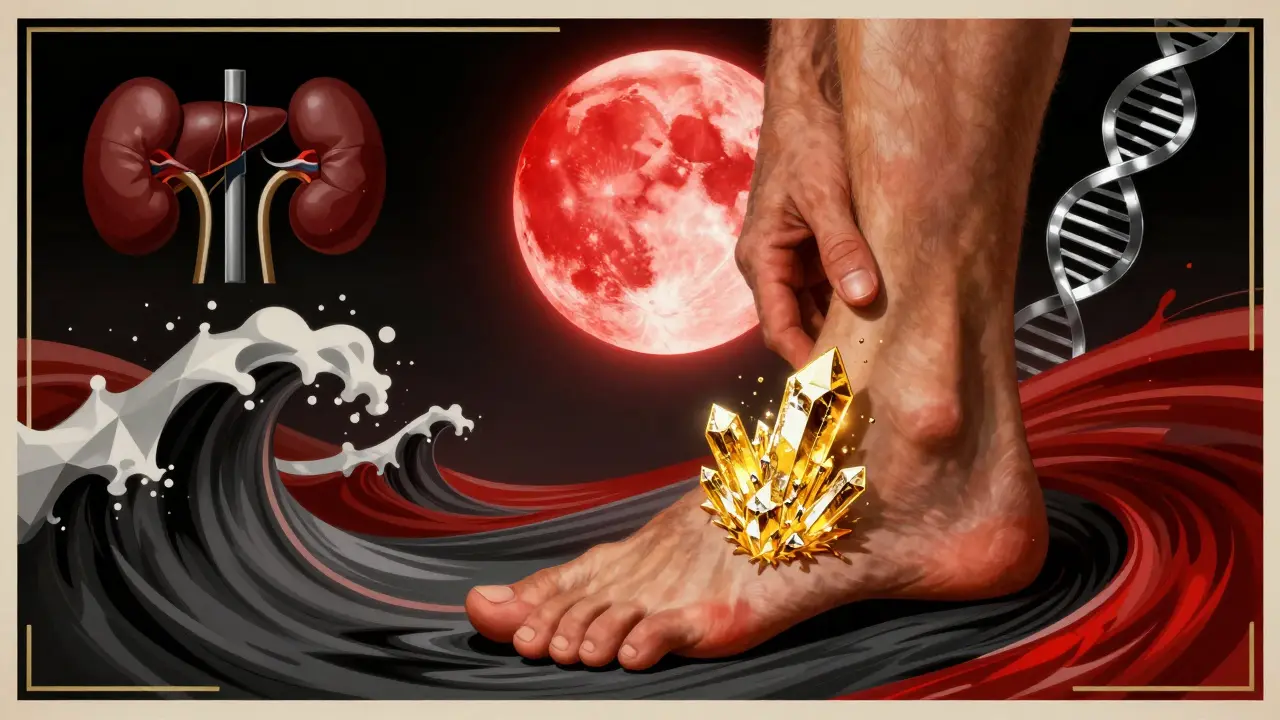
When your big toe suddenly feels like it’s been hit by a hammer-no injury, no fall, just intense pain that wakes you up at 3 a.m.-you might be dealing with gout. It’s not just "bad luck" or eating too much steak. Gout is a direct result of how your body breaks down purines, and if that system goes off track, uric acid builds up, forms sharp crystals in your joints, and triggers violent inflammation. This isn’t a rare condition. In the U.S. alone, over 8 million people live with it. And for most, it’s preventable-if you understand what’s really going on inside your body.
Why Your Body Makes Too Much Uric Acid
Purines aren’t bad. They’re natural parts of your DNA and RNA. Your body breaks them down every day. But here’s the twist: humans lost the enzyme that turns uric acid into something harmless millions of years ago. So uric acid is the final waste product. And if you make too much of it-or your kidneys can’t flush it out-it builds up. That’s hyperuricemia. The magic number? 6.8 mg/dL. That’s when uric acid starts crystallizing in your joints. At 9 mg/dL or higher? Your risk of gout jumps to nearly 28%.Most people think diet is the main culprit. But only about 10-20% of uric acid comes from food. The rest? Your own cells. When your body breaks down old or damaged cells, purines are released. If your liver is overproducing them, or your kidneys are reabsorbing too much (90% of filtered uric acid gets pulled back into the blood), you’re headed for trouble. And it’s not just about what you eat-it’s about how your genes and organs handle the process.
How Purine Metabolism Works (And Where It Breaks Down)
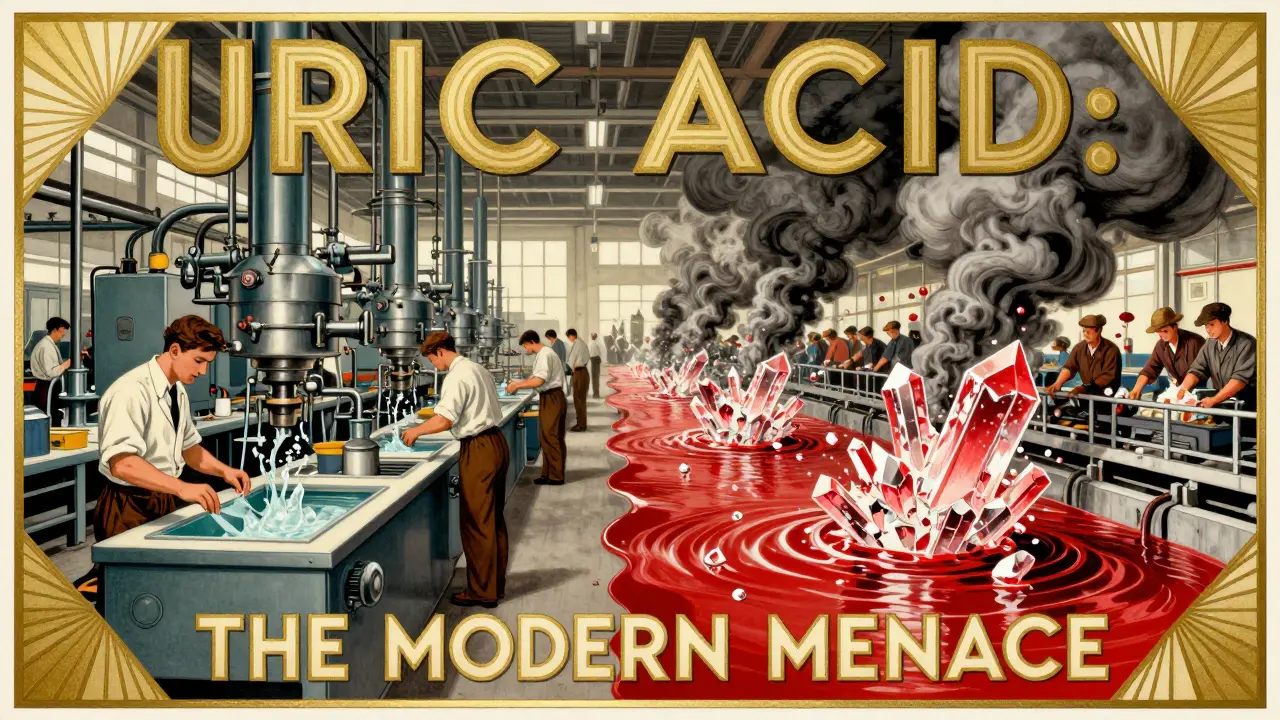
Think of purine metabolism like a factory assembly line. Nucleotides from your cells get broken down into nucleosides. Then, enzymes like purine nucleoside phosphorylase (PNP) and xanthine oxidase (XO) turn them into xanthine, and finally, into uric acid. The key enzyme here? Xanthine oxidase. It’s the last step before uric acid forms. If this enzyme is too active, you flood your system with uric acid.There’s also a genetic angle. Some people inherit mutations that make their bodies produce too many purines. The classic example is Lesch-Nyhan syndrome, caused by a missing enzyme called HPRT. But even without that rare disorder, variations in genes like SLC2A9 can make your kidneys reabsorb more uric acid than they should. That’s why two people eating the same diet can have wildly different uric acid levels.
And here’s the kicker: your kidneys are doing most of the work. They filter about 700 mg of uric acid daily. But they reabsorb 90% of it. That’s normal. But if you have kidney issues, high blood pressure, or diabetes-conditions that affect kidney function-that reabsorption gets even worse. That’s why gout is so common in people with metabolic syndrome.
Three Types of Urate-Lowering Medications-and How They Really Work
There are three main classes of drugs that lower uric acid. Each targets a different part of the problem.1. Xanthine Oxidase Inhibitors (XOIs): Stop Uric Acid at the Source
These are the first-line treatment for almost everyone. They block xanthine oxidase, the enzyme that makes uric acid. Two drugs dominate here: allopurinol and febuxostat.Allopurinol has been around since 1966. It’s cheap-generic versions cost less than $5 a month. It works well, but only if you take enough. Most people start at 100 mg a day. But studies show that 92% of patients reach their target uric acid level when the dose is pushed to 300 mg or higher. Yet, doctors often stop at 100 or 200 mg. That’s why so many people think it doesn’t work. It’s not the drug-it’s the dose.
Febuxostat came later, approved in 2009. It’s stronger. At 80 mg a day, it gets 67% of patients to target uric acid levels. But it comes with a warning. A major 2018 study found it increased the risk of death from heart problems compared to allopurinol. The FDA added a black box warning in 2019. So it’s not your first choice-if you have heart disease, avoid it.
2. Uricosurics: Help Your Kidneys Flush It Out
These drugs stop your kidneys from reabsorbing uric acid. Instead of pulling it back in, they let it go out in urine. The classic drug here is probenecid. It’s been used since 1949. But it only works if your kidneys are healthy. If your creatinine clearance is below 50 mL/min, it’s useless-and risky. You need good kidney function to use it.There’s also lesinurad. It was approved in 2015 and worked well when paired with allopurinol. But it was pulled off the market in 2019 because it caused serious kidney damage. New drugs like verinurad are now in Phase III trials. Early results show it lowers uric acid by 74% in 12 weeks when combined with febuxostat. It might be the next big thing.
3. Uricase Agents: Break Down Uric Acid Completely
This is the nuclear option. Pegloticase is a synthetic enzyme that turns uric acid into allantoin-a harmless, water-soluble compound your body easily flushes out. It’s used for severe, tophaceous gout when other drugs fail. In clinical trials, it dissolved tophi (those visible lumps of uric acid crystals under the skin) in 9 months. But it’s expensive-over $16,000 a month. And it causes infusion reactions in nearly a quarter of patients. You need premedication, monitoring, and insurance battles just to get it.There’s also arhalofenate, a new drug in development that both lowers uric acid and reduces inflammation. In a 2024 trial, it cut gout flares by 58% compared to placebo. That’s huge. It might be the first drug that treats both the cause and the symptoms at once.
Why Most People Stop Taking Their Medication
Here’s the ugly truth: 61% of people with gout stop taking their urate-lowering drugs within a year. Why?- 33% think it’s not working-even though their uric acid levels haven’t been checked.
- 29% quit because of side effects: rash from allopurinol, liver enzyme spikes from febuxostat.
- 18% say the dosing is too complicated.
And here’s the irony: the biggest risk of starting treatment isn’t the drug-it’s the flare. When you lower uric acid fast, crystals shift. That triggers inflammation. That’s why doctors recommend taking colchicine (0.6 mg daily) for at least 6 months when you start ULT. But most primary care doctors don’t know this. A 2024 study found only 29% follow this guideline. So patients get a new drug, get a flare, think it’s the medication, and quit.
What You Can Do (And What You Can’t)
Diet matters-but not as much as you think. Cutting out beer, shellfish, and liver helps. But it only drops uric acid by 1-2 mg/dL. That’s not enough to reach target if you’re at 9. You still need medication.What actually works:
- Get your serum uric acid tested regularly. Don’t assume your doctor is doing it.
- Ask for dose titration. If you’re on allopurinol and still having flares, ask if you can go higher-300 mg, then 400 mg.
- Take colchicine for at least 6 months when starting ULT. It prevents flares.
- Monitor kidney function. If your eGFR drops below 30, you may need to switch from allopurinol to febuxostat.
- Ask about genetic testing. If you’re of African or Pacific Islander descent, you might carry HLA-B*58:01, which increases your risk of severe reaction to allopurinol. Screening is now standard in Europe and recommended in the U.S.
The Big Picture: Why Gout Is Getting Worse
Gout isn’t going away. In fact, it’s growing. Since 1990, cases have jumped 47%. Why? Aging populations. Obesity. Diabetes. High blood pressure. All of these strain your kidneys and make uric acid harder to clear. In Asia-Pacific, 42% of global cases are now found. China alone has over 23 million people with gout.And the cost? The global market for gout drugs hit $2.87 billion in 2024. By 2030, it’ll be over $4 billion. But access is unequal. Allopurinol is dirt cheap. Pegloticase? Only accessible to those with top-tier insurance. That’s why so many patients give up. They can’t afford the treatment-even if it works.
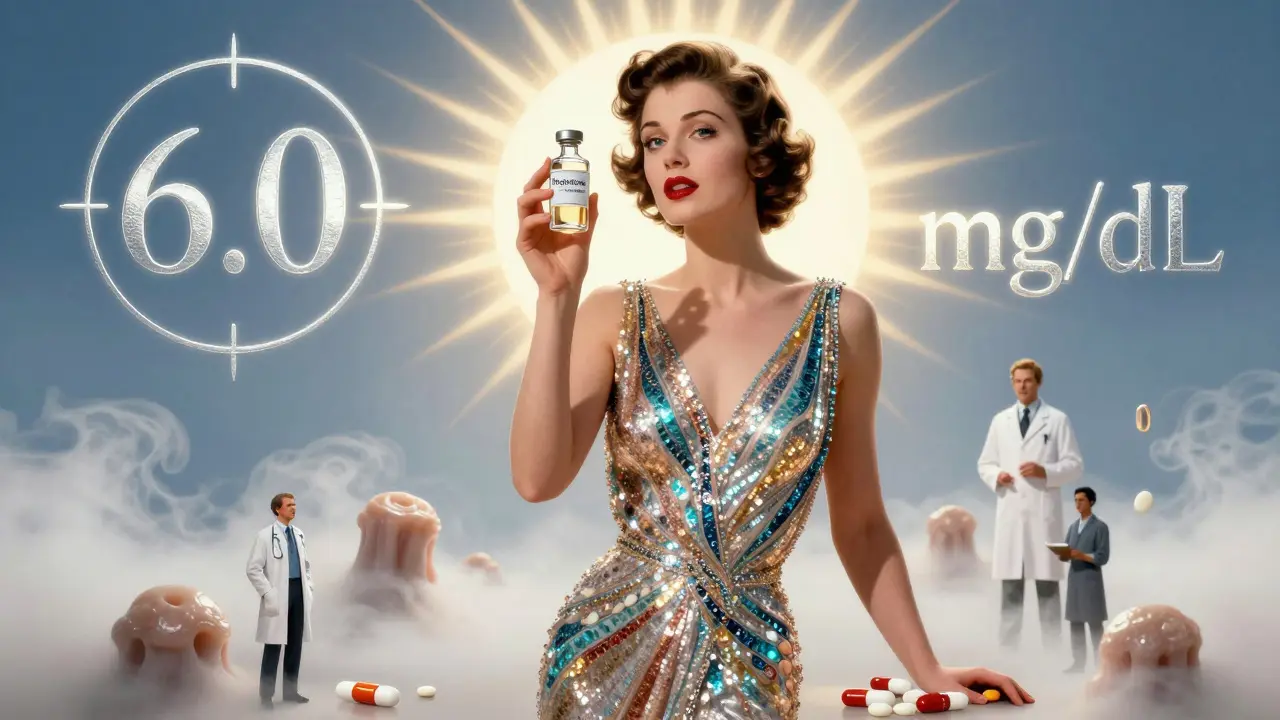
The future? Better drugs. Longer-acting uricase. Personalized medicine based on your genes. But right now, the best tool we have is simple: lower uric acid below 6.0 mg/dL. And keep it there. No flares. No tophi. No hospital visits. Just steady control. And that starts with knowing your numbers-not just your symptoms.
Can I manage gout with diet alone?
No. While cutting back on beer, shellfish, and organ meats helps, diet alone usually lowers uric acid by only 1-2 mg/dL. If your level is above 7 mg/dL, you’ll still need medication to reach the target of under 6.0 mg/dL. Diet is a support tool-not a cure.
Why does allopurinol sometimes make gout worse at first?
When you start lowering uric acid, crystals in your joints begin to dissolve. This stirs up inflammation, triggering flares. That’s why doctors recommend taking colchicine daily for at least 6 months when you begin treatment. It prevents these flares. Don’t stop your medication because you have a flare-you need it more than ever.
Is febuxostat safer than allopurinol?
No-not for everyone. Febuxostat is more effective at lowering uric acid, but it carries a higher risk of heart-related death, especially in people with existing heart disease. The FDA added a black box warning in 2019. Allopurinol remains the first choice unless you can’t tolerate it or have severe kidney disease.
How often should I get my uric acid level checked?
When starting treatment, check every 2-5 weeks until your level drops below 6.0 mg/dL. Once stable, check every 6 months. Most doctors don’t follow this, so you may need to ask for it. Your uric acid level is the only objective measure of whether your treatment is working.
What’s the difference between gout and pseudogout?
Gout is caused by uric acid crystals. Pseudogout is caused by calcium pyrophosphate crystals. They look similar-sudden joint pain, swelling-but they need different treatments. Pseudogout doesn’t respond to urate-lowering drugs. Diagnosis requires joint fluid analysis. If you have gout-like symptoms but your uric acid is normal, ask about pseudogout.
Can I stop taking my medication if I haven’t had a flare in a year?
No. Gout is a chronic metabolic condition, not just a series of flares. Stopping medication lets uric acid rise again. Crystals will reform. Flares will return-often worse. The goal is lifelong control. Even if you feel fine, keep taking your medicine and monitor your levels. You’re not cured-you’re managing.
Kenzie Goode
February 23, 2026 AT 14:30I’ve had gout for 5 years and honestly? I thought it was just from beer and steak. This post changed everything. I didn’t realize my body was making most of the uric acid. My doctor just said "cut out the shrimp" and called it a day. No wonder I kept flaring. Time to ask for a dose bump on allopurinol.
Dominic Punch
February 24, 2026 AT 07:22Let’s be real - most GPs treat gout like it’s a dietary glitch, not a metabolic disorder. Allopurinol at 100mg? That’s a placebo dose. I’m a pharmacist in London and I’ve seen 12 patients in the last month alone who quit because they got flares and no one told them about colchicine. The system is broken. You need to push for 300-400mg. And if your doc won’t listen? Go to a rheumatologist. Your toe deserves better.
Khaya Street
February 24, 2026 AT 19:31Interesting read. But let’s not ignore the elephant in the room: healthcare inequality. Allopurinol costs $5/month. Pegloticase costs $16k. If you’re Black or Latino in the U.S. and on Medicaid, you’re lucky to get the $5 drug. And even then, your doctor might not know how to titrate it. This isn’t science - it’s class warfare dressed up as medicine.
Christina VanOsdol
February 25, 2026 AT 01:50OMG YES!!! I’ve been screaming this for years!! 😤 Uric acid isn’t about diet, it’s about your kidneys REABSORBING 90% of it??? That’s wild. And febuxostat = heart attack risk?? 🤯 I’m on it and I’m scared now. Also, HLA-B*58:01 testing?? I’m African American - I need that test STAT. 🚨
Brooke Exley
February 25, 2026 AT 17:40You’re not alone. I used to think gout was just "old man pain." Then I got it at 34. I started reading everything. The colchicine tip? Life-changing. I had 4 flares in 3 months before starting it. Zero since. Don’t give up. Your body’s not broken - your treatment just wasn’t tuned right. You got this 💪
Matthew Brooker
February 26, 2026 AT 21:33Emily Wolff
February 27, 2026 AT 09:08Lou Suito
February 27, 2026 AT 23:13Jacob Carthy
February 28, 2026 AT 08:21Dinesh Dawn
February 28, 2026 AT 10:21Vanessa Drummond
March 1, 2026 AT 20:28Michael FItzpatrick
March 3, 2026 AT 09:45Brooke’s comment made me tear up a little. Seriously - this stuff is so isolating. I thought I was weak for getting gout at 31. Turns out, my genes and my kidneys are just bad at their jobs. I’m on 400mg allopurinol now, taking colchicine daily, and I haven’t had a flare in 11 months. It’s not magic. It’s science. And it works if you stick with it. You’re not failing. Your system just needs tuning.
Brandice Valentino
March 4, 2026 AT 07:08Larry Zerpa
March 6, 2026 AT 05:02Let’s dismantle this misinformation. You claim diet contributes 10-20%? That’s outdated. A 2023 meta-analysis in The Lancet showed dietary purines account for 30-40% in high-risk populations - especially in East Asia where seafood consumption is high. Also, your claim that allopurinol works at 300mg? Only if you’re not HLA-B*58:01 positive. In those cases, it’s lethal. You’re dangerously oversimplifying. This isn’t a Reddit post - it’s a public health document. Edit it.
tia novialiswati
March 7, 2026 AT 05:35Thank you for writing this. I’m a nurse and I’ve seen so many patients quit because they didn’t know about colchicine. I always tell them: "It’s not the medicine hurting you - it’s the crystals shifting." I wish more docs knew this. I’m sharing this with my whole unit. 💙