
When a pharmacist sees a brand-name prescription, they don’t just fill it. They ask: Can this be switched to a generic? It’s not just about saving money-it’s about making sure the patient gets the right medicine, safely and consistently. But getting a prescriber to agree isn’t always easy. It takes clear, evidence-based communication, and knowing exactly when to speak up.
When Generic Substitution Is Safe-and When It’s Not
Most generics are just as safe and effective as brand-name drugs. The FDA requires them to have the same active ingredient, strength, dosage form, and route of administration. But here’s the catch: they don’t have to match the inactive ingredients. That’s where problems can show up. For example, a patient with a known allergy to cornstarch or lactose might react to a generic version even if the active drug is identical. About 8.7% of substitution issues trace back to these inactive ingredients, according to the A-SMEDS guide from 2023. Pharmacists need to check the patient’s history before making any switch. Then there are narrow therapeutic index (NTI) drugs-medications where even tiny differences can cause harm. Warfarin, levothyroxine, phenytoin, and digoxin fall into this category. The FDA doesn’t automatically consider all generics for these drugs equivalent. Only 12 out of 1,456 product-specific guidances in the Orange Book address NTI drugs specifically. That means pharmacists must be extra cautious. If a patient has been stable on a brand, switching without consulting the prescriber could lead to dangerous fluctuations.The Orange Book: The Pharmacist’s Bible for Substitution
The FDA’s Orange Book is the official source for therapeutic equivalence ratings. It lists every approved drug and tells pharmacists which generics can be swapped. Ratings are simple: an “A” means therapeutically equivalent. A “B” means it’s not. In 2023, 92.7% of generics carried an “A” rating. Pharmacists don’t guess. They look it up. If a generic has an “A” rating, substitution is generally safe. But if it’s “B,” or if the prescriber wrote “dispense as written” (DAW), the pharmacist needs to pause. About 15.3% of prescriptions include DAW, and in 68% of those cases, the prescriber had a documented clinical reason-like a previous bad reaction or a complex dosing regimen. That’s why communication isn’t optional. It’s part of the job.How Pharmacists Talk to Prescribers-And Why It Works
A 2021 study in the Journal of the American Pharmacists Association showed something powerful: when pharmacists used a structured approach, prescribers accepted generic recommendations 82.4% of the time. Without structure? Only 57.3%. So what’s the structure? It’s simple:- Contact the prescriber within 24 hours of filling the prescription.
- Reference the exact Orange Book rating for the drug.
- Give the cost difference-like “This generic saves $42 per month.”
- Document everything in the patient’s record.

Why Some Prescribers Still Resist
Despite all the data, 37.6% of prescribers still worry about generics. That number jumps to 42.3% for inhalers and 38.9% for topical creams. Why? Because they’ve seen patients report changes-sometimes real, sometimes perceived. A 2023 Medscape survey found that 58.3% of doctors fear reduced efficacy. 47.6% worry about altered patient response. And 62.1% say they just don’t have time to review each request. Pharmacists can’t fix time constraints. But they can fix the message. Saying “generics are just as good” doesn’t convince. Showing data does. A 2021 study in the Journal of Managed Care & Specialty Pharmacy found that when pharmacists included specific bioequivalence numbers-like “This generic’s AUC ratio was 98.7% compared to the brand”-prescriber acceptance rose by 34.2 percentage points. That’s not magic. That’s science.What’s Changing in 2025 and Beyond
The Inflation Reduction Act, effective January 2025, expands pharmacists’ role in Medicare Part D. More patients will get access to medication therapy management (MTM) services-meaning pharmacists will be formally paid to review prescriptions, recommend generics, and follow up. And it’s not just policy. Technology is helping. AI tools like PharmAI’s Generic Substitution Assistant, now used by nearly 30% of chain pharmacies, analyze patient history, check formulary rules, and auto-generate prescriber messages. One 2023 study showed these tools improved recommendation accuracy from 76.4% to 94.2%. The FDA is also updating the Orange Book in 2024 to include real-world evidence-like how generics perform in actual clinics, not just labs. The CDC is launching a Generic Medication Safety Network in late 2024 to flag any safety signals faster.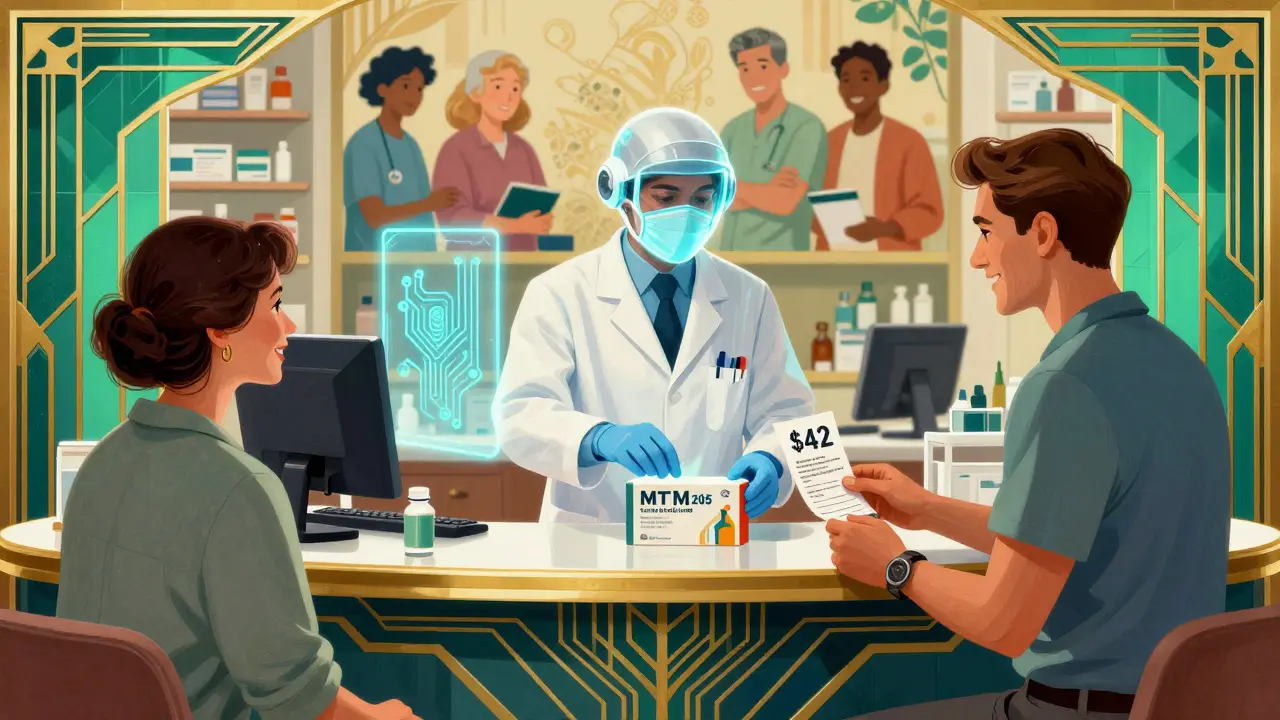
Documentation: It’s Not Just Paperwork
Every time a pharmacist recommends a generic, they must document it. Not because they’re being watched-but because it protects the patient. CMS requires specific details: date, time, method of contact (phone, secure message), prescriber name, the recommendation, and the outcome. Pharmacies using EHR-integrated systems hit 98.7% compliance. Those using paper? Only 76.4%. And the results? Pharmacies following full documentation standards saw 27.5% fewer medication errors and 18.3% higher patient satisfaction. That’s not a side effect. That’s the point.When You Shouldn’t Recommend a Generic
Even with all the data, there are times to hold back:- The patient has a documented allergy to an inactive ingredient.
- The drug has a narrow therapeutic index and the patient is stable on brand.
- The prescriber clearly wrote “DAW” with a clinical note.
- The patient has had a negative experience with a previous generic.
- The generic is new on the market and hasn’t been widely used in the clinic yet.
Shawn Raja
January 26, 2026 AT 21:59So let me get this straight - we’re paying $409 billion a year in savings because pharmacists are finally being treated like actual doctors, but some prescribers still think generics are ‘mystery meat’? 😂
Meanwhile, my grandma’s levothyroxine switch saved her $500 a year and she didn’t even notice. The only thing that changed? Her pharmacy receipt.
It’s not magic. It’s math. And science. And people who actually read the Orange Book instead of Googling ‘is generic safe’ at 2 AM.
Also, AI tools that auto-generate messages? Finally. My prescriber’s inbox used to look like a horror movie. Now it’s just a clean PDF with a coffee stain. Progress.
Let’s be real - if your patient’s reaction to a generic is ‘I feel different,’ ask them if they slept. Or if they drank coffee. Or if it’s Tuesday. We’ve all had ‘different’ days.
But hey, if you’re still using paper logs? Congrats. You’re basically a relic with a stethoscope.
Ryan W
January 27, 2026 AT 14:5192.7% A-rated generics? That’s statistically irrelevant if the FDA’s equivalence standards are built on bioequivalence in fasted healthy males - not real patients with comorbidities, polypharmacy, or renal impairment.
NTI drugs require pharmacokinetic equivalence within 80–125% AUC and Cmax. That’s a 45% window. That’s not ‘equivalent.’ That’s a gamble with a 1 in 20 chance of clinical drift.
And don’t get me started on the Inflation Reduction Act. You think Medicare’s gonna pay pharmacists to ‘manage’ meds? They’ll pay them to push generics. Same script, different label.
Documentation compliance at 98.7%? Sure. But how many of those entries are boilerplate? How many are just copy-pasted from the EHR template? You can’t automate clinical judgment.
Also, ‘dispense as written’ isn’t resistance. It’s liability management. If you don’t understand that, you’re not a pharmacist. You’re a sales rep with a white coat.
Allie Lehto
January 29, 2026 AT 00:17OMG I JUST REALIZED - we’re all just guinea pigs for Big Pharma’s generic switcheroo 😭
I switched to generic sertraline and I cried for 3 days straight. Not because I was sad - because I felt NOTHING. Like my soul was on mute.
And then I read that inactive ingredients can trigger allergies?? I’m allergic to corn. And guess what? My generic Zoloft had cornstarch. I almost died. (Okay, not really. But I felt like I did.)
Pharmacists are angels. But why don’t they TELL us this stuff? Why is it all hidden in the Orange Book like a secret society?
Also, why does my doctor always say ‘DAW’? Is he scared? Is he paid by the brand? 🤔
Also also - I think the FDA is lying. I swear my generic metformin tastes like wet cardboard now. #GenericTrauma
Neil Thorogood
January 30, 2026 AT 14:43THIS. IS. THE. BEST. POST. I’VE. READ. IN. YEARS. 🙌
Pharmacists are the unsung heroes of healthcare. While everyone’s yelling at doctors, pharmacists are quietly saving lives by checking one tiny inactive ingredient that could kill your grandma.
I had a friend on warfarin. Switched generics. INR went from 2.8 to 4.9 in 48 hours. He almost bled out. Turns out - the generic had a different binder. Not the active drug. The filler. The FILLER.
So yeah - if your prescriber says ‘DAW,’ they’re not being stubborn. They’re being smart.
And AI tools that auto-generate messages? YES. Let machines do the paperwork. Let humans do the thinking.
Also - I just sent my pharmacist a gift card. She saved me $300/month. She deserves a vacation.
Thank you for writing this. I’m sharing it with my entire family. 💪❤️
rasna saha
January 31, 2026 AT 20:44As someone from India, I’ve always used generics. They’re not just cheaper - they’re the only option for most people.
But here’s what I’ve learned: consistency matters more than brand. If your body is used to one version, stick with it.
My dad’s hypertension med? We switched generics three times. Each time, his BP spiked. We went back to the original. No drama. No panic.
Pharmacists here don’t have fancy EHRs. They write notes by hand. But they know every patient’s history. That’s the real tech.
Also - no one here complains about ‘different taste.’ We just take it. Because we’re used to making do.
Maybe we’re not perfect. But we’re practical.
Skye Kooyman
February 1, 2026 AT 07:37So generics work unless they don’t
NTI drugs are tricky
Doctors are busy
Pharmacists are the ones reading the fine print
AI helps
Documentation saves lives
And sometimes the filler is the problem
That’s it
Kipper Pickens
February 1, 2026 AT 20:44The Orange Book’s A-rating system is a regulatory fiction. Bioequivalence thresholds were set in the 1980s based on limited datasets. We now know that CYP450 polymorphisms, gut microbiome variation, and even circadian rhythms can alter generic performance.
And yet, the FDA still treats ‘A’ as binary. It’s not. It’s a spectrum.
Pharmacists are doing their best with flawed tools. But the system is broken. We’re patching a dam with duct tape and hoping the water doesn’t rise.
Also - 30% of chain pharmacies using AI? That’s not innovation. That’s automation replacing clinical nuance.
And don’t get me started on the CDC’s ‘Safety Network.’ It’s reactive, not predictive. By the time it flags something, someone’s already in the ER.
Joanna Domżalska
February 2, 2026 AT 05:41Let’s be honest - this whole post is corporate propaganda dressed up as public health.
Generics save money? Sure. But who benefits? Insurance companies. Pharmacy benefit managers. Big Pharma’s generic subsidiaries.
Patients? They get the same drug with different fillers. Sometimes it works. Sometimes it doesn’t. Sometimes they get a rash. Sometimes they feel ‘off.’
And now we’re supposed to trust AI tools that auto-generate messages? That’s not safety. That’s dehumanization.
Also - ‘dispense as written’ isn’t resistance. It’s common sense.
Stop pretending pharmacists are saints. They’re just doing their job under a broken system.
And yes - I’ve seen people get worse on generics. And yes - doctors are right to be cautious.
Not everything is a spreadsheet.
Josh josh
February 2, 2026 AT 19:21bro the orange book is literally just a pdf that no one reads
i work at a pharmacy and we just click the box that says 'generic ok' and move on
most docs dont even know what daw means
and the ai tool? its just spamming the same message to every prescriber
we dont care about bioequivalence ratios
we care about getting the prescription out before the next customer yells at us
also i hate cornstarch too but i dont have time to check every pill
we're all just winging it
bella nash
February 3, 2026 AT 07:04It is imperative to underscore the regulatory and ethical imperatives governing therapeutic substitution, particularly in the context of narrow therapeutic index pharmaceuticals. The FDA’s Orange Book, while an authoritative compendium, does not encapsulate the totality of clinical variability inherent in patient populations. Furthermore, the documented increase in documentation compliance, while statistically significant, does not necessarily correlate with improved clinical outcomes in the absence of individualized patient assessment. The proliferation of algorithmic decision-support tools, while ostensibly enhancing efficiency, may inadvertently erode the professional autonomy of the prescribing clinician and diminish the nuanced, context-sensitive nature of therapeutic decision-making. One must therefore exercise extreme caution in conflating administrative metrics with clinical efficacy.
Sally Dalton
February 4, 2026 AT 23:05Y’all are overthinking this.
I’m a pharmacist. I’ve been doing this for 18 years.
Most people don’t care if it’s brand or generic. They just want it to work. And it does.
But I always check for allergies. Always. Even if the patient says ‘I’m fine.’ I’ve seen too many people react to dyes or lactose.
And yeah - I call the doctor. I don’t wait. I don’t email. I call.
And I tell them: ‘This saves $42/month. Patient’s stable. No history of issues. Just want to make sure you’re cool with it.’
They say yes 9 times out of 10.
And when they say no? I don’t argue. I just write it down.
It’s not rocket science. It’s just kindness + attention.
Also - I cried when my grandma’s levothyroxine switch worked. She said, ‘I feel like myself again.’ That’s why I do this.
Betty Bomber
February 6, 2026 AT 06:20my pharmacy just started using that AI tool
it sends the same message to every doctor
one replied: 'who the hell is this?'
we laughed
then we realized…
he didn’t know we’d even switched his patient’s med
we just… did it
and he didn’t notice
is that good? or scary?
Mohammed Rizvi
February 8, 2026 AT 05:18India’s generics are the OG version of this. No AI. No EHR. Just a guy behind the counter who knows your mom’s name, your kid’s asthma, and that you hate the blue pills.
Generics here? Sometimes they’re made in the same factory as the brand. Sometimes they’re not. But you know what? We don’t panic.
We just switch back if it feels wrong.
And yeah - the pharmacist remembers. Not because of a database. Because they care.
Here’s the truth: in rich countries, we turn medicine into a spreadsheet.
In poor countries? We turn it into a relationship.
Maybe we’re missing the tech.
But we got the heart.
Napoleon Huere
February 8, 2026 AT 09:49What if the real issue isn’t generics - it’s that we’ve outsourced care to systems?
Pharmacists used to be the last human touch in a patient’s journey. Now they’re data-entry clerks with a license.
The Orange Book? A relic. The AI? A band-aid. The documentation? A compliance cage.
And yet - when a pharmacist calls a doctor and says, ‘I’ve seen this patient for three years. He’s stable. This switch is safe,’ something happens.
That’s not protocol.
That’s trust.
And no algorithm can replicate that.
Maybe the real innovation isn’t in the tech.
It’s in remembering that medicine is still a human act.