
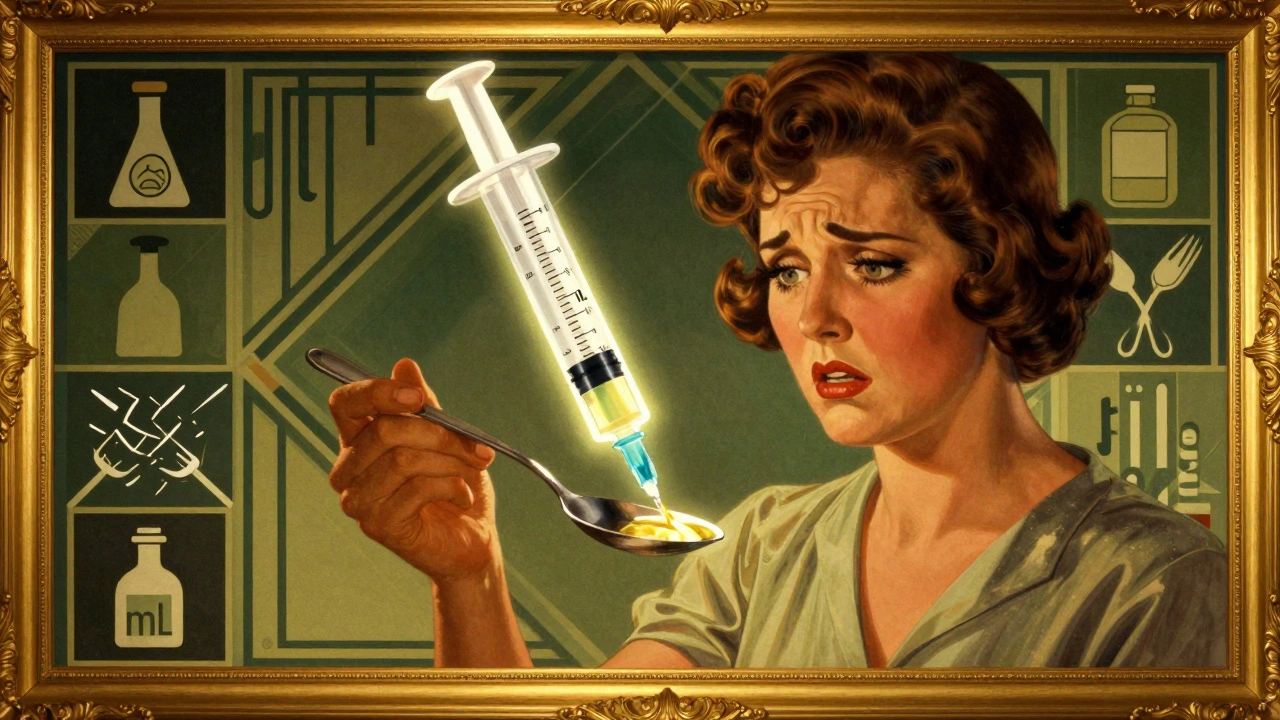
Getting the right amount of liquid medicine isn’t just about following the label-it’s about avoiding real, dangerous mistakes. Every year, thousands of children and adults receive too much or too little medication because the wrong tool was used to measure it. A teaspoon from the kitchen isn’t the same as a teaspoon on a prescription. And that small difference can mean the difference between healing and harm.
Why Household Spoons Are Dangerous
Many people reach for a kitchen spoon when they need to give a child liquid medicine. It’s easy. It’s familiar. But it’s also wrong. A standard teaspoon holds anywhere from 3 to 7 milliliters, depending on how full it is. The same goes for tablespoons. That’s why the FDA, the American Academy of Pediatrics, and the Institute for Safe Medication Practices all agree: never use household spoons for medication. A 2020 ISMP report found that household spoons are responsible for about 40% of all liquid medication errors in children. In one study, parents using spoons made errors of up to 50% more or less than the prescribed dose. That’s not a typo. Half a dose can make a drug useless. Twice the dose can cause poisoning. The problem isn’t carelessness-it’s confusion. Labels still sometimes say “give one teaspoon,” even though the device included with the medicine is marked in milliliters. That mismatch is intentional in some cases, but it’s dangerous in practice. When the label says “teaspoon” and the bottle comes with a cup marked in mL, caregivers don’t know which one to trust.The Only Safe Unit: Milliliters (mL)
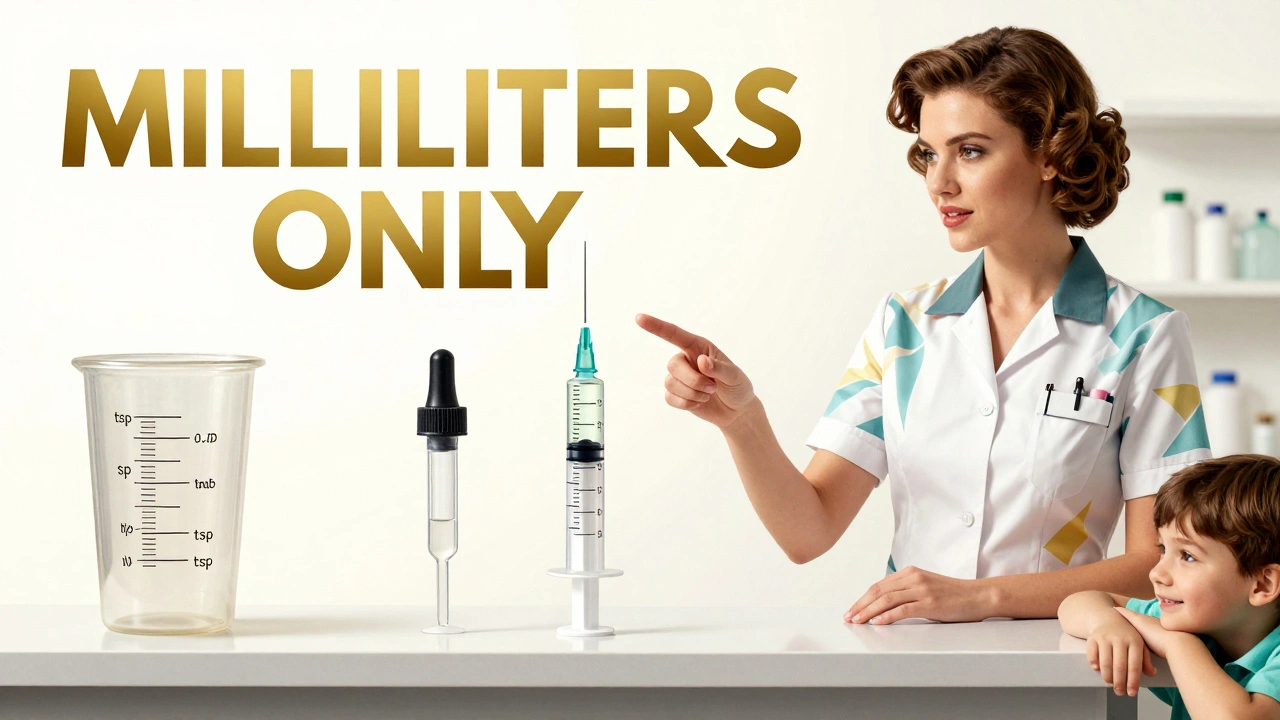
The only unit that should appear on a liquid medication label is milliliter (mL). No teaspoons. No tablespoons. No drops unless it’s a specific dropper designed for that exact medicine. Since 2011, the FDA has required that all over-the-counter liquid medications include a dosing device. In 2022, they updated their guidance to make it crystal clear: labels must use mL only. This isn’t a suggestion-it’s a rule. And it’s backed by hard data. A 2014 JAMA Pediatrics study found that parents who used labels and devices marked only in milliliters made 42% fewer dosing errors than those who saw teaspoon or tablespoon instructions. Why? Because mL is precise. It doesn’t change based on how you hold the spoon. It doesn’t vary by country or brand. One mL is always one mL. The same rule applies to the dosing device. If the label says “5 mL,” the device must have a clear mark for 5 mL. No extra lines. No confusing scales. Just what’s needed.Best Dosing Devices: Oral Syringes Win
Not all dosing tools are created equal. There are four main types: cups, spoons, droppers, and oral syringes. Here’s how they stack up:- Oral syringes: Most accurate. Error rate under 5% for doses under 5 mL. Can measure as precisely as 0.1 mL. Ideal for infants, toddlers, and any dose under 10 mL.
- Dosing cups: Common, but inaccurate. Error rates hit 43% for 5 mL doses. Hard to read because of parallax-when you look at the liquid from an angle, the level looks wrong. Also, many cups are too big, with too many lines, making it harder to find the right mark.
- Dosing spoons: Slightly better than cups, but still unreliable. Volume changes depending on how you fill it. Not recommended.
- Droppers: Good for very small doses (under 2 mL), but not for larger amounts. Hard to control flow, and they leak.
How to Use an Oral Syringe Correctly
Using an oral syringe isn’t complicated, but it’s easy to mess up if you’re not shown how. Here’s the right way:- Shake the bottle well before drawing up the medicine.
- Remove the cap and insert the syringe tip into the bottle. Don’t let it touch the outside.
- Turn the bottle upside down and slowly pull the plunger back until the liquid reaches the correct mark.
- Tap the side of the syringe gently to bring any air bubbles to the top, then push the plunger slightly to remove them.
- Hold the syringe at eye level and check the mark again. Make sure the top of the liquid is level with the line.
- Place the tip inside the cheek, not the back of the throat, and slowly push the plunger.
What to Look for in a Dosing Device
Not every syringe or cup is made the same. Here’s what to check before accepting a dosing tool:- Units: Must say “mL” only. No tsp, tbsp, or fl oz.
- Markings: Only include the doses listed on the label. If the prescription is for 1.5 mL, the device should have a mark for 1.5 mL-not just 1 mL and 2 mL.
- Increments: For doses under 5 mL, the device should have 0.1 mL or 0.2 mL increments. For adult doses over 10 mL, 1 mL increments are fine.
- Size: The device shouldn’t hold more than 2-3 times the largest dose. A 30 mL cup for a 5 mL dose is overkill and invites mistakes.
- Leading zeros: Always write “0.5 mL,” never “.5 mL.” A missing zero can lead to a 10x overdose.
- No trailing zeros: Write “5 mL,” not “5.0 mL.” Extra zeros confuse people into thinking they need to be exact to the tenth.
What Pharmacies Should Do
Pharmacists are the last line of defense. Too often, they hand out a cup with a prescription that says “give 2.5 mL.” That’s not enough. They need to hand out the right tool. The American Pharmacists Association recommends giving an oral syringe for every liquid prescription under 10 mL. In a 2020 trial, this simple change reduced dosing errors by 28%. But many pharmacies still default to cups because they’re cheaper and easier to stock. That’s changing. CVS and Walgreens now offer QR codes on prescription labels that link to short videos showing how to use the syringe. Kaiser Permanente started doing this in 2020. The result? Fewer calls to the pharmacy asking “How much is this?” and fewer hospital visits. If you’re given a cup and the dose is under 5 mL, ask for a syringe. Most pharmacies have them in stock. If they don’t, they can order one. It’s your right to get the safest tool.
What to Do If You’ve Made a Mistake
If you’ve ever given the wrong dose-whether too much or too little-don’t panic. But do act.- If you gave too much: Call Poison Control at 1-800-222-1222 (in the U.S.) or your local emergency number. Have the medicine bottle ready.
- If you gave too little: Don’t double the next dose. Just give the correct amount at the next scheduled time.
- Always write down what happened: When, how much, and what device you used. This helps your doctor or pharmacist adjust the plan.
What’s Changing for the Better
The good news? Things are improving. Since 2015, 34 U.S. states have passed laws requiring metric-only labeling on liquid medications. The FDA now requires all new liquid drug approvals to include metric-only labels and proper devices by January 2025. The European Medicines Agency has similar rules in draft form. Technology is helping too. Bluetooth-enabled syringes now connect to smartphone apps that verify the dose before it’s given. Some pharmacies are embedding QR codes on labels that play a 60-second video showing exactly how to use the device. The CDC reports a 37% drop in pediatric liquid medication errors between 2015 and 2022. That’s 12.4 errors per 100,000 visits down to 7.8. That’s progress. But challenges remain. Only 12 states check pharmacies for compliance. Nearly 30% of liquid medications still use teaspoon labeling. And low-income families are 63% more likely to get a low-quality, inaccurate dosing device.Your Action Plan
Here’s what you can do right now to ensure accurate dosing:- Always ask for an oral syringe for doses under 10 mL.
- Throw away any dosing cup that has markings for teaspoons or tablespoons.
- Check the label: Does it say “mL” only? If not, ask the pharmacist to correct it.
- Practice with water before giving medicine.
- Use the “teach-back” method: Ask the pharmacist to show you how to use the device, then do it yourself in front of them.
- Take a photo of the label and the device before leaving the pharmacy. Compare them at home.
- If you’re unsure, call the pharmacy or your doctor before giving the dose.
Can I use a kitchen spoon to give liquid medicine?
No. Kitchen spoons are not calibrated and vary in size. A teaspoon can hold between 3 and 7 milliliters, which can lead to underdosing or overdosing. Always use a dosing device marked in milliliters (mL).
Why are oral syringes better than dosing cups?
Oral syringes are more accurate because they eliminate parallax error and allow precise measurements down to 0.1 mL. Studies show only 4% error with syringes for small doses, compared to 43% with cups. Syringes also prevent spills and allow direct delivery into the mouth.
What should I do if the label says “teaspoon” but the device is in mL?
Call the pharmacy or prescriber immediately. This mismatch is a safety risk. The label should be corrected to use mL only. Do not guess the conversion-1 teaspoon is not always exactly 5 mL.
Is it safe to use a dropper that came with the medicine?
Only if it’s specifically designed for that medicine and marked in mL. Many droppers are inaccurate for doses over 2 mL and can leak. For doses under 5 mL, an oral syringe is still the safer choice.
How do I know if my dosing device is accurate enough?
It should be marked only in mL, with increments matching the prescribed dose (e.g., 0.1 mL for infant doses). The device should not hold more than 2-3 times the largest dose. Oral syringes are the only devices consistently proven to meet the USP standard of ±10% accuracy.
If you’re giving liquid medicine to a child, elderly person, or someone with limited mobility, the right tool isn’t a convenience-it’s a necessity. Don’t rely on guesswork. Don’t settle for what’s handed to you. Ask for the syringe. Check the label. Practice first. Accuracy saves lives.
Eddy Kimani
December 1, 2025 AT 22:17Let’s cut to the chase: the metric-only labeling mandate is long overdue. The FDA’s 2022 guidance finally closes the loophole where ‘teaspoon’ was used as a lazy proxy for 5 mL-except it’s never actually 5 mL. Household spoons are chaotic systems with variance up to 133% in volume. When you combine that with caregiver stress, sleep deprivation, and ambiguous labeling, you’re not just risking underdosing-you’re engineering iatrogenic harm. The oral syringe isn’t a ‘nice-to-have’-it’s the only device that meets USP Class A tolerance thresholds for precision dosing. Anything else is negligence dressed as convenience.
Carolyn Woodard
December 3, 2025 AT 10:49I’ve seen parents try to use the cap from the bottle because ‘it’s the only thing we had.’ It’s heartbreaking. The real tragedy isn’t the lack of syringes-it’s that we’ve normalized this risk. We tell people to ‘be careful,’ but we don’t give them the tools to be careful. The 42% reduction in errors with mL-only labels? That’s not a statistic-it’s the difference between a child sleeping through the night and ending up in the ER. Why are we still debating this? It’s not about education. It’s about equity. If you’re poor, you get the cup. If you’re privileged, you get the syringe. That’s the system.
Allan maniero
December 4, 2025 AT 18:09Man, I remember when my niece got her first antibiotic and the pharmacist just handed her mom a plastic cup with ‘1 tsp’ on it. No syringe. No explanation. Just a shrug. I sat there for 20 minutes watching her try to pour it without spilling, and I just thought-this is how accidents happen. It’s not that people are dumb. It’s that the system is designed to fail them. The fact that CVS and Walgreens now have QR codes linking to demo videos? That’s genius. Simple, low-cost, scalable. Why aren’t all pharmacies doing this? It’s not rocket science. It’s basic human decency wrapped in a QR code.
Zoe Bray
December 6, 2025 AT 10:01It is imperative to underscore that the utilization of oral syringes constitutes the current standard of care for the administration of liquid pharmaceuticals, particularly in pediatric and geriatric populations. The American Society of Health-System Pharmacists (ASHP) has explicitly endorsed the exclusive use of metric-based dosing devices with graduated markings calibrated to the prescribed volume. Furthermore, the presence of leading zeros (e.g., 0.5 mL) and the absence of trailing zeros (e.g., 5 mL, not 5.0 mL) are non-negotiable elements of pharmacovigilance protocol. Deviations from these standards constitute a breach of the National Coordinating Council for Medication Error Reporting and Prevention (NCC MERP) guidelines. Pharmacies must be held accountable for noncompliance.
Girish Padia
December 6, 2025 AT 21:00People are just lazy. Stop blaming the system. If you can’t read a measuring cup, maybe you shouldn’t be giving medicine. My cousin used a spoon and her kid got sick-yeah, it’s bad, but she didn’t even bother to ask the pharmacist. What do you expect? You give someone a syringe and they still use the spoon. It’s not the tool, it’s the person.
Saket Modi
December 8, 2025 AT 05:52lol why is this even a thing? just use a spoon bro. i’ve been giving my kid meds for 5 years with a kitchen tsp and he’s fine. stop overthinking it. 😅
Chris Wallace
December 8, 2025 AT 17:12I’m not a parent, but I work in a clinic and I’ve seen this play out too many times. The cup isn’t just inaccurate-it’s psychologically misleading. People look at a 30 mL cup with 10 lines and assume ‘close enough’ for 2.5 mL. But when you hand them a 5 mL syringe, suddenly they’re hyper-focused. It’s not about the tool-it’s about the cognitive load. The syringe forces attention. The cup invites distraction. And in medicine, distraction kills. I’ve watched parents switch from cups to syringes and suddenly they’re asking better questions, double-checking labels, even taking photos. The tool changes the behavior. That’s the real win.
william tao
December 10, 2025 AT 13:46Let me be blunt: if your pharmacy is still handing out dosing cups for pediatric prescriptions, they’re not just incompetent-they’re negligent. The FDA guidance is clear, the JAMA Pediatrics data is irrefutable, and the USP standard is non-negotiable. This isn’t a ‘recommendation.’ It’s a legal and ethical obligation. The fact that this is even a debate in 2025 is an indictment of the entire healthcare supply chain. Stop pretending it’s about cost. It’s about liability. And if you’re still using teaspoons, you’re one missed zero away from a malpractice lawsuit.