
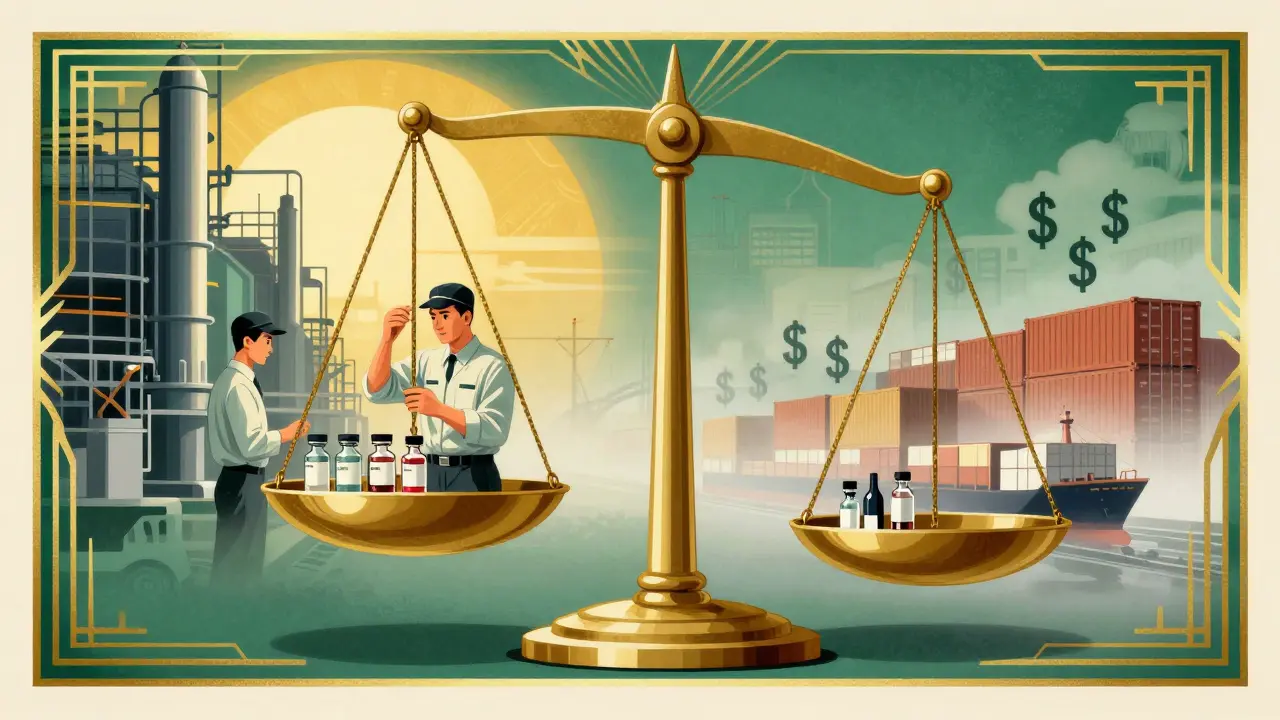
When you're making generic products-whether it's medication, medical devices, or health supplements-the choice between making them overseas or right at home isn't just about price. It's about control, speed, risk, and long-term reliability. Many businesses assume overseas is always cheaper, but that’s only part of the story. The real question is: which option actually delivers what your business needs-not just today, but next year, and the year after.
Cost Isn't Just the Price Tag
It’s true: producing overseas often looks cheaper on paper. Vietnamese and Thai factories operate at about one-tenth the labor cost of U.S. facilities. A product that costs $8.75 per unit domestically might only run $2.10 overseas. But here’s what no one tells you upfront: those savings vanish fast when you add in the hidden costs.Shipping delays? That’s $187,000 in lost holiday sales, like the fashion startup that waited eight weeks for a shipment. Third-party quality inspections? Those cost $300-$500 per batch. Customs paperwork? It adds 15-20 hours of admin work per shipment. And don’t forget tariffs: Section 301 duties on Chinese goods can hike prices by 7.5% to 25%. When you tally it all up, the cost gap shrinks to just 12-15% for many products, according to MIT’s 2024 supply chain analysis.
Domestic manufacturing, on the other hand, adds $300 to $3,000 per unit-but you get something priceless: predictability. No surprise delays. No customs surprises. No language barriers slowing down a simple design change. For health products where timing matters-think emergency supplies or seasonal demand-those delays can mean lost trust, lost sales, or worse.
Time Is Your Most Valuable Asset
Overseas production typically takes 3 months from order to delivery. That’s 45-60 days to make the product, plus 30-45 days for shipping and customs. Domestic? 45-60 days total. No extra leg. No waiting on a container to clear port.This isn’t just about convenience. In healthcare, speed saves lives. A generic drug manufacturer that needs to ramp up production after a sudden shortage can’t afford to wait 90 days. Domestic factories can turn around a 500-unit batch in under two weeks. That’s why 83% of promotional health product companies rely on domestic production for orders under 30 days.
And when you need to tweak a design? A small change in packaging, labeling, or dosage instructions? Domestic manufacturers can adjust in 3-5 days. Overseas? You’re looking at 14-21 days just to get approval, retool, and retest. That’s two full weeks where your product is stuck in limbo.
Quality Control Isn’t a Luxury-It’s a Requirement
You can’t inspect quality from 8,000 miles away. Third-party inspectors in China or Vietnam are better than nothing-but they’re not your team. They don’t know your standards. They don’t care about your brand reputation. And they’re paid by the factory you’re trying to audit.One Reddit user, FactoryOwner87, lost $48,000 when a single overseas order had a 37% defect rate. The inspector approved it. The customer rejected it. No recourse. No easy fix.
Domestic production gives you direct oversight. You walk the floor. You see how the machines are maintained. You talk to the operators. You catch a problem before it becomes a recall. Trustpilot data shows domestic manufacturers average 4.3/5 stars, with 87% of reviews praising quality and responsiveness. Overseas? Just 3.8/5, with 68% of complaints about communication.
For generic health products-where a 1% error rate can mean real harm-this isn’t optional. It’s a legal and ethical obligation.

Intellectual Property and Regulatory Risk
If you’ve developed a unique formula, packaging design, or delivery method, overseas manufacturing increases your risk of replication. Studies show product cloning is 37% more likely in Asian manufacturing hubs where enforcement of IP laws is weaker. Once your design is copied, you’re fighting a losing battle-especially if the copycat is in a country with no trade agreements with your market.Domestic production keeps your IP under U.S. law. You have legal recourse. You can sue. You can stop production. You can protect your market.
And let’s not forget regulatory compliance. FDA, FCC, or CE certifications? Overseas factories often claim they’re compliant-but you’re the one who gets fined if they’re not. You’ll need commercial invoices, certificates of origin, and sometimes even lab test reports. That’s 15-20 extra hours of work per shipment. Domestic? Just a purchase order. No paperwork maze.
What About Sustainability?
Shipping a product from Shanghai to New York emits 62% more CO2 than making it in Ohio and shipping it 200 miles. That matters. 68% of consumers say they’ll pay 5-12% more for locally made health products, according to NielsenIQ’s 2024 survey.Some overseas hubs, like Vietnam, have adopted ISO 14001-certified factories, narrowing the gap. But even then, the carbon footprint from air freight, ocean shipping, and customs handling can’t be ignored. If your brand stands for clean, responsible health solutions, where you make your product matters.

The Hybrid Model Is the New Standard
The smartest companies aren’t choosing one or the other. They’re doing both.Take the hybrid approach: make your core, high-risk, high-value components domestically-things like active pharmaceutical ingredients, safety-critical packaging, or devices with tight tolerances. Outsource the low-risk, high-volume parts-like boxes, labels, or non-critical accessories-to overseas factories.
This strategy is now used by 44% of mid-sized manufacturers, according to the Strategic Advisor Board. It gives you control where it counts and savings where it doesn’t. It’s not about going all-in on one side. It’s about building a resilient, balanced supply chain.
What’s Changing Right Now
The landscape is shifting fast. The CHIPS Act and Inflation Reduction Act are pouring billions into U.S. manufacturing. Mexico is becoming a top nearshore alternative-costing just 12-15% of U.S. rates but delivering in 7-10 days. The “China Plus One” strategy is real: 57% of Fortune 500 companies now split production across multiple countries to avoid overdependence.And climate risk? Coastal factories in Southeast Asia now carry 23% higher risk scores due to flooding, according to McKinsey’s 2025 model. That’s not theoretical. It’s financial. Insurance premiums are rising. Delays are increasing. Your supply chain isn’t just a cost center anymore-it’s a climate exposure.
The future isn’t domestic or overseas. It’s smart. It’s knowing where to hold the line and where to cut costs. It’s building flexibility into your production plan so you’re not blindsided by a port strike, a tariff hike, or a quality failure.
Final Checklist: Ask These Questions Before You Decide
- How quickly do I need this product in market? (If under 60 days, domestic wins.)
- What’s the cost of a single defect? (If it’s safety-related, go domestic.)
- Do I own IP? (If yes, domestic protects it better.)
- Can I handle 120+ hours of import paperwork? (If not, domestic is easier.)
- Am I producing under 1,000 units? (Domestic MOQs start at 100-500; overseas usually require 1,000-5,000.)
- Is my customer base willing to pay more for locally made? (If yes, domestic adds brand value.)
There’s no perfect answer. But there’s a right answer-for your business, your product, and your customers.
Is overseas manufacturing always cheaper than domestic?
No. While labor costs overseas are significantly lower, hidden expenses like shipping, tariffs, customs delays, third-party inspections, and quality failures often erase the savings. For many health products, the real cost difference is now only 12-15% after accounting for all factors, according to MIT’s 2024 supply chain analysis.
How long does it take to produce goods domestically vs. overseas?
Domestic manufacturing typically takes 45-60 days total from order to delivery. Overseas production averages 90 days: 45-60 days to manufacture, plus 30-45 days for shipping and customs clearance. For time-sensitive health products, that difference can mean the difference between meeting demand and losing customers.
Can I trust third-party quality inspectors for overseas production?
They help, but they’re not a substitute for direct oversight. Third-party inspectors are hired and paid by the factory, creating a conflict of interest. One manufacturer lost $48,000 when an inspector approved a batch with a 37% defect rate. Domestic production allows you to see the process firsthand, reducing risk dramatically.
What’s the minimum order quantity for overseas vs. domestic manufacturing?
Domestic manufacturers typically accept orders as small as 100-500 units, making them ideal for startups or testing new products. Overseas factories usually require 1,000-5,000 units minimum, which can tie up capital and increase inventory risk for small businesses.
Is nearshoring to Mexico a good alternative to China?
Yes, especially for U.S.-based businesses. Mexican manufacturing costs about 12-15% of U.S. rates but delivers in 7-10 days, compared to 28-42 days from Asia. It’s becoming a top choice for companies that want cost savings without the long lead times or geopolitical risks of Asian production.
Should I make all my products domestically or overseas?
Most successful companies use a hybrid model: produce critical, high-risk, or time-sensitive components domestically, and outsource low-risk, high-volume parts overseas. This balances cost, control, and speed. About 44% of mid-sized manufacturers now use this approach, according to the Strategic Advisor Board.
Meenal Khurana
February 4, 2026 AT 14:58Domestic isn't always pricier-just more transparent. I’ve seen overseas ‘savings’ turn into nightmares with defective batches and no recourse. Stick to local for anything health-related. Simple.
Joy Johnston
February 5, 2026 AT 16:56Thank you for laying this out so clearly. The hidden costs section alone should be mandatory reading for every procurement manager. I’ve worked with both domestic and overseas suppliers, and the administrative burden of overseas-customs forms, language barriers, time zone delays-isn’t just a nuisance, it’s a liability. When your product is a life-saving generic, predictability isn’t a luxury-it’s the baseline. Domestic manufacturing may cost more on paper, but the ROI in trust, speed, and compliance is undeniable.
Shelby Price
February 6, 2026 AT 11:29Interesting take. I’ve got a friend who runs a small supplement brand and they switched to Mexico last year-costs dropped 20%, lead times cut in half, and no quality issues yet. 🤔 Maybe the ‘overseas = risky’ narrative is outdated?
Keith Harris
February 8, 2026 AT 05:52Oh please. You’re selling FUD like it’s gospel. Domestic manufacturing is a bloated, unionized relic. You think your ‘direct oversight’ means anything when your factory owner’s cousin runs the QC department? Meanwhile, Vietnam’s FDA-equivalent just upgraded their certification standards to match the U.S. And guess what? Their defect rates are lower than your mom’s home bakery. Stop romanticizing ‘Made in America’ like it’s a moral victory. It’s just expensive nationalism with extra steps.
Mandy Vodak-Marotta
February 9, 2026 AT 14:56Okay so I’ve been in this game for 12 years, and I’ve seen every flavor of this debate. I started with offshore because it was ‘cheaper’-and yeah, I lost $110K in one year because a shipment got stuck in Singapore for 47 days and we missed the entire holiday season. Then I switched half my line to a shop in Ohio-small batch, high-touch, no surprises. I still outsource labels and packaging to Thailand because, honestly, who cares if the box is printed in Bangkok? But the actual product? The formula? The safety seals? That’s all domestic now. And you know what? My repeat customers are up 70%. My stress levels? Down 90%. I’m not saying go all-in on one side-I’m saying be smart. Pick your battles. And don’t let ‘cheap’ make you poor.
rahulkumar maurya
February 10, 2026 AT 17:53How quaint. You treat manufacturing like a moral dilemma rather than a strategic optimization problem. The notion that ‘domestic oversight’ guarantees quality is laughable-many U.S. facilities are underfunded, outdated, and staffed by undertrained labor. Meanwhile, Tier-1 manufacturers in Vietnam and Malaysia operate ISO 13485-certified clean rooms with AI-driven inspection systems. Your nostalgia for ‘walking the floor’ is charming, but it’s not scalability. If you’re still using ‘trust’ as a compliance metric, you’re not a business owner-you’re a hobbyist.
Alec Stewart Stewart
February 11, 2026 AT 07:27Big respect to everyone who’s shared their real-world stories here. I’ve been on both sides too-worked with a factory in Guangdong that was great until the owner’s nephew started ‘adjusting’ the dosage. Then I found a small shop in Indiana that makes my product with the same care my grandma used to bake cookies. 🤝 It’s not about being ‘patriotic.’ It’s about not putting your customers’ health at risk for a few bucks. You’re not just selling pills-you’re selling peace of mind.
Geri Rogers
February 13, 2026 AT 06:50YESSSS this!! 🙌 I run a wellness brand and switched 80% of our production domestic last year-yes, we pay more per unit, but our customer retention went from 42% to 89%. People don’t just buy products-they buy trust. And nothing builds trust like knowing exactly who made it, where, and under what conditions. Also-shoutout to Mexico! We just partnered with a nearshore facility in Monterrey and it’s been a game-changer. Fast, affordable, and no 30-day customs purgatory. 🇲🇽❤️
Janice Williams
February 15, 2026 AT 00:03While the author presents a compelling narrative, it is imperative to recognize the inherent biases embedded in this analysis. The reliance on anecdotal evidence, such as Reddit user testimonials and non-peer-reviewed survey data, undermines the academic rigor expected in supply chain discourse. Furthermore, the dismissal of overseas manufacturing as inherently risky fails to account for the robust regulatory frameworks now in place across ASEAN nations. One must also consider the macroeconomic implications of reshoring-namely, the inflationary pressures and labor shortages it exacerbates. This is not a binary choice; it is a complex, multi-variable optimization problem requiring data-driven modeling, not emotional appeals.
Justin Fauth
February 16, 2026 AT 10:29Let me get this straight-you’d rather pay double and support lazy American workers than trust hardworking people overseas? This isn’t ‘quality control,’ it’s xenophobic protectionism dressed up as ethics. We’re in 2025. The world doesn’t revolve around Ohio. China’s not going anywhere, and neither are the factories in Vietnam that actually know how to build stuff. If you can’t handle global trade, maybe stick to selling lemonade on the corner. America doesn’t need more ‘patriotic’ factories-it needs more brains.
Amit Jain
February 17, 2026 AT 23:14My uncle runs a small pharma unit in Pune. They make generic pills for U.S. brands. Quality is good. Cost is low. Lead time is 25 days. No hidden fees. Just one thing: they don’t lie. If they say it’s FDA-compliant, they show you the docs. I’ve seen more shady U.S. shops than I care to count. Don’t assume all overseas is bad. Find the good ones. They’re out there.
Harriot Rockey
February 18, 2026 AT 06:54Love this breakdown so much 💖 I just launched a new supplement line and used the hybrid model-active ingredient made in Wisconsin, packaging printed in Vietnam. Saved 40% on costs and still got my first batch in 3 weeks. My customers keep asking where it’s made-and I tell them the truth: ‘The good stuff? Made right here. The box? Made by folks who know how to print.’ 🌎🇺🇸 It’s not about choosing one side. It’s about being intentional. And honestly? That’s the most American thing you can do.