
When a new drug warning pops up, it’s not just noise-it’s a potential lifesaver. Every year, preventable medication errors cause thousands of deaths and billions in avoidable costs. The good news? Professional societies have built systems to keep clinicians informed, but only if you know where to look and how to use it. This isn’t about reading every bulletin. It’s about building a smart, reliable system that cuts through the clutter and delivers actionable safety updates before they become crises.
Know the Major Sources and What They Offer
You don’t need to subscribe to everything. But you do need to know which organizations are actually moving the needle on medication safety. The big players aren’t just publishing newsletters-they’re reacting to real-world errors.
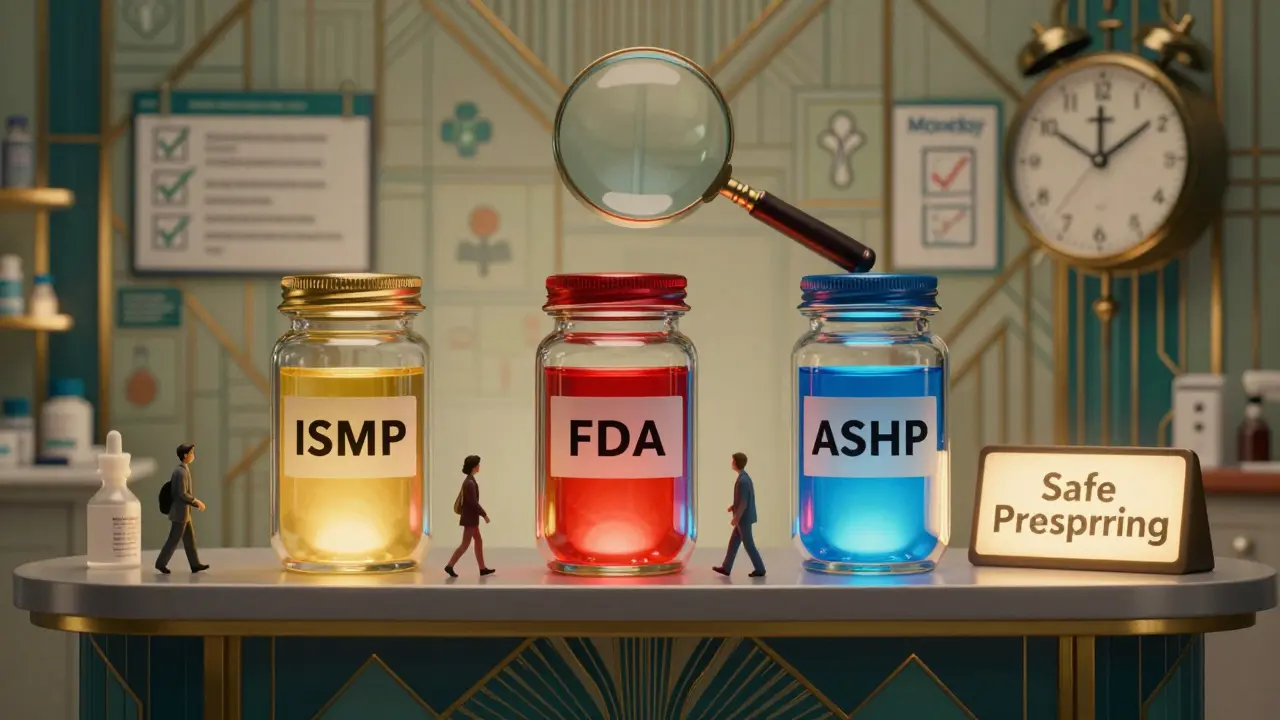
- ISMP (Institute for Safe Medication Practices): Now part of ECRI, ISMP runs the largest voluntary medication error reporting system in the world. They process over 2,800 error reports each year. Their weekly Medication Safety Alert! newsletter is the gold standard. It doesn’t just report problems-it gives you exact steps to fix them. Example: A 2023 alert warned about look-alike vials of insulin and heparin. Within weeks, hospitals using the alert redesigned storage protocols and cut related errors by 68%.
- ASHP (American Society of Health-System Pharmacists): Their Medication Safety Resource Center offers free access to practical tools like self-assessments and implementation checklists. Their biennial Targeted Medication Safety Best Practices are used in 87% of U.S. hospitals. If your hospital has a safety officer, they’re probably using ASHP’s tools to build local protocols.
- FDA (Food and Drug Administration): The FDA’s Drug Safety and Availability portal sends out alerts when drugs are recalled, have new black box warnings, or show unexpected side effects. In 2023 alone, they issued 47 alerts. These aren’t predictions-they’re reactions to harm that already happened. Still, they’re mandatory reading. A 2022 NEJM study found the median delay between an adverse event and an FDA alert was 47 days. That’s why you need other sources too.
- WHO (World Health Organization): Their Medication Without Harm initiative is a global framework, not a daily update service. It’s best for understanding policy shifts and international standards. Only 42 of the 137 participating countries met their 2023 benchmarks. So while WHO sets the vision, local systems do the work.
- AORN (Association of periOperative Registered Nurses): If you work in surgery, this is critical. Their 2023 Medication Safety guideline overhaul added new sections on technology use and organizational accountability. Perioperative teams using the update saw a 63% drop in medication errors within 30 days of implementation.
Set Up a Subscription System That Actually Works
Subscribing isn’t enough. You need a system that filters, prioritizes, and delivers updates where you can act on them.
Start with these three subscriptions:
- ISMP Medication Safety Alert! (weekly): $299/year. This is non-negotiable. It’s the only source that turns error reports into immediate, actionable fixes. Most subscribers report implementing at least one change per issue.
- FDA Drug Safety Alerts (email): Free. Sign up at fda.gov/drugs/drug-safety-and-availability. Set your email filter to flag these. You’ll get warnings about new black box labels, recalls, and boxed warnings.
- ASHP Medication Safety Resource Center (free tier): Access their self-assessment tools. Use them once a quarter to audit your practice. You don’t need the $99 premium version unless you need CE credits.
Don’t waste money on AORN unless you’re in OR. Don’t chase WHO unless you’re in public health policy. Focus on what impacts your daily work.
Build a Routine-Don’t Let Updates Slip Through the Cracks
Most clinicians don’t have time to scan 10 different websites. The solution? Make it automatic and scheduled.
- Monday morning ritual: Open your ISMP alert. Highlight one item you can act on this week. Share it with your team. Example: “The new alert says to stop using ‘U’ for units. Let’s change our e-prescribing template by Friday.”
- Wednesday check: Scan your FDA email. If there’s a new alert, check your formulary. Do you carry that drug? If yes, notify your pharmacy.
- Quarterly deep dive: Use ASHP’s self-assessment tool. It takes 45 minutes. Answer honestly. You’ll likely find one area where your process is outdated.
Organizations with a designated medication safety officer spend 2-3 hours a week managing this flow. For solo practitioners, even 15 minutes a week makes a difference. The goal isn’t to read everything-it’s to act on something.
Use Tools to Turn Updates Into Action
Updates mean nothing if they stay in your inbox. The best providers turn them into protocols.
Here’s how:
- Update your e-prescribing templates: ISMP’s list of error-prone abbreviations (like “QD” for daily) is updated annually. If your EHR still allows “U” for units or “QOD” for every other day, fix it now. Epic and Cerner are rolling out automatic ISMP flagging in 2024.
- Run quick staff huddles: After an ISMP alert on insulin safety, hold a 5-minute huddle. Show the vial photo. Ask: “Where do we store insulin here?” Then change it.
- Integrate into competency checks: AORN found that embedding updates into quarterly simulation drills reduced errors by 63%. You don’t need a simulator. Just use a case study. “Last week, ISMP warned about this mix-up. What would you have done differently?”
Don’t just read. Change.
Watch Out for the Pitfalls
Even the best systems have traps.
- Information overload: 37% of clinicians say they get overwhelmed by too many alerts. Solution: Stick to 2-3 trusted sources. Delete the rest.
- “That’s not my problem” syndrome: AORN’s updates are gold for OR staff but useless to a primary care doc. Don’t waste time on irrelevant sources.
- Assuming the FDA will catch everything: The FDA acts after harm occurs. Relying on them alone is like waiting for a smoke alarm to go off before you fix the wiring.
- Ignoring implementation gaps: A 2023 AHRQ survey found 68% of hospitals couldn’t turn guidelines into practice. If your team reads the alert but doesn’t change the process, it’s just noise.
What’s Changing in 2024 and Beyond
The landscape is evolving fast.
- ISMP’s 2024-2025 Best Practices added two new rules: one on AI-assisted prescribing and another on compounding pharmacy oversight. If your hospital uses AI for dosing, you need to know this.
- AORN is switching to quarterly micro-updates instead of biennial overhauls. That means more frequent, smaller changes. Stay subscribed.
- FDA and ISMP are partnering to build real-time error reporting into EHRs. Pilot launches in late 2024. This could mean alerts pop up right when you’re about to prescribe a risky combo.
- International standardization is coming: The International Coalition of Medication Safety Organizations (ICMSO) is creating a unified update taxonomy in Q2 2025. That means clearer, more consistent language across sources.
Stay flexible. The best system today might change next year. But the core rule won’t: Act on one thing every week.
What You Need to Remember
Medication safety isn’t about memorizing guidelines. It’s about building habits.
- Subscribe to ISMP and FDA-no exceptions.
- Use ASHP’s free tools once a quarter to audit your practice.
- Act on one update per week. Even if it’s small.
- Share updates with your team. Safety is a team sport.
- Ignore everything else. You don’t need to follow every society. You need to prevent harm.
The $42 billion in annual costs from medication errors? Half of that is preventable with simple, consistent actions. You don’t need to be perfect. You just need to be consistent.
What’s the most important source for medication safety updates?
ISMP’s Medication Safety Alert! newsletter is the most critical source for frontline clinicians. It’s based on thousands of real error reports, published weekly, and gives specific, actionable steps. Hospitals that follow ISMP recommendations see up to 70% fewer preventable errors. No other source combines speed, specificity, and real-world validation like ISMP.
Do I need to pay for all these updates?
No. You only need to pay for ISMP’s newsletter ($299/year) if you’re an individual. All other major sources-FDA, ASHP’s basic resources, and WHO-are free. ASHP’s premium content ($99/year) is only worth it if you need continuing education credits. Most clinicians get everything they need from ISMP and FDA alone.
How often should I review safety updates?
Check your ISMP alert every Monday. Scan FDA emails every Wednesday. Use ASHP’s self-assessment tool once a quarter. That’s it. You don’t need to read every bulletin. You need to act on one thing each week. Consistency beats volume.
Can I rely on my hospital’s safety team to handle this?
Not entirely. While hospitals have safety officers, they’re often overwhelmed. Many still don’t implement 40% of the best practices they receive. If you’re prescribing or administering meds, you’re responsible for your own safety. Use the alerts to double-check your own processes-not just wait for someone else to fix it.
What if I work in a small clinic with no pharmacy support?
You’re even more vulnerable. Without pharmacy support, you’re the last line of defense. Start with ISMP and FDA. Print out their key alerts and post them where you prescribe. Use ASHP’s free self-assessment to spot gaps in your workflow. Even a single change-like removing abbreviations from your notes-can prevent a deadly mistake.
Are these updates only for doctors and pharmacists?
No. Nurses, technicians, and even administrative staff who handle medication orders are at risk. ISMP’s alerts are designed for the whole care team. If you’re involved in prescribing, dispensing, or administering meds, you need to be informed. Safety isn’t a job title-it’s everyone’s responsibility.