
Every year, over 250,000 medication errors happen in U.S. nursing homes - and most of them are preventable. For older adults taking five or more medications, the risk of a harmful mistake jumps to nearly 60%. These aren’t just minor slip-ups. Wrong doses, expired pills, duplicate prescriptions, or medications given at the wrong time can lead to hospitalization, falls, organ damage, or even death. The good news? You don’t need to be a doctor to spot these errors. And you don’t need to wait for someone else to act. If you’re a family member, caregiver, or even a concerned neighbor, knowing how to identify and report elderly medication mistakes can save a life.
What Counts as a Medication Mistake?
A medication error isn’t just when someone takes the wrong pill. It’s any time the medication doesn’t match what was meant to be given. The most common types in seniors include:- Wrong dose: Too much or too little - especially with blood thinners, diabetes meds, or blood pressure drugs.
- Wrong time: Giving a medication meant for bedtime at breakfast, or skipping doses because staff are short-staffed.
- Wrong drug: Confusing similar-sounding names like Hydralazine and Hydroxyzine, or giving two versions of the same drug (like Tylenol and a cold medicine that also contains acetaminophen).
- Wrong route: Swallowing a pill meant to be placed under the tongue, or giving an injection meant for the vein into the muscle.
- Missing monitoring: Not checking blood pressure after a new heart med, or not testing kidney function before giving a drug that stresses the kidneys.
- Expired or damaged meds: Pills that are crumbling, discolored, or past their expiration date still being handed out.
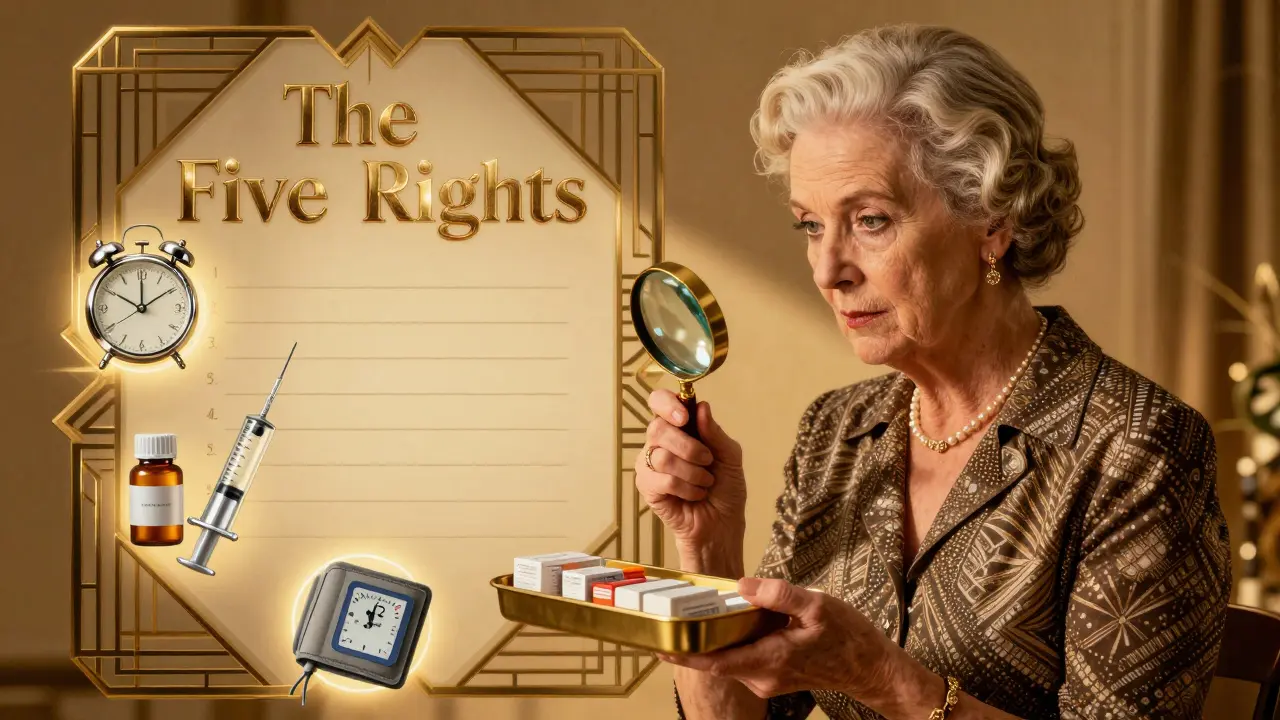
The Five Rights are your basic checklist: Right patient, right drug, right dose, right route, right time. If even one of these is off, it’s an error. Use this checklist every time you see a medication being given - whether it’s at home, in a nursing home, or during a hospital visit.
How to Spot These Errors Before They Happen
You don’t have to wait for harm to occur. Here’s how to catch mistakes early:- Keep a living medication list. Write down every pill, patch, liquid, or injection the person takes - including over-the-counter drugs, vitamins, and herbal supplements. Update it weekly. Include the reason for each med (e.g., “Lisinopril for blood pressure”) and the dose (e.g., “10 mg once daily”).
- Check the label every time. Compare the pill in the hand to the list. Does the color match? The shape? The imprint code? If it looks different, ask why.
- Ask about changes. If a new med is added, ask: “Why now?” “What side effects should we watch for?” “Is this replacing something else?”
- Watch for signs of confusion. If someone is more drowsy, unsteady, confused, or nauseous after a new med, it could be a reaction. Don’t assume it’s just “getting older.”
- Use the Beers Criteria. The American Geriatrics Society lists 34 medications that are risky for seniors - like anticholinergics, benzodiazepines, and certain NSAIDs. Ask if any of these are being used, and why.
One real example: A woman in her 80s was given both Advil and a generic ibuprofen daily - doubling her NSAID dose. Her family noticed she was vomiting and had dark stools. The medication list caught the duplication before she developed a bleeding ulcer.
How to Report a Medication Error - Step by Step
Reporting isn’t about blaming. It’s about fixing systems so no one else gets hurt. Here’s what to do:- Act immediately if it’s life-threatening. If someone is having trouble breathing, passing out, or showing signs of overdose, call 911. Then call the National Response Center at 1-800-332-1088 to report the incident.
- Notify the prescribing doctor. Call the doctor who wrote the prescription. Say: “I believe there was a medication error. Here’s what happened.” Get their response in writing if possible.
- File an incident report with the facility. Whether it’s a nursing home, assisted living, or hospital, ask for the Medication Error Reporting Form. Demand a copy. If they refuse, say: “I’m exercising my right as a family member to document this.”
- Use the right form. The form should capture: the patient’s name and ID, date and time of error, what went wrong, who was involved, and the potential severity (use NCC MERP categories E-H - meaning injury, life-threatening, or death).
- Report to the state ombudsman. Every state has a Long-Term Care Ombudsman Program. Call 1-800-677-1116. They’re trained to investigate and have legal authority to demand records. Families who report to ombudsmen see 68% of issues resolved within 72 hours.
- Report to the FDA. For serious side effects or dangerous drugs, file a report through MedWatch: www.fda.gov/medwatch. This helps the FDA track patterns across the country.
Don’t be afraid to push. One Reddit user, u/ElderCareAdvocate, shared: “When I caught the nurse giving my mother double doses of blood pressure medication, the facility initially refused to file an incident report until I threatened to contact the state ombudsman. This is why families need to know their rights.”
Why Reporting Matters - More Than You Think
Most people think reporting an error is just about one person. But it’s not. The AHRQ found that hospitals using standardized reporting systems reduced preventable harm by up to 50%. Why? Because each report helps identify patterns. If three different staff members report the same error - like giving warfarin without checking INR levels - the facility has to fix the process. Maybe the electronic records don’t flag high-risk meds. Maybe nurses aren’t trained to double-check. Maybe there’s no pharmacist on-site.Voluntary reporting systems like MEDMARX capture over 80% of errors - because they don’t punish the person who reports. Mandatory systems? They catch only 14%. Fear silences people. But when you report without blame, you help change the system.
And the data doesn’t lie. Nursing homes with barcode scanning systems cut administration errors by 86%. Those with clinical decision support tools reduced dangerous prescribing by 55%. These tools exist. But only 55% of nursing homes use them. Your report can be the push that gets one installed.
What to Do If You’re Ignored or Blamed
Too often, families are told: “It was just a mistake,” “The resident was confused,” or “We don’t have time to document that.” Here’s how to respond:- If they say it’s the patient’s fault: “The medication was given by staff. The responsibility lies with the facility.”
- If they refuse to document: “I will be filing a report with the state ombudsman and the FDA. I’d prefer to resolve this internally.”
- If they delay: “I need a written response within 24 hours. If I don’t get one, I’ll escalate.”
- If they threaten retaliation: “I’m protected under federal law. Retaliation against a reporter is a violation of the Nursing Home Reform Act.”
Remember: In 2023, the federal government started fining nursing homes $10,000 per unreported serious error. They’re now legally required to report. You’re not being difficult - you’re holding them accountable.
Tools and Resources You Can Use Right Now
- Medication Reconciliation Tool: Ask for a full review of all meds at every transition - hospital to home, home to nursing home. This alone prevents 67% of adverse events.
- Beers Criteria 2023: Search “AGS Beers Criteria 2023 PDF” - it’s free. Use it to question risky prescriptions.
- State Ombudsman: Call 1-800-677-1116. They’ll connect you to your local office.
- FDA MedWatch: Report serious reactions here: www.fda.gov/medwatch.
- ISMP Medication Safety Alerts: Subscribe to their free alerts - they publish real cases of errors and how to prevent them.
Technology is helping too. AI tools like MedAware now predict dangerous prescribing patterns with 94% accuracy. CMS now rates nursing homes partly on their medication error rates. These changes didn’t happen because of paperwork - they happened because families spoke up.
Final Thought: You’re Not Just a Family Member - You’re a Safety Advocate
Elderly medication errors aren’t accidents. They’re system failures. And they’re preventable. You don’t need permission to protect someone you care about. You don’t need a medical degree. You just need to pay attention, ask questions, and refuse to stay silent.The next time you hand someone their pills, pause. Check the label. Ask why. Document what you see. Report what you find. One report might not fix everything - but it might be the one that stops the next mistake. And that’s worth it.
What are the most common medication errors in elderly patients?
The most common errors include wrong dosage (42.7% of cases), giving medication at the wrong time (23.1%), administering the wrong drug (15.8%), and incorrect administration techniques (12.3%). Prescribing errors - like duplicate drugs or unsafe medications - are also frequent, especially when seniors take five or more prescriptions.
How can families identify a medication error?
Use the Five Rights: right patient, right drug, right dose, right route, right time. Keep a written, updated list of all medications. Check pill labels every time they’re given. Watch for new symptoms like dizziness, confusion, nausea, or bleeding. If something looks off, trust your gut - and ask for an explanation.
What should I do if I catch a medication error?
If it’s life-threatening, call 911 and then report it to the National Response Center at 1-800-332-1088. For non-emergencies, notify the prescribing doctor, file an incident report with the facility, and request a copy. Then contact your state’s Long-Term Care Ombudsman at 1-800-677-1116. Never accept “it was just a mistake” as the final answer.
Are nursing homes required to report medication errors?
Yes. Under the 2023 Nursing Home Reform Act, facilities must report serious medication errors. Failure to report can result in $10,000 fines per incident. However, many still underreport due to fear of penalties or lack of staff. This is why family involvement is critical - you’re often the first line of detection.
Can I report a medication error anonymously?
Yes, you can report to the FDA’s MedWatch program anonymously. You can also file with your state ombudsman without giving your name - though providing contact info helps them investigate faster. Voluntary reporting systems like MEDMARX protect your identity and focus on fixing systems, not blaming individuals.
What’s the best way to prevent medication errors long-term?
The most effective long-term solution is comprehensive medication reconciliation at every care transition - hospital, nursing home, or clinic. Studies show this prevents 67% of adverse events in seniors on five or more drugs. Pair that with electronic prescribing systems, barcode scanning, and clinical decision support tools. But none of this works without families asking questions and demanding transparency.
Haley Gumm
February 24, 2026 AT 05:28Just wanted to say this post saved my grandma’s life. We caught her on double doses of lisinopril because the nursing home switched brands and the label changed color. I used the Five Rights checklist and freaked out when the pill looked all wrong. They denied it at first, but once I showed them the updated med list, they had to admit it. Now they do weekly med reconciliations. Don’t underestimate how powerful a simple list can be. 💕
Spenser Bickett
February 24, 2026 AT 07:45so like… we’re just supposed to be amateur pharmacists now? cool. next they’ll ask us to read the MRI scans and fix the EKGs. i get it, families are the new frontline. but also… why is the system so broken that a 72-year-old’s daughter has to be the one catching errors that trained nurses should’ve caught? i mean, i’m not mad… i’m just disappointed. in america. again.
Christopher Wiedenhaupt
February 25, 2026 AT 22:06Thank you for this comprehensive guide. I work in healthcare administration and can confirm that the most effective interventions are medication reconciliation at transitions of care and barcode scanning systems. The data is clear: when implemented properly, error rates drop by over 80%. The challenge is funding and staffing. Many facilities operate at 60% capacity for pharmacy support. This isn't negligence-it's systemic underinvestment. Families reporting errors are essential, but policy change is what will scale the solution.
John Smith
February 27, 2026 AT 20:12Wow. So now we’re all supposed to be detectives for our elderly relatives while the system crumbles? How noble. How tragic. How utterly predictable. I mean… did you really need 2000 words to tell us to check the pill bottle? Or is this just performance activism disguised as advocacy? I’m tired. Not of the problem. Of the people who turn grief into blog posts.
Shalini Gautam
February 28, 2026 AT 16:21I live in India and we don’t have nursing homes like you do. But I’ve seen elderly people on 10+ meds because doctors just keep prescribing. No one checks. No one questions. Your checklist is gold. I’m translating this into Hindi for my family. We need this everywhere. Even if the system is broken, we still have each other. That’s what matters.
Natanya Green
February 28, 2026 AT 20:59OMG. I JUST HAD THE EXACT SAME THING HAPPEN TO MY MOM!!! 😭 She was on BOTH Advil AND ibuprofen and I didn’t even realize it until she started vomiting blood. I SCREAMED. I CRIED. I THREATENED TO CALL THE OMBUDSMAN. And guess what? They gave me a $50 gift card and said ‘we’ll do better.’ I didn’t want a gift card. I wanted accountability. I wanted them to get fired. I wanted justice. And now? I’m posting this everywhere. If you’re reading this, check your loved one’s meds. TODAY. I mean it. I’m not joking. I’m not dramatic. I’m a survivor.
Steven Pam
March 1, 2026 AT 23:52This is the kind of post that gives me hope. Seriously. I’ve been feeling helpless about my dad’s care, but this broke it down so clearly. I made a printed checklist and taped it to the fridge. I started asking questions at every visit. And you know what? The staff started responding better. It’s not about being confrontational-it’s about being consistent. You don’t have to be a hero. Just show up. Keep showing up. That’s how change happens.
Timothy Haroutunian
March 3, 2026 AT 17:59Let’s be real here. The entire system is designed to fail. Nursing homes are profit centers disguised as care centers. Staff are overworked, underpaid, and undertrained. Families are expected to fill the gaps. And then we get told we’re being ‘difficult’ when we ask for a simple pill label check. The fact that we need a 2000-word guide to prevent a 70-year-old from dying from a duplicated prescription says everything about how broken this is. It’s not about individual vigilance. It’s about dismantling a corrupt industry. And until that happens, we’re just rearranging deck chairs on the Titanic.
Erin Pinheiro
March 4, 2026 AT 09:27Ok so I read this whole thing and honestly I’m kind of mad. Like why is this even a thing? Why do we have to be the ones checking meds? Shouldn’t the nurses be doing this? I mean I love my mom but I’m not a pharmacist. And why is the Beers Criteria not just built into every EHR? And why does every facility have a different system? I wrote them a letter. They didn’t reply. I called. They said ‘we’re understaffed.’ I said ‘so am I.’ They hung up. Now I’m crying. Again. This is exhausting. I just want her to live. Not survive. Not barely. Live.