
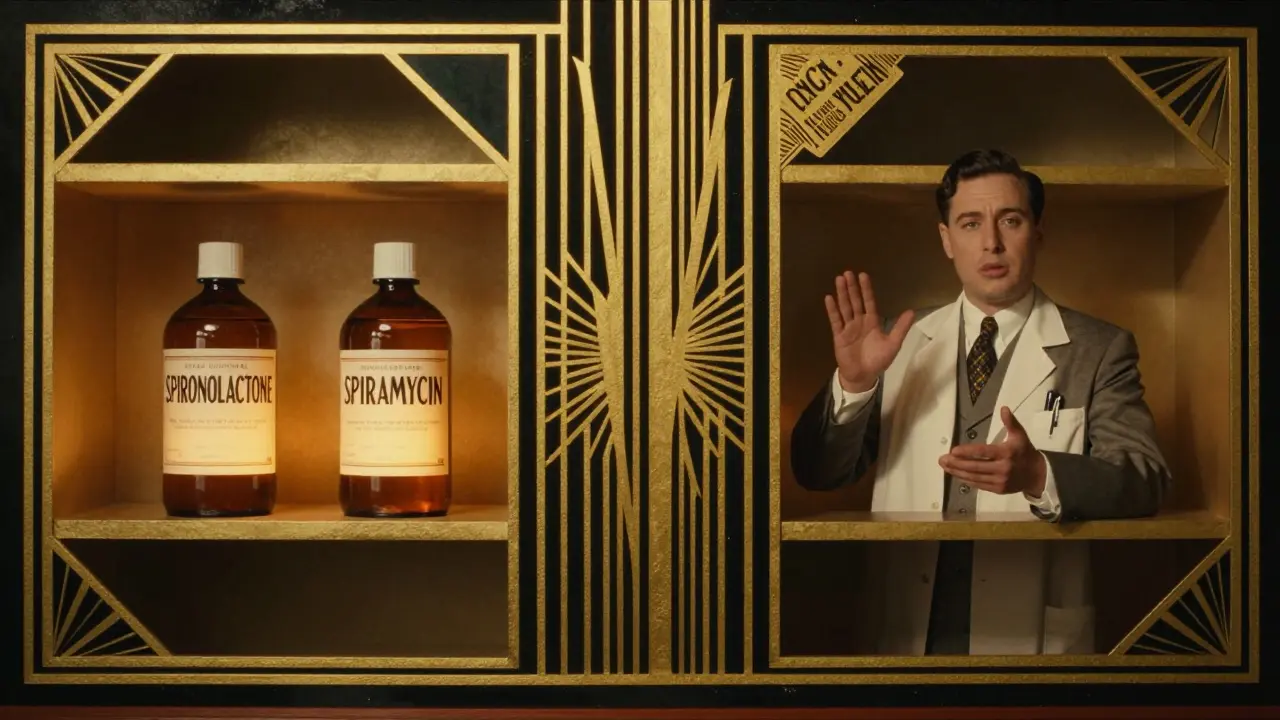
Every year, thousands of patients in the UK and US receive the wrong medication-not because of a doctor’s mistake, but because two pills look too much alike. A bottle of spironolactone sitting next to spiramycin. A vial of hydralazine right beside hydroxyzine. These aren’t typos. They’re packaging disasters waiting to happen. And in pharmacies, they’re more common than you think.
According to the Institute for Safe Medication Practices (ISMP), nearly one in five medication errors reported in the U.S. involve look-alike or sound-alike drugs. That’s about 10,000 preventable mistakes each year. Some lead to hospitalizations. Others end in death. The good news? Most of these errors can be stopped-with simple, proven steps.
Start with Physical Separation
The cheapest and most effective fix? Put similar-looking drugs far apart. Not just on different shelves. Not just in different drawers. Keep them in completely separate zones.
A 2020 study from the University of Arizona found that physically separating look-alike medications reduced dispensing errors by 62%. That’s not a small win. That’s life-saving. In a hospital pharmacy, this might mean putting all insulin products in one locked cabinet, away from any other injectables. In a community pharmacy, it could mean using plastic dividers on the shelf to isolate drugs like clonazepam and clonidine.
It sounds obvious, but most pharmacies don’t do it. Why? Space. Budget. Tradition. But here’s the truth: you don’t need a new layout. You need a mindset shift. Use cheap shelf dividers ($200-$500 total), label each zone clearly, and train staff to treat separation like a rule-not a suggestion.
Use Tall Man Lettering Everywhere
Ever notice how some drug names are written with capital letters in the middle? Like DOPamine instead of dopamine? That’s Tall Man Lettering (TML). It’s not decoration. It’s a visual cue that tells your brain: these are different.
Studies show TML cuts selection errors by 47%. The FDA and ISMP recommend it for high-risk pairs like:
- DOPamine vs. DoBUTamine
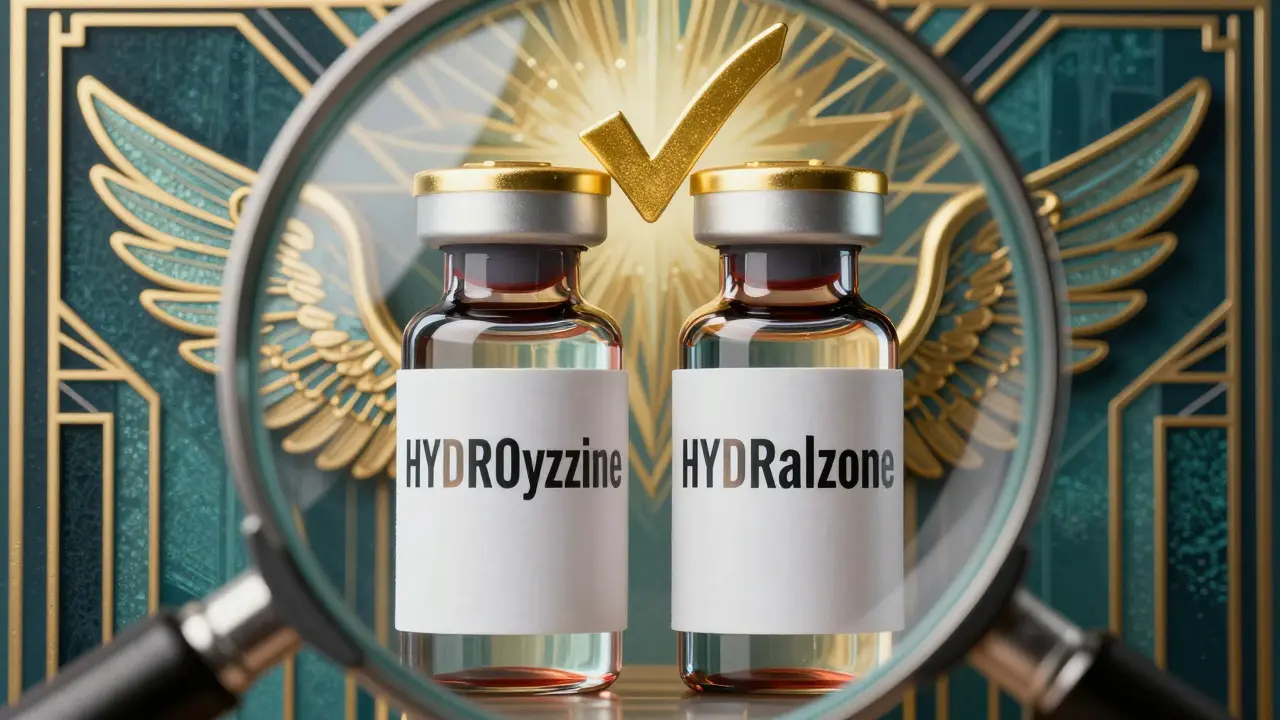
- HYDROxyzine vs. HYDRAlazine
- PREDNISone vs. PREDNISolone
- CELEcoxib vs. CELEBREX
But here’s the problem: not all systems use it the same way. Some EHRs show TML. Others don’t. Some labels print it. Others ignore it. That inconsistency is dangerous. If a pharmacist sees hydroxyzine on a screen but HYDROxyzine on the bottle, confusion creeps in.
Fix it by demanding consistency. Work with your pharmacy software vendor to enable TML across all screens, labels, and reports. If your system doesn’t support it, push for an upgrade. The FDA’s 2024 draft guidance now requires TML for 25 high-risk pairs-and that’s just the start.
Barcode Scanning Isn’t Optional
Barcode scanning isn’t a luxury. It’s your last line of defense.
When a pharmacist scans a medication and the system says, “This isn’t what the prescription says,” it stops the error before it reaches the patient. The Agency for Healthcare Research and Quality (AHRQ) found barcode scanning reduces administration errors by 86%. That’s not theory. That’s real data from real hospitals.
But here’s the catch: it only works if staff use it. A 2021 study at UCSF found that 5-12% of scans were bypassed-usually during rush hours. Why? Pressure. Convenience. Habit.
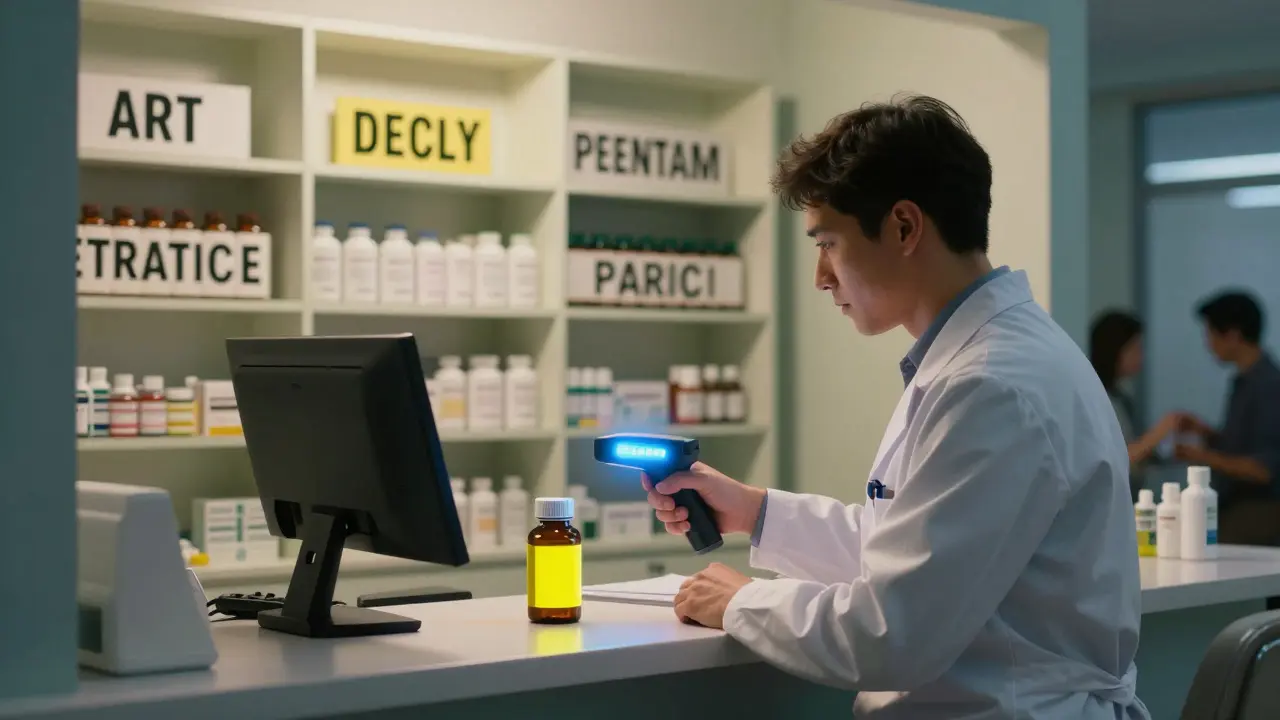
Stop bypasses by making scanning non-negotiable. Tie it to your quality checks. Record every bypass. Review them weekly. Reward teams that hit 100% compliance. If your pharmacy doesn’t have barcode scanning yet, start now. The upfront cost? $15,000-$50,000. The cost of one wrong dose? Thousands in legal fees, reputational damage, and maybe a life.
Check New Drugs Before They Hit the Shelf
Most errors happen not with old drugs-but with new ones.
When a pharmacy gets a new shipment, the first thing staff do is unpack it, scan it, and put it on the shelf. That’s a mistake.
Erin Fox, PharmD at University of Utah Health, says: “When new products arrive, pause. Compare them to drugs already in stock. Look for packaging similarities. Are the shapes the same? The colors? The font? The label layout?”
That’s called a “new drug LASA check.” It takes 10 minutes per new item. But it prevents disasters. For example, in 2023, ISMP added 17 new look-alike pairs to their list-including buprenorphine and butorphanol. If your pharmacy didn’t check those before stocking them, you were playing Russian roulette.
Make this a standard step in your receiving process. Add it to your checklist. Train new hires on it. Don’t assume the manufacturer got it right.
Use Alert Labels for High-Risk Pairs
Some drug pairs are so dangerous, they need extra warning.
One retail pharmacy in Bristol started using bright yellow alert stickers on bottles of spironolactone and spiramycin. They also added a note on the label: “Check prescription-easy to confuse.” Within six months, wrong-drug dispensing dropped by 75%.
It’s low-tech. It’s cheap. And it works.
Other high-risk pairs that benefit from alert labels:
- Levothyroxine and levodopa
- Hydromorphone and hydrocodone
- Fluoxetine and fluvoxamine
Don’t overdo it. Too many alerts become background noise. Pick only the top 10-15 most dangerous pairs. Make the labels clear, consistent, and impossible to ignore.
Train Staff Like Lives Depend on It
Technology helps. But people still make the final decision.
A 2023 survey found that 78% of pharmacy directors say staff resistance is the biggest barrier to implementing safety measures. Why? Because change is hard. Because they’ve always done it this way.
Fix it by making training real. Not a PowerPoint. Not a one-hour webinar. Real scenarios.
Do this: Gather your team. Show them two bottles side-by-side. One is atenolol. One is atenolol-but the label is slightly different. Ask: “Which one is the prescription for?”
Then show them the error rate from the last quarter. Show them the cost of one mistake. Show them the patient who almost died because someone grabbed the wrong bottle.
Turn safety into a culture-not a policy. Celebrate when someone catches a mistake. Make it a team win.
What Doesn’t Work
Don’t rely on just one thing.
Tall Man Lettering alone? It only fixes name confusion. But 35% of errors come from packaging-same shape, same color, same font. That’s why Dr. David Bates warned in JAMA: “Tall Man Lettering gives a false sense of security.”
Barcode scanning alone? If staff skip it, it fails.
Physical separation alone? In a crowded community pharmacy, you might not have space.
The only solution that works? Layering.
Combine physical separation + Tall Man Lettering + alert labels + barcode scanning + staff training. That’s the 94% error-reduction formula proven in a 2023 study in the American Journal of Health-System Pharmacy.
There’s no magic bullet. But there’s a magic combo.
Where to Start Today
You don’t need to fix everything at once. Start here:
- Download ISMP’s free Tool for Evaluating the Risk of Confusion Between Drug Names (it takes 8-12 hours for a typical pharmacy).
- Identify your top 5 most dangerous look-alike pairs.
- Physically separate them this week.
- Add yellow alert labels to those bottles by next Friday.
- Check if your EHR shows Tall Man Lettering. If not, email your vendor.
- Run a barcode scan drill next shift. Count how many people skip it.
That’s it. Five actions. One week. No budget needed for four of them.
Medication safety isn’t about spending more money. It’s about thinking differently. It’s about seeing the bottle-not just the label. It’s about asking, “What if I grabbed the wrong one?” before you hand it to the patient.
Because in pharmacy, the difference between right and wrong isn’t a typo. It’s a life.
What are the most common look-alike drug pairs in UK pharmacies?
The most frequent look-alike pairs in UK pharmacies include spironolactone and spiramycin, hydralazine and hydroxyzine, clonazepam and clonidine, levothyroxine and levodopa, and hydrocodone and hydromorphone. These pairs are often confused because their names sound alike and their packaging uses similar fonts, colors, or bottle shapes. ISMP’s updated 2024 list added 17 new pairs, including buprenorphine and butorphanol, based on recent error reports.
Is Tall Man Lettering required by law in the UK?
Tall Man Lettering is not legally required in the UK, but it is strongly recommended by the Medicines and Healthcare products Regulatory Agency (MHRA) and the National Institute for Health and Care Excellence (NICE). The UK follows international safety standards, and many NHS trusts and private pharmacies use TML as a best practice. The FDA’s 2024 guidance has influenced UK policy, and many pharmacies now adopt TML voluntarily to reduce risk.
Can barcode scanning prevent all medication errors?
No, barcode scanning cannot prevent all errors, but it stops about 86% of administration mistakes. It won’t catch errors where the wrong prescription was written, or if the barcode is damaged or misprinted. It also fails if staff bypass the scan-common during busy shifts. That’s why it must be part of a layered system: combined with physical separation, alert labels, and staff training.
How often should pharmacies review their look-alike drug list?
Pharmacies should review their look-alike drug list every quarter. New drugs enter the market regularly, and packaging designs change. ISMP updates its List of Confused Drug Names quarterly, and the FDA releases new guidance annually. Pharmacies should also review after any near-miss or error, and whenever a new supplier or generic version is added to inventory.
What’s the biggest mistake pharmacies make when trying to prevent look-alike errors?
The biggest mistake is relying on just one solution-like Tall Man Lettering alone. Many think changing the font will fix everything. But packaging similarity, not just name similarity, causes 35% of errors. Another common error is assuming staff will always follow protocols. Without enforcement, training, and accountability, even the best systems fail. The most successful pharmacies treat safety as a daily habit, not a checklist.
Next Steps for Pharmacies
If you’re a pharmacy manager, start with a 30-minute audit this week. Grab your top 10 most dispensed medications. Lay them out side by side. Do any look too similar? Are they stored next to each other? Are there alert labels? Is barcode scanning used consistently?
If you’re a pharmacist, speak up. Don’t wait for policy. If you see two bottles that could be mixed up, say so. Put a sticky note on the shelf. Ask for a review. Your voice could stop the next error.
Medication safety isn’t about perfect systems. It’s about people paying attention. And in pharmacy, attention is the most powerful tool you have.
Uju Megafu
January 21, 2026 AT 00:00This is why America’s healthcare is a circus. You’re telling me we need $50K for barcode scanners when we could just, I dunno, TRAIN PEOPLE? My cousin works at a pharmacy in Lagos and they use colored tape and handwritten notes-no tech, no budget-and zero errors. Stop outsourcing your laziness to gadgets.
MAHENDRA MEGHWAL
January 21, 2026 AT 17:44While the recommendations outlined are commendable and grounded in empirical evidence, it is imperative to acknowledge the systemic constraints faced by community pharmacies in resource-limited settings. The implementation of physical separation, tall man lettering, and barcode scanning requires not only financial investment but also sustained administrative support, which is often lacking in underfunded institutions.
Furthermore, the reliance on staff compliance without institutional reinforcement may lead to inconsistent adherence, particularly during peak hours. A structured, multi-tiered approach-combining technological, procedural, and cultural interventions-is essential for scalability and long-term efficacy.
It is also worth noting that regulatory alignment with international standards, such as those from ISMP and MHRA, should be institutionalized through national pharmacy guidelines to ensure uniformity across all practice settings.
Kevin Narvaes
January 21, 2026 AT 20:49bro i just read this and i’m like… why are we still doing this? we got AI now. why are pharmacists squinting at bottles like it’s 2003? just scan it, let the computer yell at you if it’s wrong, and move on. also why is everyone so into tall man lettering like it’s some ancient ritual? it’s just capital letters. not magic.
also i saw a guy at cvs grab hydralazine instead of hydroxyzine last week and he didn’t even notice. he was on his phone. that’s the real problem. not the labels. the people.
Dee Monroe
January 22, 2026 AT 16:42I’ve been thinking about this for days-not just as a pharmacist, but as someone who’s watched my grandmother nearly die from a mix-up between levothyroxine and levodopa. It’s not about the tech, honestly. It’s about the silence. The quiet assumption that ‘someone else will catch it.’ We’ve normalized risk because it’s easier than speaking up. That’s the real epidemic.
When you walk into a pharmacy and see someone working under fluorescent lights, rushing between 17 prescriptions, with no one checking their work… that’s not negligence. That’s a system that’s broken its own people. We treat safety like a checklist item, not a sacred pact with the person holding out their hand for help.
What if we started treating every bottle like it was our mother’s? Like it was our child’s? Not because we’re scared of lawsuits, but because we’re human? That’s the only change that lasts. The rest? Just noise.
Philip Williams
January 24, 2026 AT 12:14Excellent and comprehensive analysis. The layered approach outlined is precisely what evidence-based practice demands. I would add that peer-to-peer audits, conducted monthly, significantly reinforce compliance with safety protocols. Additionally, integrating real-time error feedback into staff evaluations-without punitive measures-fosters a culture of accountability and continuous improvement. The data from the American Journal of Health-System Pharmacy is unequivocal: synergy between physical, procedural, and human factors yields optimal outcomes.
Ben McKibbin
January 24, 2026 AT 13:18Let’s be real: nobody gives a damn until someone dies. And even then, it’s ‘oh no, what a tragedy’-then back to business as usual. You want change? Stop asking for ‘best practices.’ Start demanding consequences. Fire the manager who ignores barcode bypasses. Sue the vendor who won’t enable TML. Make it hurt. The only thing that moves institutions faster than guilt is liability.
This isn’t about ‘culture.’ It’s about power. And if you’re not willing to wield it, you’re part of the problem. I’ve seen pharmacies with zero budget fix this with duct tape and a whiteboard. What’s your excuse?
Melanie Pearson
January 24, 2026 AT 20:09It’s pathetic that a developed nation like the United States still relies on sticky notes and colored dividers to prevent fatal errors. This isn’t innovation-it’s desperation. We have the technology, the data, the expertise. Yet we allow pharmacies to operate like 1980s hardware stores. Shameful. And the fact that the UK doesn’t mandate Tall Man Lettering legally? That’s not just negligence. It’s a national disgrace.
Why are we still debating this? We know what works. Enforce it. Or stop pretending you care about patient safety.
Rod Wheatley
January 25, 2026 AT 07:36YES. YES. YES. I’ve been screaming this for years! I work in a small-town pharmacy, and we started using yellow stickers on spironolactone and spiramycin last year-and guess what? We haven’t had a single mix-up since. Not one. And it cost us $12 in labels.
Also-barcodes? We made a rule: no scan, no release. Even the owner has to follow it. We started giving out ‘Safety Hero’ coffee mugs to anyone who caught an error. People love it. It’s not about punishment. It’s about pride.
And training? We do 10 minutes a day. No PowerPoints. Just two bottles. ‘Which one’s right?’ And we talk about it. Like real people. It’s not rocket science. It’s just… caring enough to look twice.
Jerry Rodrigues
January 26, 2026 AT 13:55Interesting read. I’ve seen a lot of these measures fail because they become checkboxes instead of habits. The real issue isn’t the tools-it’s whether people believe they matter. If staff think safety is just for audits, nothing sticks. But if they feel responsible? That’s when change happens. Quietly. Consistently. Without fanfare.
Stephen Rock
January 28, 2026 AT 03:07Wow. Another feel-good listicle from someone who’s never stocked a shelf. You think putting a yellow sticker on a bottle stops a tired intern from grabbing the wrong one at 3 a.m.? Please. The real problem is staffing ratios. 1 pharmacist for 120 scripts an hour. No one’s gonna slow down to check capital letters. You want safety? Hire more people. Not stickers. Not tech. People.
This whole post reads like a consultant’s brochure. No real talk. No truth.
Andrew Rinaldi
January 29, 2026 AT 03:22There’s something deeply human about this issue. We’re not just talking about labels and scanners-we’re talking about how we treat people who are trying to do their jobs well under impossible conditions. The fact that we need to remind each other to look twice… that’s the tragedy. Not the packaging.
Maybe the real solution isn’t more rules. Maybe it’s more grace. More space. More time. More trust.
Gerard Jordan
January 30, 2026 AT 21:45👏 THIS. Every single point. I’ve been doing this for 22 years. The yellow stickers? Genius. The barcode drill? Life saver. The ‘which one’s right?’ game? My team loves it. 🙌 We even made a little poster: ‘Don’t be the reason someone’s mom dies.’ 🏥❤️ It’s not just policy-it’s family. And family looks out for each other.
Roisin Kelly
February 1, 2026 AT 09:00So… let me get this straight. We’re supposed to trust that a pharmacy with no budget, no training, and 3 people working 12-hour shifts is gonna magically stop mixing up drugs because of a sticker? LOL. This is all a distraction. The real problem is that pharmacies are profit mills. They don’t care if you live or die-they care if you refill on time. This whole post is corporate gaslighting.
lokesh prasanth
February 2, 2026 AT 23:08Stickers. Barcodes. Separation. All useless without culture change. People ignore rules. Always. Fix the mind, not the shelf.