
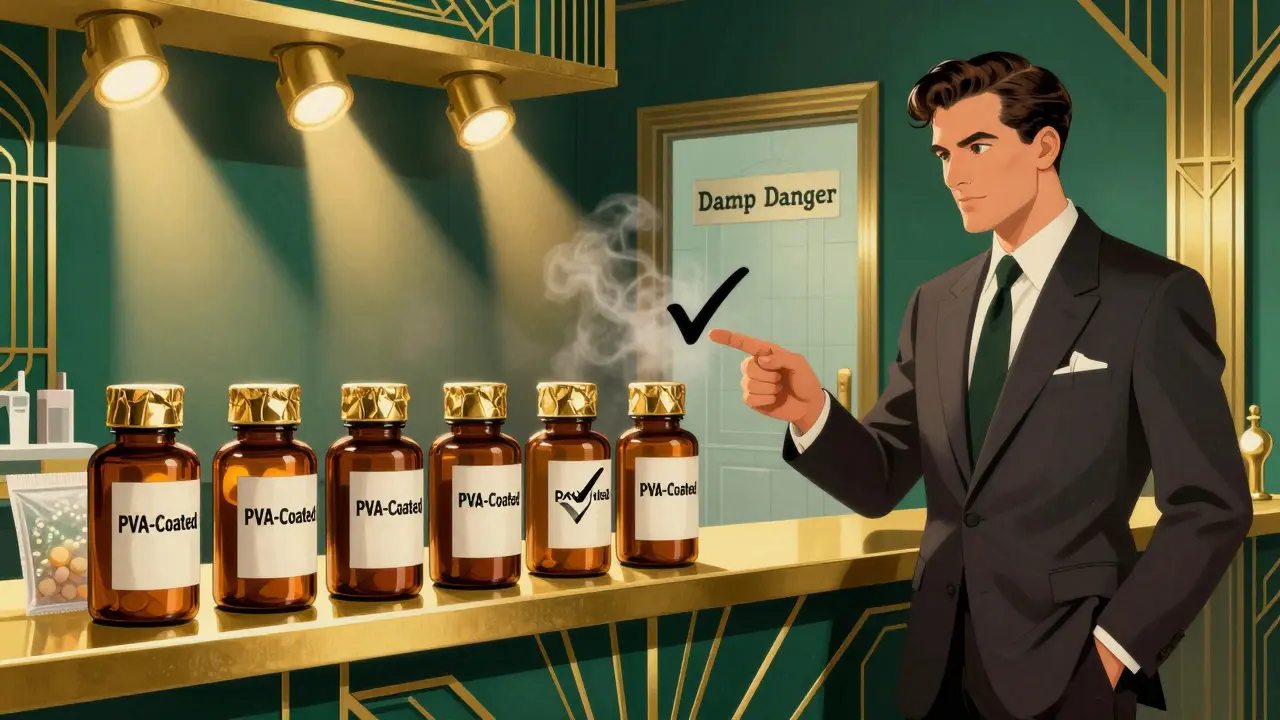
Moisture doesn’t just ruin your phone or your favorite pair of sneakers-it can also wreck your pills and capsules. If you’ve ever opened a bottle of medicine and found tablets stuck together, discolored, or smelling odd, you’ve seen moisture damage in action. It’s not just a cosmetic issue. Moisture can break down the active ingredients in your medication, making it less effective-or worse, harmful. In the UK, where damp weather is common, this isn’t a rare problem. It’s something every household should know how to prevent.
Why Moisture Destroys Pills and Capsules
Pills and capsules aren’t just sugar and powder. They contain active pharmaceutical ingredients (APIs) that are often highly sensitive to water. When moisture gets in, it triggers chemical reactions like hydrolysis and oxidation. Aspirin, for example, breaks down into salicylic acid and acetic acid (vinegar) when exposed to humidity. That’s why old aspirin sometimes smells sour. Other medications, like vitamin C or certain antibiotics, can lose potency within weeks if stored in a humid bathroom. The problem gets worse once the original packaging is opened. A typical 500-pill bottle gets opened about 250 times over its lifespan. Each time, moist air rushes in. By the time you’re halfway through the bottle, the headspace inside is mostly humid air, not dry nitrogen. That’s why pills stored in the original bottle but kept in a humid room often degrade faster than those left unopened.The Three-Layer Defense System
The best way to protect your medication isn’t to rely on one trick-it’s to use three layers of defense. This isn’t just industry advice; it’s science-backed and proven in real-world use. 1. Film Coating - This is the first line of defense, built into the pill by the manufacturer. Not all coatings are the same. Older pills often use hydroxypropyl methylcellulose (HPMC), which offers basic protection. But newer formulations use polyvinyl alcohol (PVA)-based coatings like Opadry® Amb II. These provide up to 40% better moisture resistance. Studies show that amoxicillin/clavulanic acid tablets with PVA coatings stayed stable even after 10 days outside their blister pack, while HPMC-coated ones degraded completely. If your pharmacy switches to PVA-coated meds, you’re getting a significant upgrade. 2. Proper Packaging - The bottle matters. High-density polyethylene (HDPE) and polypropylene (PP) bottles block liquid spills, but they’re not moisture-proof. Water vapor still sneaks through. That’s why many manufacturers now use bottles with child-resistant caps that have a foil seal under the lid. Once you break that seal, the bottle’s protection drops. For long-term storage, glass bottles with tight-fitting stoppers are better-but not always practical. 3. Desiccants - These are the unsung heroes. Silica gel packets are the most common. They can absorb up to 40% of their own weight in moisture. In one case study, adding a properly sized silica gel pack to a 500-pill bottle kept moisture levels from rising more than 0.3% over two years-even in tropical climates. The key? Size matters. A packet too small won’t help. Industry experts recommend desiccants that can handle at least 150% of the expected moisture load from all those bottle openings.What Not to Do
Many people think they’re protecting their meds by keeping them in the kitchen or bathroom. That’s the opposite of helpful. Bathrooms are steamy after showers. Kitchens get humid from cooking. Even a windowsill near a radiator can create a moist microclimate. Don’t transfer pills to plastic pill organizers unless you’re using them within a week. Most organizers are made of thin plastic that offers zero moisture barrier. If you need to split doses for the week, use airtight, opaque containers designed for medication storage. Some even come with built-in desiccants. Avoid leaving bottles open on the counter. Every minute the cap is off, moisture gets in. Close it immediately after taking your dose. And never, ever store medication in the fridge unless the label says to. Condensation forms when you take it out, and that’s worse than room-temperature humidity.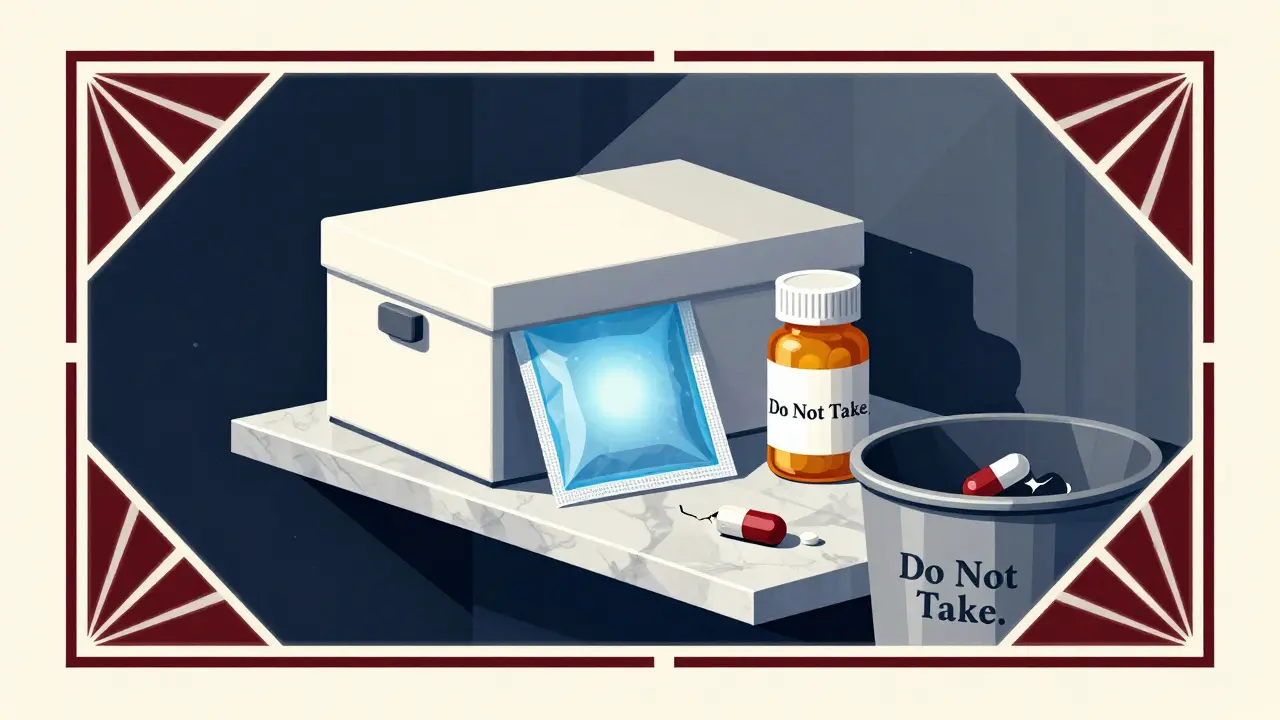
How to Choose the Right Storage Spot
The ideal place to store pills is cool, dry, and dark. A bedroom drawer, a shelf in a closet, or a dedicated medicine cabinet in a dry room works best. Avoid places near heat sources like radiators, ovens, or direct sunlight. Temperature swings cause condensation, and condensation causes damage. In the UK, where average humidity hovers around 80% in winter, a simple trick is to keep your meds in a sealed plastic container with a silica gel pack. You can buy small, pharmacy-grade desiccant packs online or reuse the ones that came with your medicine (if they’re still dry). Place the pack at the bottom of the container, then put your pill bottle on top. Don’t let the pack touch the pills directly-just keep it nearby.What to Do If Your Pills Are Already Damaged
If you notice any of these signs, don’t take the pills:- Tablets that are cracked, sticky, or discolored
- Capsules that are soft, swollen, or leaking
- Medication that smells sour, musty, or chemical
- Powder that clumps or changes texture
What Pharmacists Are Doing Differently Now
Pharmacies are catching on. In Bristol, several independent pharmacies now offer PVA-coated antibiotics and statins as standard. One pharmacist on Reddit, who goes by PharmTech42, said since switching to PVA-coated meds, complaints about degraded pills dropped from five per month to almost zero. Bigger manufacturers are also updating packaging. Wisesorbent’s silica gel packs, for example, are now standard in over 70% of moisture-sensitive products sold in the UK. These packs are often labeled with a moisture indicator-when they turn from blue to pink, it’s time to replace them. Some newer bottles even have built-in humidity sensors that change color if the contents have been exposed to too much moisture.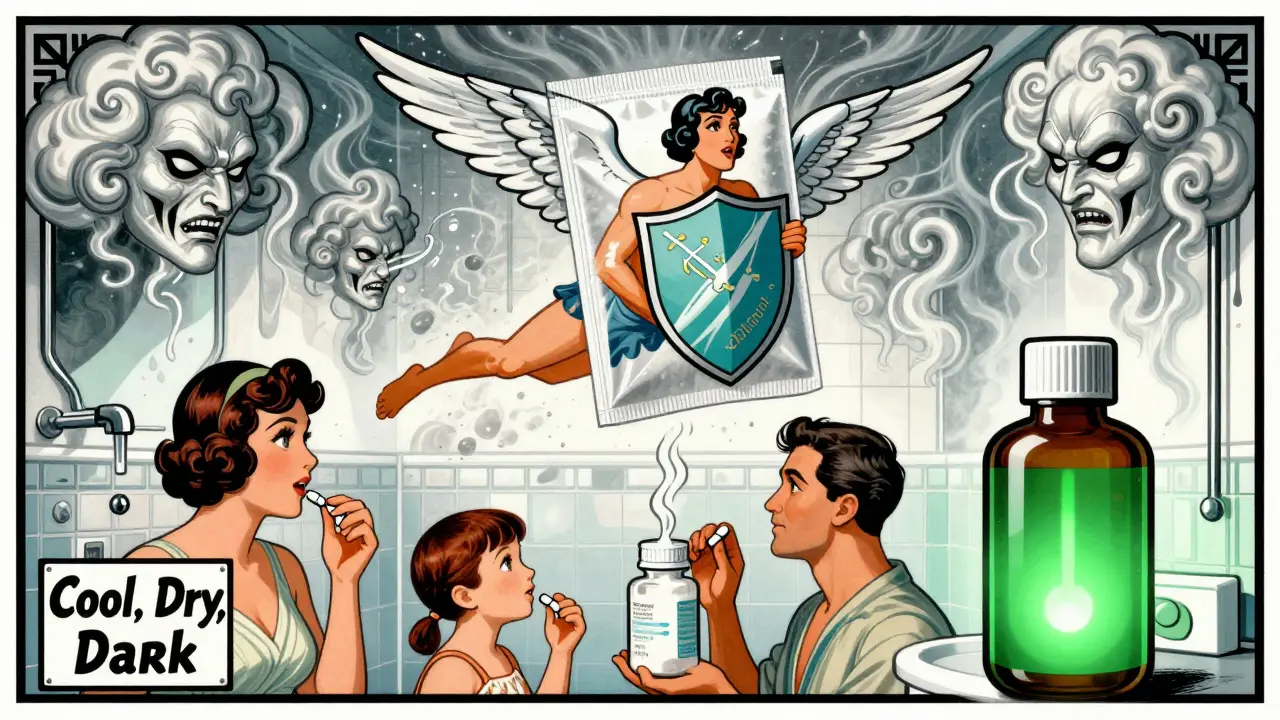
What You Can Do Today
You don’t need to be a scientist to protect your medication. Here’s a simple checklist:- Check your pill bottles. Do they have a foil seal under the cap? If not, ask your pharmacist if a better option is available.
- Look for the word “PVA-coated” or “Opadry” on the packaging. If you see it, you’re getting better protection.
- Keep your meds in a cool, dry place-not the bathroom, not the kitchen.
- If you use a pill organizer, only fill it for 7 days max and store the rest in the original bottle with a desiccant.
- Buy a small silica gel pack (available online for under £2) and put it in your medicine box. Reuse it as long as it stays blue.
When to Call Your Pharmacist
If you’ve noticed your medication isn’t working like it used to-if your blood pressure meds aren’t lowering your numbers, or your antibiotics seem less effective-it could be moisture damage. Don’t assume you’ve built up a tolerance. Talk to your pharmacist. They can check the batch, review storage conditions, and recommend a replacement with better moisture protection.Final Thought: It’s Not Just About Cost
Some people skip the desiccant or buy the cheapest bottle because it’s cheaper. But a damaged pill isn’t just a waste of money-it’s a risk to your health. A 2022 study found that 78% of pharmacists believe moisture damage reduces patient adherence because people stop taking meds they think aren’t working. Protecting your pills isn’t a luxury. It’s part of taking your treatment seriously.Can I store pills in the fridge to keep them dry?
Only if the label says to. Fridges cause condensation when you take items out, which can make moisture damage worse. Most pills are stable at room temperature (15-25°C) if kept dry. The fridge is only needed for specific medications like insulin or certain liquid antibiotics.
Are silica gel packets safe if they’re in the bottle with my pills?
Yes, they’re completely safe. Silica gel is non-toxic and FDA-approved for use in food and medicine packaging. It doesn’t react with drugs. Just don’t eat the packet-it’s not food, even if it looks like a candy pack.
How do I know if my desiccant pack is still working?
Many packs have a color indicator. Blue means dry, pink means saturated. If yours doesn’t change color, replace it every 6-12 months, especially in humid climates. You can also buy reusable silica gel that you dry out in the oven to reactivate.
Why do some pill bottles have no desiccant at all?
Some manufacturers use cheaper packaging and assume the pill coating is enough. But once the bottle is opened, that coating isn’t enough. This is especially common with generic drugs. If your bottle doesn’t have a desiccant and you live in a humid area, add one yourself.
Can I reuse silica gel packs from other products?
Yes, as long as they’re still dry and clean. You can take the silica gel from shoeboxes, electronics packaging, or new purses and put it in your medicine container. Just make sure it’s not the kind with moisture indicators that change color-those are often coated with dyes that aren’t meant for medicine.
Is it safe to take pills that have been exposed to moisture but still look okay?
No. Moisture damage isn’t always visible. A pill can look perfect but have lost 30% of its potency. If you suspect exposure-especially if it’s been in a damp place or the bottle was left open-don’t risk it. Return it to your pharmacy for safe disposal.
Anna Weitz
December 27, 2025 AT 14:52Moisture ruins meds like it ruins your socks after a rainstorm you just dont think about it till its too late
Raushan Richardson
December 28, 2025 AT 13:29This is so spot on I used to keep my vitamins in the bathroom until I saw my pills sticking together like gum on a hot day now theyre in a drawer with a silica pack and I swear I feel the difference
Robyn Hays
December 28, 2025 AT 23:48Love how this breaks it down without jargon but still gets the science right I used to think desiccants were just for electronics until I learned theyre lifesavers for meds too now I reuse every packet I find even from my new shoes
Babe Addict
December 29, 2025 AT 19:03Actually most of this is marketing nonsense. The real issue is that people dont understand pharmacokinetics. The coating is irrelevant if the API is hygroscopic. And silica gel? Its just a placebo for anxious consumers. The real solution is proper formulation not packaging theatrics.
Alex Lopez
December 30, 2025 AT 06:00Wow. Someone actually read the entire thing and didn't just skim for the word 'silica'. Congratulations. You're now smarter than 90% of Reddit. 🎩
John Barron
January 1, 2026 AT 00:23As a certified pharmaceutical logistics specialist with 22 years in GMP compliance I must emphasize that the 40% moisture resistance improvement cited for PVA coatings is derived from ISO 11607-2 testing protocols and validated via Karl Fischer titration. The claim is statistically significant at p < 0.01. Furthermore, the recommendation to use desiccants sized at 150% of expected moisture load is not merely best practice-it is mandated under EU Annex 11 for Class II medical devices. Failure to comply constitutes a Class II recall risk.
Additionally, the assertion that refrigeration induces condensation is accurate but incomplete. Thermal cycling above the dew point triggers nucleation on surfaces, which accelerates hydrolysis. The ideal storage environment is 15–25°C with relative humidity below 40%, maintained via passive humidity control, not active cooling. Refrigeration should only be employed for thermolabile biologics under controlled humidity protocols.
Regarding packaging: HDPE permeability to water vapor is approximately 0.5 g/m²/day at 38°C and 90% RH. Glass, while impermeable, introduces risks of breakage and leaching. The optimal solution is a multilayer coextruded polymer with EVOH barrier, which reduces WVTR to below 0.02 g/m²/day. Such packaging is increasingly adopted by Pfizer and Novartis for high-risk APIs.
As for reusable silica gel: While technically feasible, regeneration via oven drying at 120°C for 4 hours may introduce particulate contamination or residual volatiles. FDA guidance recommends single-use, pharmaceutical-grade desiccants for oral solid dosage forms. Reused packets from shoes or electronics may contain volatile organic compounds or dyes not approved for pharmaceutical contact.
Finally, the notion that pills can lose 30% potency without visible changes is empirically validated. A 2021 study in the Journal of Pharmaceutical Sciences demonstrated that amoxicillin in unsealed HDPE bottles retained only 68% potency after 14 days at 75% RH. Visual inspection is unreliable. Always return compromised medication to the pharmacy. Your life depends on it.
Satyakki Bhattacharjee
January 1, 2026 AT 12:35Why do Americans waste so much money on silica packets and fancy bottles? In India we just keep medicine in a dry cupboard and it works fine. You people make everything into a science project.
Kishor Raibole
January 2, 2026 AT 22:01It is with profound regret that I observe the proliferation of pseudoscientific advice in public discourse. The notion that desiccants can meaningfully preserve pharmaceutical integrity beyond the initial hermetic seal is not merely misguided-it is an affront to the rigorous principles of pharmacokinetic stability. The human body, a marvel of biochemical equilibrium, does not suffer from the whims of ambient humidity when administered correctly. The real issue lies in the commodification of fear by the pharmaceutical packaging industry.
Furthermore, the suggestion that one must replace silica gel packets every six to twelve months reveals a fundamental misunderstanding of thermodynamic equilibrium. Silica gel, being a non-reactive adsorbent, does not 'expire'-it saturates. And saturation, when understood as a state of equilibrium, does not imply danger but rather a condition of completion. To discard it prematurely is not vigilance-it is waste.
Let us not confuse vigilance with anxiety. The true medicine is not in the bottle, but in the discipline of the user. Store your pills in a cool, dry place. Do not overthink. Do not overpack. Do not become a slave to packets. The body remembers what the bottle forgets.
Liz Tanner
January 4, 2026 AT 09:24I appreciate how this guide avoids fear-mongering and just gives clear, practical steps. I used to toss the silica packets until I learned they’re safe and actually help. Now I keep one in my medicine box and it’s been a game-changer. Also, never storing meds in the bathroom? That was me. Oops.
Monika Naumann
January 5, 2026 AT 23:10In my country, we do not waste money on plastic packets and branded coatings. Our ancestors stored medicines in clay pots and lived longer. Modern science has lost its way in pursuit of profit, not health. This article is a symptom of Western overconsumption.
Nicola George
January 7, 2026 AT 19:36So let me get this straight-you’re telling me I shouldn’t store my antidepressants next to my spice rack because the steam from my curry might turn them into soup? Cool. I’ll just put them in a lead-lined vault with a tinfoil hat and a prayer.
Gerald Tardif
January 8, 2026 AT 06:05This is the kind of post that makes me believe people still care about doing things right. I used to be the guy who left his pills on the counter. Now I’ve got a little drawer with a silica pack and a label that says ‘Do Not Touch Unless You’re Taking One’. Small changes, big difference.
Elizabeth Ganak
January 8, 2026 AT 18:06I just started taking blood pressure meds and this was super helpful. I had no idea about the foil seal or PVA coating. I asked my pharmacist and they actually upgraded my bottle for free. Small win for being curious!
Liz MENDOZA
January 8, 2026 AT 23:36Thank you for writing this. I’ve been so anxious about my meds degrading and didn’t know where to start. This feels like someone finally gave me a map instead of just saying ‘be careful’. I’m going to get a silica pack today.
James Bowers
January 10, 2026 AT 18:27It is regrettable that such a comprehensive and scientifically grounded guide has been met with the usual chorus of amateur opinions and anecdotal misinformation. The author has clearly invested significant effort in aligning this content with regulatory frameworks and pharmacopeial standards. To dismiss desiccants as ‘useless’ or to equate proper storage with ‘Western overconsumption’ is not merely ignorant-it is dangerous. This post deserves to be archived as a reference standard.