
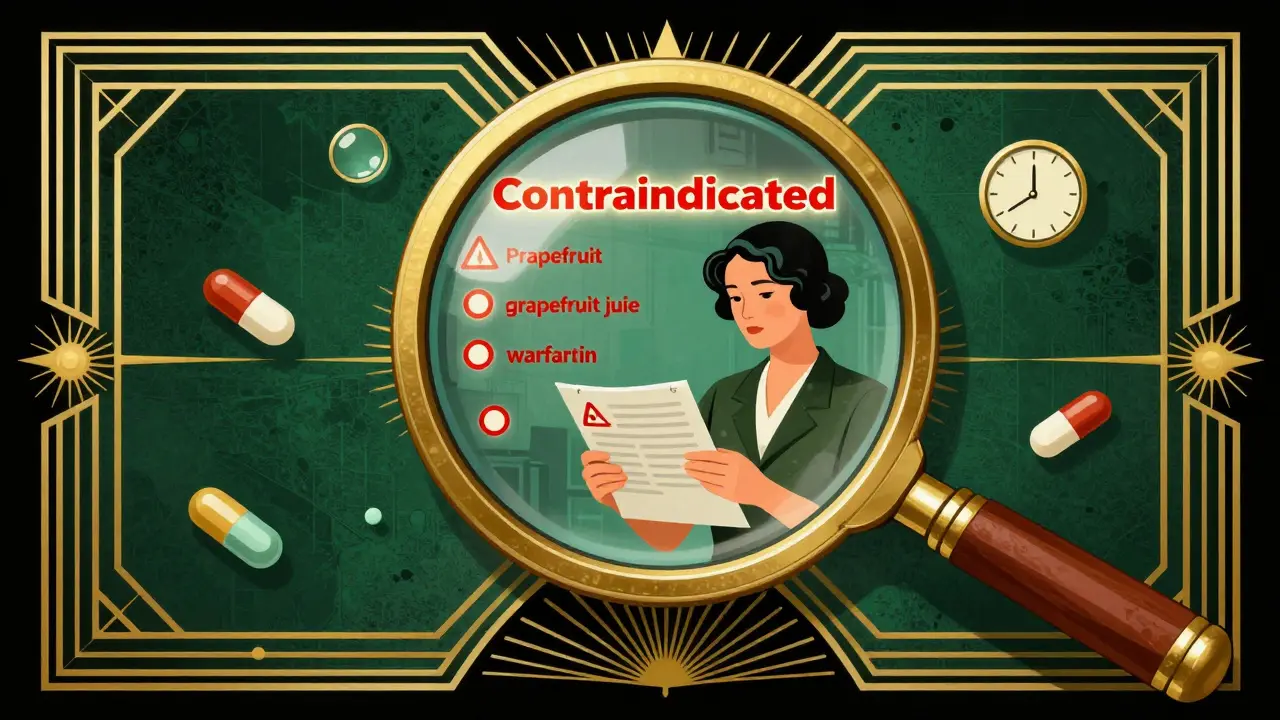
When you pick up a new prescription, the little paper guide that comes with it isn’t just filler. It’s your first line of defense against dangerous drug interactions. Yet most people skim it like a manual for a toaster they never use. That’s risky. Every year, drug interactions send tens of thousands to emergency rooms and contribute to thousands of deaths in the U.S. alone. You don’t need to be a pharmacist to understand what these warnings mean-you just need to know where to look and what to look for.
Where to Find Interaction Warnings
Interaction warnings don’t hide. They’re in clear, labeled sections, but they vary depending on whether your medicine is prescription or over-the-counter (OTC). For prescription drugs, the key section is called Drug Interactions. It’s usually Section 7 in the official prescribing information, but on the patient guide you get at the pharmacy, it’s often bolded or placed near the top. For OTC meds like painkillers or cold remedies, check the Warnings section on the Drug Facts label. That’s where you’ll see phrases like "Do not take with" or "Ask your doctor before use if you are taking..."
Don’t skip the fine print. Some of the most dangerous interactions happen with things you think are harmless-like ibuprofen, garlic supplements, or even grapefruit juice. The guide won’t say "be careful with everything." It will name exact substances and explain why they matter.
Understanding Severity Levels
Not all interactions are created equal. Medication guides use standardized language to tell you how serious a warning is. Here’s what to watch for:
- Contraindicated - This means don’t take them together. Period. Examples: warfarin with NSAIDs like ibuprofen, or simvastatin with clarithromycin. These combinations can cause life-threatening bleeding or muscle damage.
- Major - Can cause serious harm. You might still take both, but only under close supervision. For instance, sertraline and tramadol together can trigger serotonin syndrome-a rare but deadly condition.
- Moderate - May cause side effects that need monitoring. Like taking a blood pressure pill with a decongestant. Your doctor might adjust doses or check your numbers more often.
- Minor - Usually safe. Might cause mild stomach upset or drowsiness. Still worth noting, but not an emergency.
The FDA now requires all new medication guides to use these exact terms-no more vague phrases like "may interact." That change alone has improved patient understanding by over 40% since 2023.
Common Culprits Behind Drug Interactions
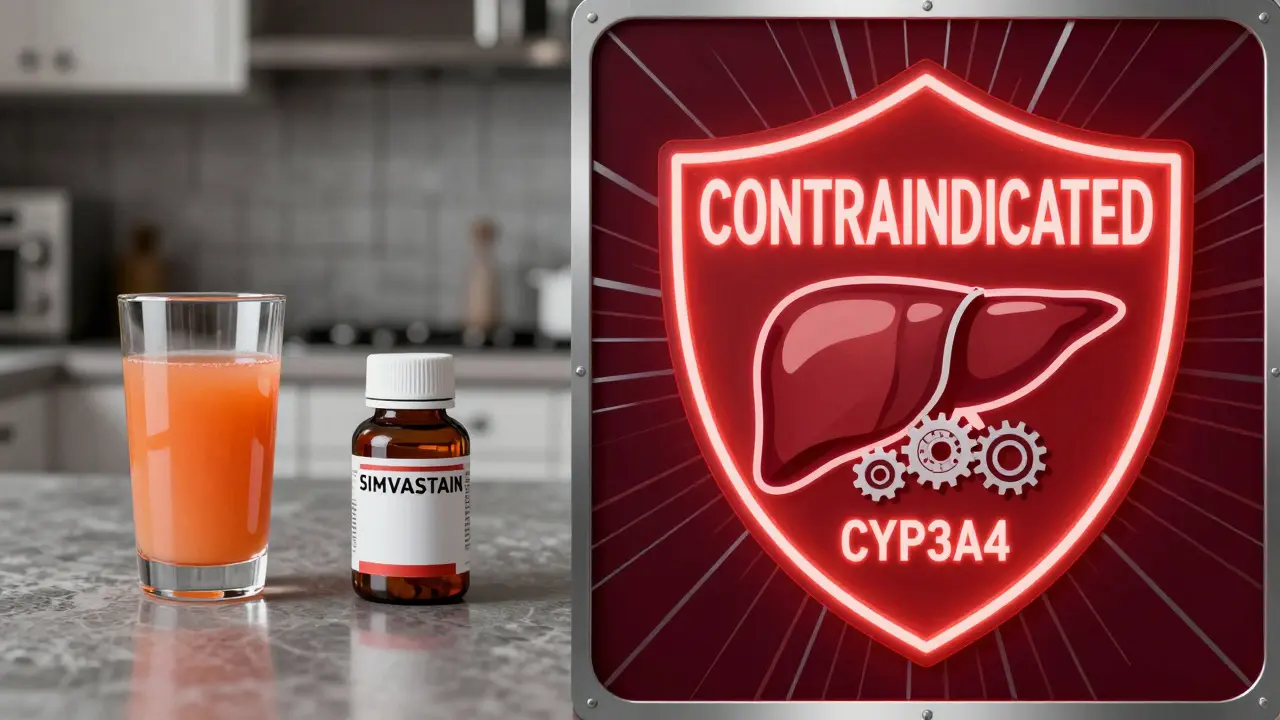
Most dangerous interactions involve how your body processes drugs. The main player? The cytochrome P450 enzyme system, especially CYP3A4. This is your liver’s main drug-processing machine. When one drug slows it down, others build up to dangerous levels.
Here are the top offenders:
- Strong CYP3A4 inhibitors - Clarithromycin, ketoconazole, grapefruit juice. These can make statins like simvastatin 10 times more potent, raising your risk of muscle breakdown.
- Anticoagulants - Warfarin, apixaban. These are sensitive to changes. Even small doses of aspirin, fish oil, or cranberry juice can spike bleeding risk.
- SSRIs and SNRIs - Sertraline, fluoxetine, venlafaxine. Mixing these with painkillers like tramadol or dextromethorphan can cause serotonin syndrome, which can lead to seizures or death.
- OTC cold meds - Pseudoephedrine, phenylephrine. These can raise blood pressure dangerously if you’re on beta-blockers or MAO inhibitors.
And don’t forget supplements. St. John’s wort, ginkgo, and garlic can interfere with over 50 common medications. Most patients don’t even think to mention them to their doctor.
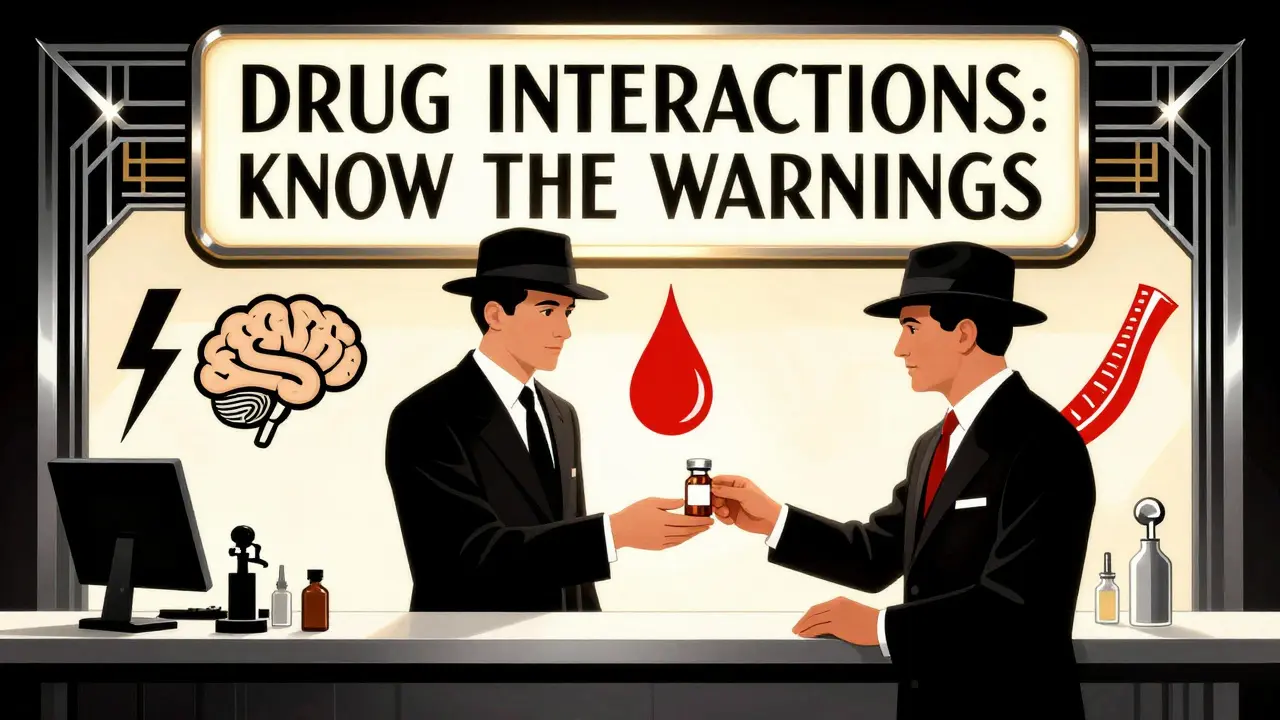
How to Read the Warnings Correctly
Reading the guide isn’t about memorizing every word. It’s about spotting patterns. Here’s how:
- Look for bold text. This signals absolute rules: "Do not take if..." or "Contraindicated with..."
- Watch for italics. These are cautionary notes: "Ask your doctor before use if you are taking..."
- Check for bullet points. They list specific drugs, supplements, or foods to avoid.
- Find the mechanism. If it says "increases blood levels of X" or "reduces effectiveness of Y," you know it’s not just a general warning-it’s a measurable risk.
For example, the apixaban guide says: "Increased risk of bleeding that can be fatal. Do not take if you have active pathological bleeding. Avoid concomitant use with other anticoagulants." That’s direct. No guessing.
What You’re Probably Missing
The biggest mistake patients make? Only checking their prescription drugs. According to FDA data, 37% of serious interactions involve OTC meds or supplements. You might take warfarin, but also take ibuprofen for back pain and a fish oil capsule for heart health. All three together? That’s a triple threat.
Another blind spot: timing. Many interactions happen because people take two drugs too close together. A 2021 study showed that spacing doses by just 2-4 hours reduces moderate interactions by 60%. So if your doctor says "take both in the morning," ask: "Can I take one at breakfast and the other at lunch?"
And food matters. Grapefruit isn’t just a fruit-it’s a drug interaction powerhouse. One glass can increase simvastatin levels by 300% for up to 24 hours. The guide might say "avoid grapefruit," but it won’t tell you that even a small amount can trigger this. That’s why you need to ask your pharmacist: "What exactly does ‘avoid’ mean?"
Tools to Help You Stay Safe
You don’t have to do this alone. Here’s what works:
- Keep a written list. Write down every medication, supplement, and herb you take-including doses and times. Update it every time something changes. 48% of patients who do this avoid serious interactions.
- Use the FDA’s Drug Interaction Checker. It’s free, updated quarterly, and searchable by brand or generic name. Just type in what you’re taking and it flags risks.
- Scan the QR code. Newer medication guides have QR codes that link to interactive digital versions. These often include voice readings, videos, and real-time alerts. Since January 2023, 37% of new drugs include them.
- Photograph your guides. Snap a picture of each one with your phone. That way, you can search them later when you’re at the pharmacy or talking to a doctor.
Some hospitals now generate personalized interaction reports from your electronic records. A 2022 Mayo Clinic pilot study found this cut interaction incidents by 42%. Ask your doctor if your clinic offers something like this.
What’s Changing in 2025
The FDA is making big changes. Starting January 1, 2025, every new drug application must include a scannable QR code linking to a digital guide with voice navigation. That’s huge for people with low vision or reading difficulties. Also, by December 2025, all medication guides will use the same three severity levels: Contraindicated, Avoid, and Use with Caution. No more confusing terms like "potential risk" or "conditional warning."
Generic drugs are still lagging-only 53% of their guides meet current readability standards. But if you’re prescribed a generic, ask for the brand-name guide. The warnings are often identical, and the brand version is usually clearer.
Real Stories, Real Risks
One Reddit user, "MedTechSarah," caught a dangerous interaction between sertraline and tramadol because she read both medication guides. She noticed the serotonin syndrome warning and called her doctor before taking them together. She avoided a trip to the ER.
Another user, "ChronicPainPatient," was confused by warfarin’s warning to "avoid grapefruit." He didn’t know one glass could spike his INR by 1.5-2.0 in a day. He almost had a bleed. After talking to his pharmacist, he now keeps a log of everything he eats and drinks.
These aren’t rare cases. A 2022 Consumer Reports survey found that 78% of patients read their medication guides-but only 32% could correctly identify a major interaction. The rest missed the signs because the warnings weren’t clear enough-or they didn’t know what to look for.
Your Action Plan
Here’s what to do right now:
- Grab every medication guide you have at home-prescription and OTC.
- Find the "Drug Interactions" or "Warnings" section in each.
- Circle any drug, supplement, or food that’s listed as a risk.
- Compare them to your current list of what you take.
- Call your pharmacist. Say: "I’m on these meds. Are any of these combinations dangerous?"
- Take a photo of each guide and save it on your phone.
- Update your list every time you get a new prescription or start a new supplement.
You don’t need to be an expert. You just need to be careful. Medication guides are written to protect you-not to confuse you. Once you know how to read them, you’re not just following instructions-you’re taking control of your health.
What should I do if I see a warning I don’t understand?
Don’t guess. Call your pharmacist or doctor. Ask them to explain the warning in plain language. For example, if it says "avoid grapefruit," ask: "Does that mean no juice, no fruit, or just not at the same time as my pill?" Pharmacists are trained to break this down for patients.
Can I skip a medication if it has interaction warnings?
Never stop a prescribed medication without talking to your doctor. Some warnings mean you need to adjust the dose, take it at a different time, or get more frequent blood tests-not that you should quit entirely. For example, warfarin and vitamin K-rich foods can be managed with consistent intake, not elimination.
Are generic drugs less safe than brand names when it comes to interactions?
No. The active ingredient is the same, so the interaction risks are identical. But generic medication guides are often written in harder-to-read language. If the generic guide is unclear, ask your pharmacist for the brand-name guide-it will have the same warnings, just clearer.
Do herbal supplements count as drugs in interaction warnings?
Yes. Supplements like St. John’s wort, ginkgo, garlic, and even high-dose vitamin E can interfere with blood thinners, antidepressants, and heart medications. They’re not regulated like drugs, but they still trigger real biological reactions. Always list them on your medication sheet.
How often should I review my medication guides?
Every time you get a new prescription, refill a medication, or start a new supplement. Also, review them at least twice a year-even if nothing changed. New research comes out constantly. A drug that was safe last year might have a new warning this year.
Can pharmacies help me check for interactions?
Absolutely. Most pharmacies have software that checks all your medications when you fill a new prescription. But don’t rely on it alone. Ask the pharmacist: "I’m also taking [list supplements]. Are there any interactions I should know about?" Many will do a free review if you ask.
Ethan Purser
January 6, 2026 AT 03:26So let me get this straight-you’re telling me grapefruit juice is basically a silent drug assassin? I’ve been drinking it with my statin like it’s some kind of morning ritual. Guess I’m switching to orange juice… or maybe just alcohol. At this point, I’m not sure what’s worse.
Doreen Pachificus
January 6, 2026 AT 05:48I read my meds guide once and got overwhelmed. I put it in a drawer and forgot about it. Then my cousin had a bad reaction to mixing OTC cold meds with her blood thinner. Now I keep them on my fridge with a sticky note: ‘READ THIS BEFORE YOU TAKE IT.’ Simple. But it works.
Vicki Yuan
January 6, 2026 AT 20:36Thank you for writing this with such clarity. As someone who manages multiple chronic conditions, I’ve learned the hard way that pharmacists are your best allies-not just dispensers of pills. I now schedule a 10-minute med review every time I refill anything. They catch things the doctor misses. And yes, I list every supplement-even the ‘harmless’ ones like turmeric. Turns out, it’s a blood thinner too. Who knew?
Also, the QR code tip? Genius. I scanned mine last week and got a 90-second video explaining why I shouldn’t take my antidepressant with St. John’s wort. It showed a visual of enzyme inhibition. I actually understood it. That’s the future right there.
Uzoamaka Nwankpa
January 7, 2026 AT 07:30I came here because I was told to read this. I didn’t want to. I don’t trust doctors. I don’t trust pharmacies. I don’t trust labels. But I’m still here. Maybe because I’m tired of being sick. Maybe because I’m tired of being told I’m ‘non-compliant.’ This guide didn’t fix me. But it didn’t talk down to me either. That’s rare.
Akshaya Gandra _ Student - EastCaryMS
January 7, 2026 AT 12:29so i just found out my ginkgo biloba is bad with my blood pressure med?? i thought it was just for memory?? lol oops
Angie Rehe
January 8, 2026 AT 22:20Let’s be real-this post is just another corporate FDA-approved fear campaign wrapped in pseudoscientific jargon. CYP3A4? Seriously? Most people don’t even know what a cytochrome is. You’re not empowering patients-you’re overwhelming them with terminology that serves no purpose other than to make pharmacists feel superior. The real problem? Lack of access. Not education. You can’t ‘read your way out’ of a system that doesn’t give you time, money, or consistent care.
And don’t get me started on QR codes. Not everyone has a smartphone. Not everyone can afford data. And not every pharmacy updates their digital guides. This feels like performative safety.
Jacob Milano
January 10, 2026 AT 22:12I used to think my meds were just… pills. Then I had a panic attack after mixing tramadol with my Zoloft. Turns out, serotonin syndrome isn’t just a scary word-it’s your brain screaming for help. I spent three days in the ER. They said I was lucky I didn’t seize. Now I carry a laminated card in my wallet with every med I take. I show it to every new doctor. I even showed it to my dentist. He laughed. Then he Googled it. Now he asks me before giving me anything. That’s power right there.
Also, grapefruit juice? I don’t even buy it anymore. I used to love it. Now it’s just a reminder that my body doesn’t play nice with ‘natural’ things. And honestly? That’s okay. I’d rather live a little boring than die a little too soon.
Aaron Mercado
January 11, 2026 AT 16:36STOP. RIGHT. NOW. I’ve seen this happen too many times. People read the guide, nod, say ‘I got it,’ then go right back to taking ibuprofen with warfarin because ‘it’s just one pill.’ One pill. ONE. PILLLLL. And then they end up in the ER with a GI bleed. And the doctor has to say, ‘Didn’t you read the label?’ And they say, ‘I thought it meant something else.’ No. It didn’t. It said ‘CONTRAINDICATED.’ In bold. In caps. With a skull emoji if they could’ve added one. You’re not just risking your life-you’re wasting hospital resources, endangering nurses, and making doctors lose sleep. Read. The. Guide. Or don’t. But don’t act surprised when you’re the statistic.
saurabh singh
January 13, 2026 AT 14:30Bro, this is gold. I’m from India, and here, everyone takes herbs with their pills-ashwagandha, turmeric, amla. No one thinks twice. But after reading this, I sat my mom down and showed her how garlic and blood thinners can be a deadly combo. She didn’t believe me until I showed her the FDA guide. Now she keeps a little notebook. We even made a chart with colors: red = no way, yellow = ask doc, green = fine. Simple. Local. Works. Thanks for the clarity.
Vikram Sujay
January 15, 2026 AT 13:59While the practical advice presented is commendable, one must consider the epistemological foundations of patient autonomy in pharmaceutical literacy. The assumption that textual comprehension alone equates to safety presumes a level of cognitive bandwidth and sociocultural capital that is not universally distributed. The burden of vigilance, thus, disproportionately falls upon those least equipped to bear it-precisely the populations most vulnerable to adverse outcomes. A systemic solution, rather than an individualized one, remains imperative.
Allen Ye
January 15, 2026 AT 19:29Look, I get it-reading the guide is important. But here’s the real issue nobody’s talking about: the fact that these guides are written by lawyers, not doctors, and approved by bureaucrats who’ve never held a pill in their hand. The language is sanitized to avoid liability, not to inform. ‘Contraindicated’ sounds scary, but what does it actually mean for someone with no biology background? And why do we still use Latin terms like ‘CYP3A4’ in a patient-facing document? It’s not education-it’s gatekeeping dressed up as safety. The QR codes? Nice gimmick. But if the digital version still uses the same confusing jargon, you’re just digitizing the problem. We need plain language. We need visuals. We need voice. And we need it yesterday.
Also, the fact that generic guides are worse? That’s not a bug-it’s a feature. Big pharma wants you to buy the brand. Don’t be fooled.
mark etang
January 17, 2026 AT 04:06It is imperative that all patients engage in diligent pharmacovigilance. The integration of digital tools, coupled with consistent patient education, represents a paradigm shift in medication safety. One must not underestimate the significance of structured documentation and proactive consultation with licensed pharmacy professionals. Adherence to these protocols is not optional-it is a fundamental component of responsible healthcare stewardship.
John Ross
January 17, 2026 AT 04:31Let’s be honest-most people don’t care until they’re in the ER. This post is great, but it’s preaching to the choir. The real target audience? The guy who takes his wife’s blood pressure meds because he’s too lazy to make an appointment. The one who pops Tylenol PM with his antidepressant because he can’t sleep. The one who thinks ‘natural’ means ‘safe.’ You can’t educate them with a guide. You need a system. A pharmacy alert. A mandatory counseling session. A warning on the bottle that screams. Because right now? We’re just handing out pamphlets to people who don’t read.