
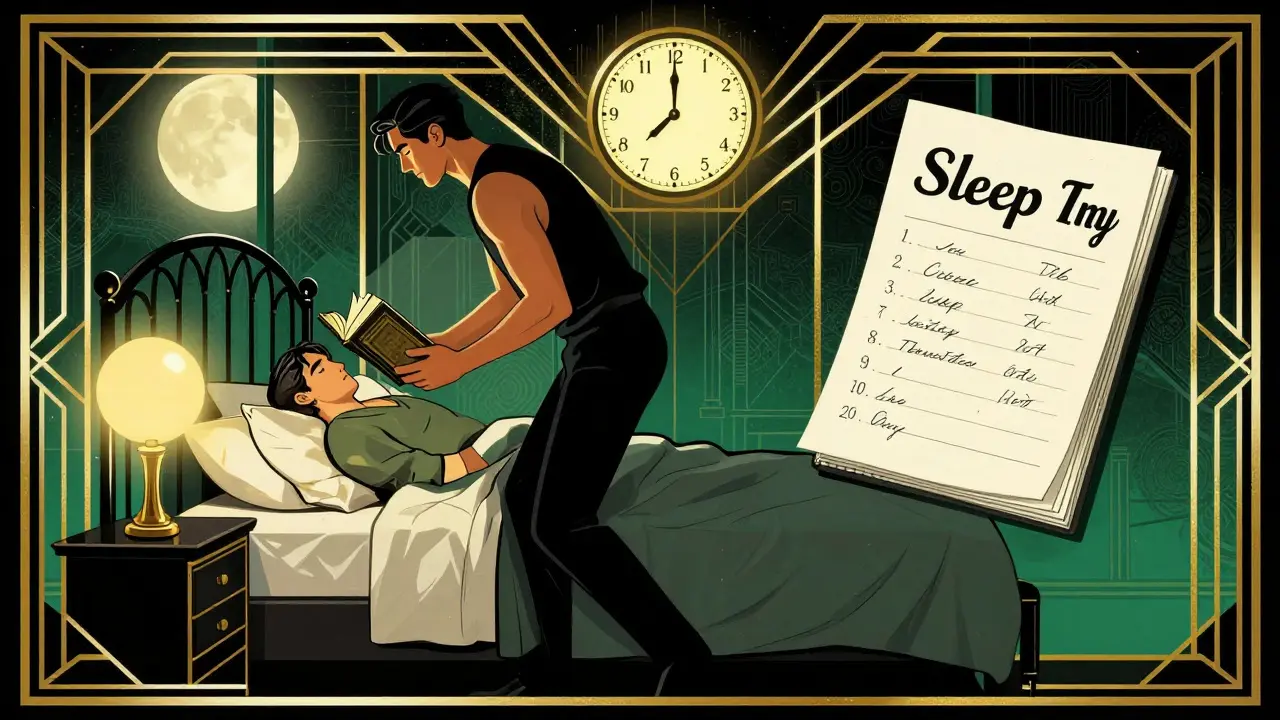
What if you could fix your insomnia without pills, without side effects, and without waking up groggy every morning? It’s not a fantasy. For over 40 years, doctors and researchers have been perfecting a method that works better than sleeping pills for most people - and it doesn’t involve taking anything at all. This method is called Cognitive Behavioral Therapy for Insomnia, or CBT-I. And it’s not just a trend. It’s the first-line treatment recommended by the American College of Physicians, backed by dozens of clinical studies, and used by millions of people who finally got their sleep back - without drugs.
Why Pills Don’t Solve Insomnia
Sleeping pills might help you fall asleep the first night. But after a few weeks, they stop working as well. Your body builds tolerance. You need more to get the same effect. Then you start worrying about withdrawal. Or worse - you wake up feeling foggy, unbalanced, or even more anxious than before. Studies show that while pills can reduce the time it takes to fall asleep by about 15 minutes on average, those gains vanish once you stop taking them. And for many, insomnia comes back stronger than ever.CBT-I doesn’t mask the problem. It fixes the root causes. It teaches your brain and body how to sleep naturally again. No chemicals. No dependency. Just real, lasting change.
How CBT-I Works (The Science Behind It)
CBT-I isn’t one trick. It’s a system made up of five proven techniques, all backed by peer-reviewed research. Together, they retrain your sleep system. Think of it like physical therapy - but for your sleep.Let’s break down what actually happens in a typical CBT-I program:
- You track your sleep for 1-2 weeks using a simple diary - when you go to bed, when you get up, how long it takes to fall asleep, how many times you wake up.
- Your sleep efficiency (the percentage of time in bed actually spent sleeping) is calculated. Most people with chronic insomnia have efficiency below 75%. The goal? Get it above 85%.
- You learn to associate your bed with sleep - not stress, not scrolling, not lying awake worrying.
- You gradually reduce the time you spend in bed to match how much sleep you’re actually getting - which sounds counterintuitive, but it works.
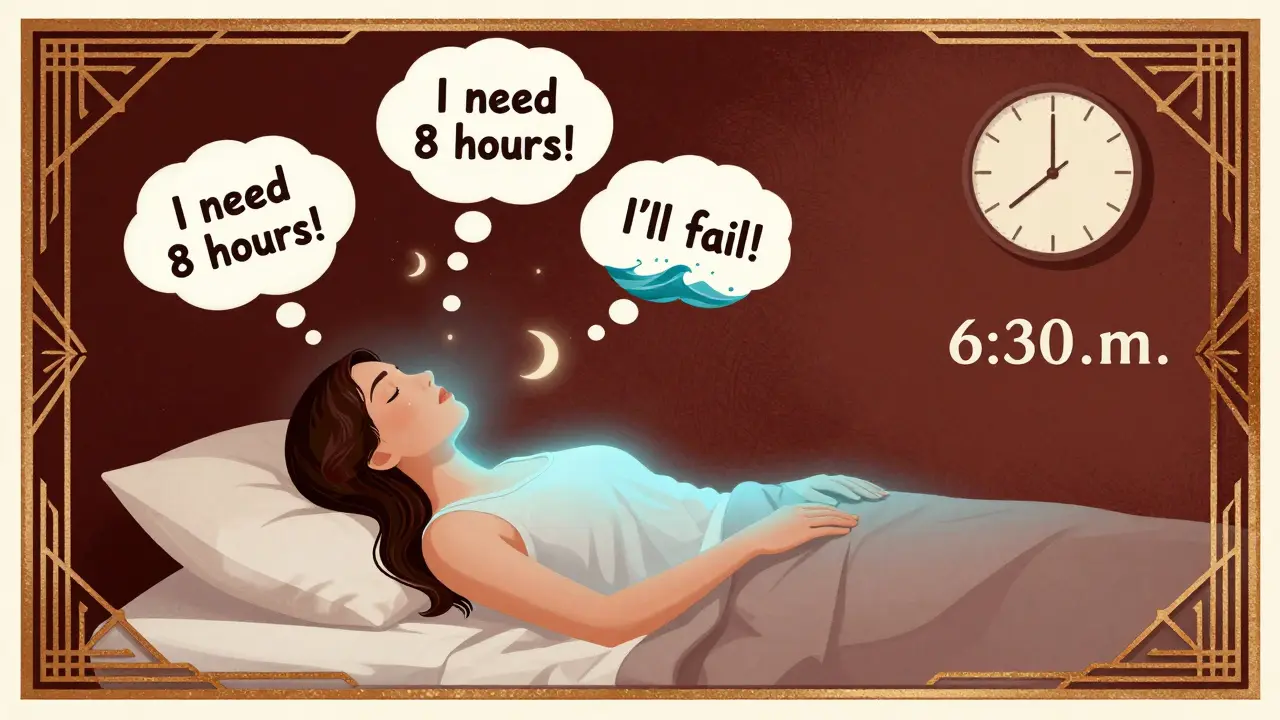
- You challenge the thoughts that keep you awake: “I need 8 hours or I’ll fail at work,” or “If I don’t sleep tonight, I’m ruined.”
A 2023 study in JAMA Network Open followed over 1,200 people using digital CBT-I. After six months, 76% of them still had significantly better sleep. That’s not a fluke. That’s science.
Technique #1: Stimulus Control - Rebuild the Bed-Sleep Connection
Your bed should be a sleep-only zone. That’s the core idea of stimulus control therapy.If you’ve been lying in bed for an hour, staring at the ceiling, your brain starts to associate your bed with frustration - not rest. CBT-I breaks that link.
Here’s how to do it:
- Only go to bed when you’re sleepy - not just tired.
- Get out of bed if you haven’t fallen asleep after 20 minutes. Go to another room. Do something quiet and dimly lit - read a book, listen to calm music. No screens.
- Don’t return to bed until you feel sleepy again.
- Repeat this every night, even if you wake up in the middle of the night.
- Use your bed only for sleep and sex. No work. No phone. No Netflix.
- Wake up at the same time every day - even on weekends. No exceptions.
This isn’t easy at first. You might feel more tired. But within a week or two, your brain starts to recognize: bed = sleep. And that’s when things begin to shift.
Technique #2: Sleep Restriction - Less Time in Bed = Better Sleep
This is the most counterintuitive part of CBT-I - and the most powerful.You’re probably spending 8, 9, even 10 hours in bed trying to get 6 hours of sleep. That’s why you’re lying awake so much. Your body isn’t tired enough to fall asleep quickly.
Here’s the fix:
- Look at your sleep diary. What’s your average total sleep time over the past week? Let’s say it’s 5.5 hours.
- That becomes your new time-in-bed limit. You only allow yourself 5.5 hours in bed - even if you feel exhausted.
- Set a fixed wake-up time (e.g., 6:30 a.m.). Then calculate your bedtime: 6:30 a.m. minus 5.5 hours = 1:00 a.m.
- Go to bed at 1:00 a.m. Wake up at 6:30 a.m. No naps. No extra time.
Yes, you’ll feel tired for the first few days. That’s normal. You’re creating mild sleep pressure - just enough to make sleep deep and efficient.
After a week or two, if your sleep efficiency (sleep time ÷ time in bed) hits 85% or higher, you can add 15 minutes to your time in bed. Keep doing this until you’re sleeping 7-8 hours naturally - without forcing it.
A 2015 meta-analysis of 20 studies found that sleep restriction alone reduced the time people spent awake after falling asleep by 26 minutes on average. That’s almost half an hour of extra rest per night - without a single pill.
Technique #3: Cognitive Restructuring - Stop the Nighttime Panic
Your thoughts are sabotaging your sleep. Not your body. Not your biology. Your mind.Common thoughts that keep people awake:
- “I have to sleep 8 hours or I’ll be useless tomorrow.”
- “If I don’t sleep tonight, I’ll lose my job.”
- “I’ve been awake for 3 hours - I’ll never fall asleep.”
These aren’t facts. They’re fears dressed up as truths. CBT-I helps you challenge them.
Try this exercise:
- Write down the thought that pops up when you can’t sleep.
- Ask: “Is this thought helpful?”
- Ask: “What’s the evidence for this? What’s the evidence against it?”
- Replace it with a more balanced thought: “I can still function on 5 hours. My body will recover. Worrying won’t make me sleep faster.”
One study found that people who practiced cognitive restructuring reduced their nighttime anxiety by 60% in just four weeks. Less anxiety = less wakefulness.
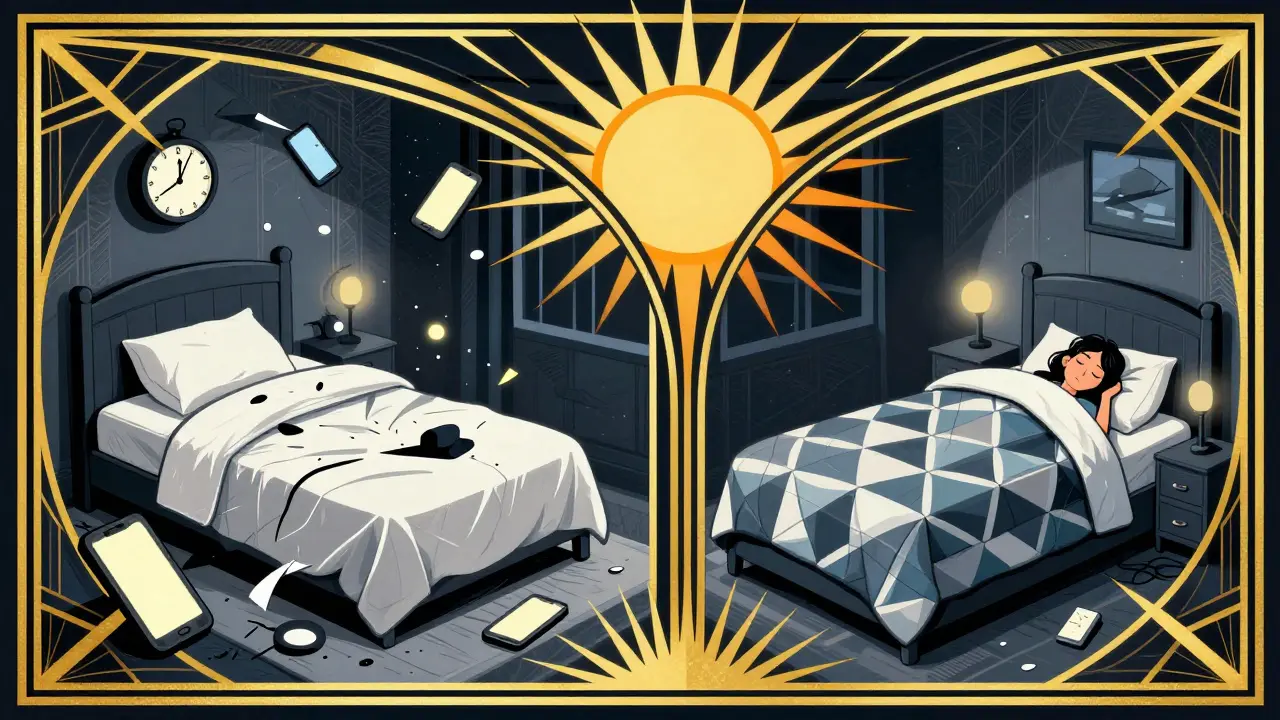
Technique #4: Sleep Hygiene - What You Do During the Day Matters
Sleep hygiene isn’t about rules. It’s about awareness.Here’s what actually helps:
- Get natural light in the morning - even 10 minutes outside helps reset your internal clock.
- Avoid caffeine after 2 p.m. - it stays in your system for 6-8 hours.
- Limit alcohol. It might make you drowsy, but it fragments your sleep later in the night.
- Don’t eat heavy meals within 2-3 hours of bedtime.
- Keep your bedroom cool (around 65°F or 18°C), dark, and quiet.
But here’s the catch: sleep hygiene alone doesn’t cure insomnia. It supports the real work - stimulus control and sleep restriction. Think of it like brushing your teeth. It’s important, but it won’t fix a cavity.
Technique #5: Relaxation Training - Calm Your Nervous System
Insomnia isn’t just about being unable to fall asleep. It’s about being stuck in “fight-or-flight” mode.Try this simple breathing exercise before bed:
- Inhale slowly through your nose for 4 seconds.
- Hold for 4 seconds.
- Exhale through your mouth for 6 seconds.
- Pause for 2 seconds.
- Repeat for 5 cycles.
This activates your parasympathetic nervous system - the one that says, “It’s safe to sleep.”
Progressive muscle relaxation also works well: tense each muscle group for 5 seconds, then release. Start at your toes and work up to your forehead. You’ll feel your body soften - and your mind quiet.
What to Expect in the First Week
Let’s be honest: the first few days of CBT-I are hard. You might feel worse before you feel better.During sleep restriction, you’ll likely lose 30-60 minutes of sleep in the first week. That’s intentional. Your body needs to build up sleep pressure to reset the system.
Don’t give up. This is the phase most people quit. But if you stick with it, your sleep efficiency will climb. By week 4, most people report falling asleep faster and waking up less. By week 6, many say they feel like they’ve “gotten their life back.”
Digital CBT-I: The Easiest Way to Start
Finding a CBT-I therapist can be tough. There are only about 1,500 certified behavioral sleep specialists in the entire U.S.Thankfully, you don’t need to see someone in person. Digital CBT-I programs - like Sleepio, CBT-i Coach, and Somryst - deliver the same techniques through apps and websites. They include sleep diaries, automated feedback, guided exercises, and progress tracking.
A 2023 study showed digital CBT-I achieved a 77% response rate at one month - matching in-person results. And it’s covered by Medicare and 85% of private insurers now.
Who Benefits Most From CBT-I?
CBT-I works for almost everyone with chronic insomnia:- Adults over 40 - who struggle with sleep maintenance
- Teens - where medication is often avoided
- Pregnant people - who can’t take sleep meds
- People with PTSD, cancer, or chronic pain
- Shift workers - with consistent routines
A 2024 study found CBT-I was the most effective treatment for adolescents with insomnia - better than medication, with no side effects. That’s huge.
Why CBT-I Lasts When Pills Don’t
Sleeping pills treat the symptom. CBT-I treats the cause.When you stop taking pills, your brain forgets how to sleep on its own. But when you learn CBT-I, you gain skills - tools you can use for life.
People who complete CBT-I don’t just sleep better for a few weeks. They sleep better for years. The improvements keep growing after treatment ends. That’s because you’re not relying on a chemical. You’re relying on your own biology - retrained and restored.
Getting Started: Your 7-Day Plan
Here’s how to begin today:- Get a sleep diary (free templates online). Track bedtime, wake time, time to fall asleep, awakenings, and how you feel in the morning.
- Calculate your average sleep time over 7 days.
- Set a fixed wake-up time. Don’t change it, even on weekends.
- Calculate your bedtime: wake-up time minus your average sleep time.
- For the next 7 days, only go to bed at that time. Get up at that time. No exceptions.
- If you’re awake for more than 20 minutes, get up. Do something quiet. Don’t check the clock.
- At the end of the week, review your diary. You’ll already see a difference.
You don’t need to be perfect. You just need to be consistent.
Final Thought: You’re Not Broken
Insomnia isn’t a flaw. It’s a learned habit. And habits can be unlearned.CBT-I isn’t magic. It’s method. It’s effort. But it’s worth it. Thousands of people have done it. You can too. No pills. No side effects. Just better sleep - for good.
Can CBT-I help if I’ve been on sleeping pills for years?
Yes. Many people who’ve relied on sleeping pills for years successfully transition to CBT-I. The process often starts by gradually reducing medication under a doctor’s supervision while beginning CBT-I techniques. Research shows CBT-I is more effective long-term than medication, even when used together. Most people find they can stop pills within 4-8 weeks of starting CBT-I, with no rebound insomnia.
How long until I see results from CBT-I?
Most people notice small improvements in sleep quality within 2-3 weeks. The biggest changes - falling asleep faster, waking up less - usually show up by week 4-6. The 2023 JAMA study found 77% of users had meaningful improvement by the first month. It’s not instant, but it’s lasting.
Do I need a therapist to do CBT-I?
No. While working with a certified behavioral sleep therapist is ideal, digital CBT-I programs like Sleepio and CBT-i Coach are clinically proven to be just as effective for most people. These apps guide you through each step, track your progress, and adjust your plan based on your sleep data. Many are covered by insurance.
What if I can’t stick to the same wake-up time on weekends?
Consistency is key. Even a 30-minute variation can disrupt your progress. If you’re struggling, start by limiting weekend changes to no more than 1 hour. The goal isn’t perfection - it’s building a rhythm your body can rely on. Over time, your body will naturally want to wake up at the same time, even without an alarm.
Is CBT-I effective for people with anxiety or depression?
Yes. In fact, CBT-I often improves symptoms of anxiety and depression alongside sleep. Poor sleep worsens mood disorders, and fixing sleep can break that cycle. Studies show CBT-I reduces anxiety about sleep by 60% and improves overall mood - even without additional therapy. It’s one of the few treatments that helps both sleep and mental health at the same time.
If you’ve tried everything and still can’t sleep, CBT-I isn’t just another option - it’s the most proven path forward. Start with your sleep diary today. You’ve got nothing to lose - and years of good sleep to gain.
Shanahan Crowell
January 2, 2026 AT 11:23This is the most life-changing thing I’ve ever read about sleep!! I’ve been on zzz-pills for 7 years-7 YEARS-and after 3 weeks of CBT-I, I’m sleeping 7 hours straight without an alarm. I cried the first morning I woke up without that foggy brain. Thank you for this. Seriously. I’m telling everyone.
Kerry Howarth
January 3, 2026 AT 04:28Stimulus control works. I tried it last month. Bed = sleep only. No phone. No TV. Got up after 20 minutes. First week was brutal. Week 3? I fell asleep in 8 minutes. No pills. No supplements. Just discipline.
Joy F
January 4, 2026 AT 06:08Let’s be real-this isn’t ‘therapy.’ It’s behavioral conditioning. You’re training your amygdala to stop screaming ‘DANGER, NO SLEEP’ every time you lie down. It’s Pavlov meets neuroscience, and frankly, it’s terrifying how effective it is. The fact that Big Pharma doesn’t want you to know this? That’s not a coincidence. That’s capitalism.
They make billions off your sleeplessness. CBT-I? It’s free. It’s sustainable. It’s dangerous to their business model. So they bury it under ‘sleep hygiene tips’ and ‘melatonin gummies.’
And don’t get me started on ‘sleep trackers.’ Those devices are psychological torture. They turn rest into a performance metric. You’re not a robot. You’re not a data point. You’re a human being trying to survive a world that never lets you rest.
But hey-thanks for the method. It’s the only thing that’s worked. Even if it’s a system designed to make you compliant with a broken society.
Haley Parizo
January 5, 2026 AT 07:35People think sleep is about relaxation. It’s not. It’s about control. Control over your circadian rhythm. Control over your thoughts. Control over the narrative your brain keeps repeating like a broken record: ‘You’re failing. You’re not enough.’ CBT-I doesn’t fix sleep-it fixes your relationship with yourself.
And let’s be honest: if you’re still relying on pills, you’re not broken. You’re just out of options. The system failed you. The doctors failed you. But this? This is your reclamation.
Stop begging your body to sleep. Start commanding it. And it will listen.
Michael Burgess
January 5, 2026 AT 18:34Just did the 4-4-6-2 breathing last night. 😴 I didn’t even finish all 5 cycles. I was out. Like, instantly. No meds. No app. Just breath. I’m not a believer in ‘woo-woo’ stuff-but this? This is science with a pulse. I’m telling my whole family. Also, I got a printable sleep diary from the NIH site-link in replies if anyone wants it. 🙌
Liam Tanner
January 6, 2026 AT 17:06I’ve been doing CBT-I for 8 weeks now. I used to wake up 4-5 times a night. Now it’s maybe once. I still have bad nights-but I don’t panic anymore. That’s the real win. The tools work. You just have to show up.
Lori Jackson
January 8, 2026 AT 06:58Oh please. You think this is some revolutionary ‘natural’ solution? Everyone’s been told to ‘sleep hygiene’ since the 90s. The real reason this works is because it’s a placebo wrapped in jargon. You’re not ‘retraining your brain’-you’re just forcing yourself to be tired. And if you’re not sleeping? You’re just weak. Or lazy. Or mentally unfit.
Meanwhile, doctors are prescribing benzodiazepines like candy. But no, let’s blame the patient for not being ‘disciplined’ enough. Classic.
Wren Hamley
January 8, 2026 AT 21:19Wait-so if I’m only allowed 5.5 hours in bed, and I average 5.5 hours of sleep… why am I not sleeping 100% of that time? Isn’t that mathematically impossible? Or am I missing something? I feel like I’m being gaslit by sleep science.
Also-can someone explain why ‘sleep restriction’ doesn’t just make you chronically sleep-deprived? Like, isn’t that the whole problem?
Ian Ring
January 10, 2026 AT 11:47Interesting stuff-though I’d be cautious about the ‘no exceptions’ rule for wake-up times. In my experience, consistency matters-but so does flexibility. I’ve found that allowing a 45-minute window on weekends helps maintain the rhythm without triggering resentment. Also, I use a sleep diary app called Sleep Cycle-highly recommend. The graphs are oddly satisfying.
And yes-CBT-I works. I’ve been off melatonin for 11 months now. Still wake up at 5:45 a.m. like a clock. 🕰️
JUNE OHM
January 11, 2026 AT 04:59THIS IS A GOVERNMENT COVER-UP. THEY DON’T WANT YOU TO KNOW SLEEP CAN BE FIXED WITHOUT DRUGS. WHY? BECAUSE THEY’RE SELLING YOU ANXIETY THROUGH SOCIAL MEDIA AND THEN PROFITING OFF SLEEP PILLS. THE CDC IS IN ON IT. I’VE SEEN THE DOCUMENTS. 🤫
Also, I’ve been doing this for 2 weeks and my cat’s been staring at me weirdly. Coincidence? I THINK NOT.
Philip Leth
January 13, 2026 AT 03:35Man, I tried this after my divorce. Wasn’t sleeping for 3 months straight. Did the 20-minute rule-got up, read a book, came back. First night? Still awake. Second night? Same. Third night? Fell asleep in 12 minutes. Now I’m sleeping like a baby. No pills. No weird herbs. Just… patience. And a really good pillow.
Angela Goree
January 14, 2026 AT 20:07Why is everyone acting like this is some new-age miracle? I’ve been doing this since 2012. I’m a veteran. I’ve been through 3 different therapists. I’ve got the sleep logs. I’ve got the graphs. I’ve got the scars. This isn’t a trend. It’s a lifeline. And if you’re not doing it-you’re just choosing to suffer.
Tiffany Channell
January 16, 2026 AT 09:11Let me guess-you’re one of those people who thinks ‘sleep efficiency’ is a real metric? You think your worth is measured by how many hours you spend unconscious? That’s not health. That’s optimization culture. You’re not fixing insomnia. You’re just becoming a slave to your sleep tracker.
And don’t even get me started on ‘digital CBT-I.’ You’re letting an algorithm dictate your rest? That’s not therapy. That’s surveillance with a wellness veneer.
Real sleep isn’t quantifiable. It’s sacred. And you’ve turned it into a spreadsheet.
Ian Detrick
January 17, 2026 AT 02:51What’s wild is how CBT-I mirrors Buddhist mindfulness practices-observing thoughts without judgment, accepting discomfort, letting go of control. It’s ancient wisdom wrapped in modern science. The brain doesn’t care if you call it ‘cognitive restructuring’ or ‘non-attachment.’ It just wants to stop fighting itself.
And honestly? The fact that we need a structured program to relearn how to sleep… says more about our culture than our biology.
Angela Fisher
January 18, 2026 AT 02:02I’ve been on CBT-I for 6 months. I used to think I was broken. I thought I was just ‘bad at sleep.’ Turns out, I was just trapped in a loop of fear, guilt, and screen-time. I didn’t know I was punishing myself. I thought if I just tried harder, I’d sleep. But you can’t force sleep. You can only create the conditions for it to come.
Now I wake up at 6:30 a.m. every day. No alarm. I don’t check my phone for the first hour. I drink tea. I watch the sunrise. I feel… human again.
And yes-I cried the first time I slept through the night without waking up. I didn’t know I’d forgotten what that felt like.
Don’t let anyone tell you this is ‘easy.’ It’s not. But it’s worth it. So much more than any pill.
And if you’re still skeptical? Just try the 20-minute rule for one week. Get up. Walk around. Don’t look at the clock. Come back when you’re sleepy. Do it for 7 days. And then tell me it didn’t change something.
I’m not a doctor. I’m not a guru. I’m just someone who used to hate bedtime. Now? I look forward to it.