

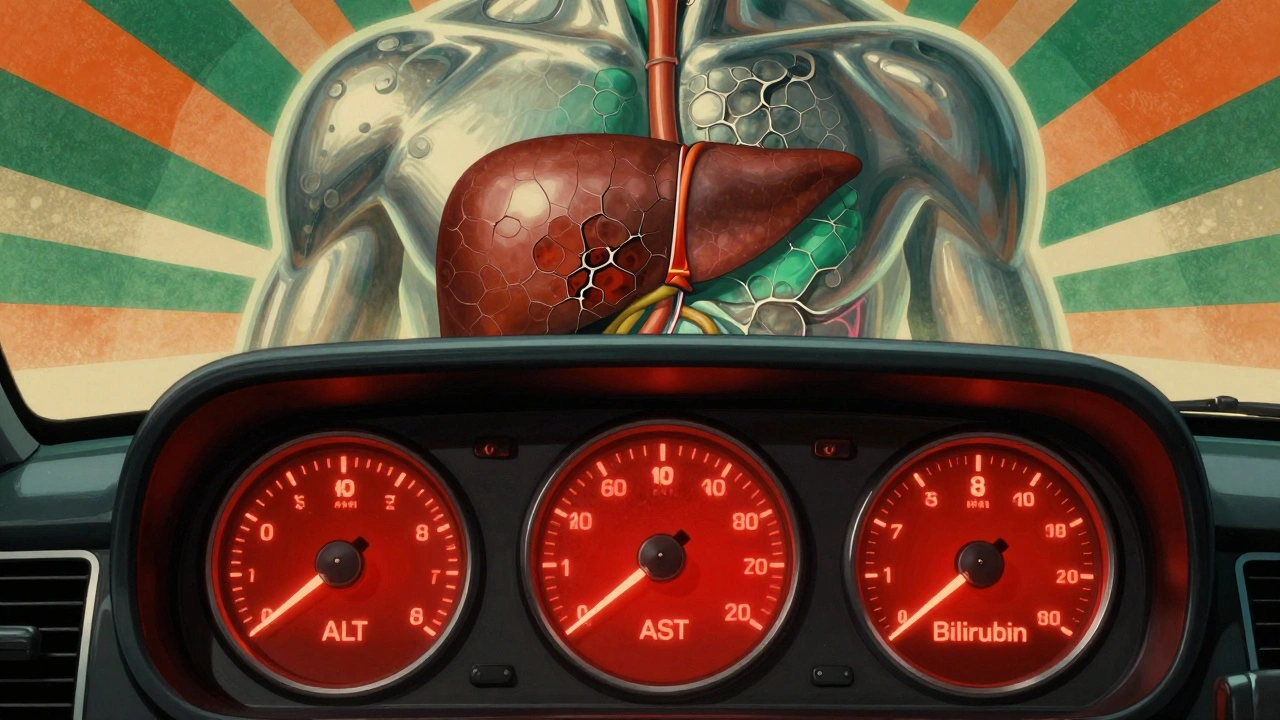
When your doctor orders liver function tests, they’re not checking how well your liver is working - they’re looking for signs it’s been damaged. The name "liver function tests" is misleading. Most of these blood markers don’t measure function at all. They measure injury. Think of it like checking the oil light in your car. It doesn’t tell you how well the engine runs. It just says something’s wrong.
What’s Actually Measured?
The standard panel includes ALT, AST, ALP, GGT, bilirubin, albumin, and sometimes prothrombin time. But only a few of these matter most for initial interpretation: ALT, AST, and bilirubin. The rest help fine-tune the story.
ALT (alanine aminotransferase) is mostly found in liver cells. When those cells get damaged - from virus, fat, or drugs - ALT leaks into the blood. It’s the most liver-specific marker we have. Normal levels? Around 7-55 U/L. But here’s the catch: men and people with higher body weight often have higher normal values. If your BMI is over 30, your "normal" ALT could be 10-15% higher than someone lean. That’s not disease. That’s biology.
AST (aspartate aminotransferase) is also in the liver, but it’s also in your heart, muscles, and kidneys. That’s why a high AST doesn’t always mean liver trouble. A heart attack, severe muscle injury, or even intense weightlifting can spike AST. But when AST and ALT rise together, the ratio between them tells a powerful story.
Bilirubin is the yellow pigment your liver processes from old red blood cells. When the liver can’t handle it - because bile ducts are blocked or liver cells are failing - bilirubin builds up. That’s what causes jaundice. Normal total bilirubin? 3-17 μmol/L. If it’s high, doctors look at the direct (conjugated) part. If direct bilirubin is high, it’s likely a blockage or bile flow problem. If indirect is high, it’s often about too many red cells breaking down or the liver just being overwhelmed.
Patterns Matter More Than Numbers
One number alone means almost nothing. It’s the pattern that tells the real story.
Heptocellular pattern - this is liver cell damage. ALT and AST are way up, often more than 10 times the upper limit. ALP and bilirubin? Only slightly elevated or normal. This happens in:
- Acute viral hepatitis (hepatitis A or B - ALT can hit 1,000 U/L or more)
- Drug overdose (especially paracetamol/acetaminophen)
- Ischemic liver injury (from low blood pressure or heart failure)
- Nonalcoholic steatohepatitis (NASH), now called MASLD - ALT usually higher than AST
Cholestatic pattern - this means bile flow is blocked. ALP and bilirubin are high. ALT and AST? Only mildly raised. This happens in:
- Gallstones blocking the bile duct
- Primary biliary cholangitis (autoimmune bile duct disease)
- Medications that slow bile flow
- Pancreatic cancer pressing on the bile duct
Here’s the key trick: if ALT is more than 10 times normal and ALP is less than 3 times normal, it’s liver cell damage. If ALP is more than 3 times normal and ALT is only mildly up, it’s a bile flow problem.
The AST/ALT Ratio: A Hidden Clue
This one ratio can point to the cause faster than any scan.
If AST is more than twice ALT - say, AST 120, ALT 50 - it’s a red flag for alcohol-related liver damage. In alcoholic hepatitis, this ratio is above 2 in 90% of cases. The liver gets damaged by alcohol in a way that releases more AST than ALT. But if AST is above 500 U/L, alcohol alone probably isn’t the cause. You’ve got to think about paracetamol overdose.
If ALT is higher than AST - say, ALT 80, AST 50 - it’s more likely NAFLD/MASLD, viral hepatitis, or drug injury. In fatty liver disease, ALT is often 1.5 to 2 times higher than AST.
If they’re almost equal - AST 60, ALT 55 - it could be chronic hepatitis C or early cirrhosis. The liver is so scarred, it’s not releasing enzymes the way it used to.
What About Bilirubin and Albumin?
Bilirubin tells you about flow. Albumin tells you about long-term function.
Albumin is made by the liver. Normal range? 35-50 g/L. But it doesn’t drop fast. It takes weeks to fall because its half-life is 20 days. So if albumin is low, it means your liver has been struggling for a long time - chronic cirrhosis, advanced disease. A normal albumin doesn’t mean your liver is healthy. It just means it hasn’t failed yet.
Prothrombin time (PT) measures how fast your blood clots. The liver makes clotting factors. If PT is prolonged, your liver can’t make enough of them. This is a sign of serious, acute damage. It’s more sensitive than albumin for sudden decline. A rising PT in someone with liver disease is a warning sign.
False Alarms and Common Mistakes
Not every slightly high ALT means you have liver disease.
Studies show that 10-15% of healthy people have ALT or AST levels up to 1.5 times the upper limit. That’s normal for them. A 2022 JAMA Internal Medicine study found that 37% of GPs ordered unnecessary scans for ALT levels between 41-80 U/L - numbers that often just reflect obesity, mild fatty liver, or even recent exercise.
AST can rise from a heart attack. ALT can spike after a serious muscle injury. Even intense cycling or weightlifting can cause temporary elevations. That’s why doctors look at trends, not single numbers.
And ALP? It’s not just liver. Bone also makes it. If ALP is high but GGT is normal, you might have a bone issue - like Paget’s disease or healing fracture - not liver disease.

When Should You Worry?
You don’t need to panic over a mildly elevated ALT. But here’s when to act:
- ALT or AST above 500 U/L - get checked immediately. Could be paracetamol overdose, acute hepatitis, or ischemic injury.
- Rapid rise - more than 100 U/L per week - needs urgent review.
- ALT and AST persistently above 2x the upper limit for more than 6 months - start investigating for fatty liver, hepatitis, or autoimmune disease.
- Bilirubin above 50 μmol/L with jaundice - see a doctor within days.
- Low albumin + prolonged PT - signs of advanced liver damage. Needs specialist input.
For mild elevations - say, ALT 60-80 U/L - the best next step isn’t a scan. It’s lifestyle. Lose 5-10% of your body weight if you’re overweight. Cut out alcohol. Control blood sugar. Check for thyroid or muscle issues. Re-test in 3-6 months. Most of the time, it improves.
What Comes Next?
Doctors don’t stop at blood tests. If patterns suggest liver disease, they’ll often check:
- FIB-4 score - uses age, AST, ALT, and platelets to estimate liver scarring
- ELF test - a newer blood test that measures fibrosis markers
- Ultrasound - to see fat, fluid, or blockages
- Hepatitis panel - for viruses
- Autoimmune markers - if it looks like an immune attack
A 2021 study of over 12,000 patients showed that combining LFT patterns with FIB-4 increased accuracy for detecting advanced scarring from 68% to 89%. That’s huge. Blood tests alone aren’t enough. But they’re the first step.
The big shift in liver health? The term "NAFLD" is being replaced with "MASLD" - Metabolic Dysfunction-Associated Steatotic Liver Disease. It’s not just about fat. It’s about insulin resistance, high blood pressure, and high triglycerides. The pattern? ALT higher than AST. And it’s rising fast - now the most common cause of liver disease worldwide.
Future tests are moving beyond simple enzymes. New biomarkers and imaging tools can spot fibrosis before it turns to cirrhosis. But for now, ALT, AST, and bilirubin - understood in context - still guide the first decisions.
Bottom Line
Liver function tests aren’t about function. They’re about damage. Don’t fixate on one number. Look at the pattern. Is ALT way up? That’s cell death. Is ALP and bilirubin high? That’s bile backing up. Is AST twice ALT? Think alcohol. Is albumin low and PT long? That’s serious, long-term damage.
Most mild elevations aren’t emergencies. But they’re signals. Ignore them, and fatty liver can turn to cirrhosis. Address them - with weight loss, less alcohol, better blood sugar - and your liver can heal. It’s not magic. It’s biology. And it works.
Shawna B
December 3, 2025 AT 21:54ALT being higher than AST in fatty liver makes so much sense now
Jerry Ray
December 4, 2025 AT 09:28Wrong. ALT isn't liver-specific at all. Muscle trauma raises it more than you think. Your whole post is based on outdated textbook nonsense.
Victor T. Johnson
December 5, 2025 AT 13:25Think about it 🤔 we call them liver function tests but they're injury markers... that's like calling your car's check engine light the "engine performance indicator"... we're all just living inside a linguistic lie designed by med schools to make us feel smart when we're really just memorizing noise
the liver doesn't care about your lab values it just keeps working while we panic over numbers
your body isn't broken it's adapting
and yet we treat every ALT spike like a death sentence
we're terrified of biology because we don't understand it
we want a pill not a lifestyle
the real disease isn't fatty liver it's our disconnect from our own bodies
we outsource health to labs and then wonder why we're sicker than ever
the answer isn't more tests it's less fear
the liver doesn't need fixing it needs space to breathe
and we're the ones holding our breath
Nicholas Swiontek
December 6, 2025 AT 10:58This is such a clear breakdown 🙌 I’ve seen so many people freak out over a slightly high ALT and it’s usually just weight or recent workouts. Love how you emphasized lifestyle over panic. Seriously, losing 5-10% body weight can turn things around - I’ve seen it in my own family. No scan needed, just patience and better habits. Keep sharing stuff like this!
Robert Asel
December 7, 2025 AT 10:47While your exposition is superficially coherent, it suffers from a fundamental epistemological flaw: the conflation of biomarker elevation with pathological intent. One cannot infer causality from correlation, particularly when confounding variables such as body mass index, physical exertion, and circadian rhythm are not controlled for in the referenced studies. Furthermore, the term MASLD, while semantically preferable, remains a construct of pharmaceutical-influenced nomenclature committees. The true etiology of hepatic enzyme dysregulation remains obfuscated by reductionist paradigms.
Shannon Wright
December 8, 2025 AT 20:35I want to thank you for writing this - it’s rare to see such a nuanced, compassionate explanation of liver tests. So many people get scared by a single number and end up in a spiral of anxiety and unnecessary procedures. You’re right - patterns matter. And you’re also right that most mild elevations aren’t emergencies. I’ve worked with patients for years who thought they had cirrhosis because their ALT was 70, and after three months of cutting back on sugar, drinking more water, and walking daily, their numbers dropped into the normal range. It’s not magic. It’s biology. And it’s hopeful. Please keep educating people like this. We need more voices like yours in medicine.
vanessa parapar
December 9, 2025 AT 23:01Wow you’re so naive. Did you know most labs have outdated reference ranges? And if your ALT is over 40 and you’re a woman, you’re probably already in early cirrhosis. Your "lifestyle changes" won’t help - you need a hepatologist yesterday. I’ve seen this too many times. People wait and then end up on the transplant list. Don’t be one of them.
Ben Wood
December 11, 2025 AT 02:52Uhh... ALT is NOT liver-specific... AST is found in the heart too... but so is CK... and troponin... and CRP... and... you're missing the point entirely. Also, "normal" ranges are arbitrary and based on population averages that include obese, sedentary people... which makes "normal" meaningless. You need to consider z-scores, not just upper limits. And why are you ignoring GGT? It's the real marker. Also, your "ratio" thing is outdated since 2018. I read a meta-analysis.
Sakthi s
December 11, 2025 AT 12:49Simple and clear. Thanks for this. Many people overthink liver numbers. Small changes help a lot.
Rachel Nimmons
December 12, 2025 AT 04:43Who controls the reference ranges? Why do they change every few years? And why is MASLD suddenly replacing NAFLD? Coincidence that big pharma just launched a new drug for it? I’ve read that the FDA approved it based on surrogate markers - not survival data. The liver isn’t broken. The system is.