

Statin Muscle Pain Assessment Tool
How to Use This Tool
Answer the following questions about your situation. This tool assesses whether your muscle pain is likely related to statin medication based on factors from recent medical research. Remember: this is not a diagnosis. Always consult your doctor for medical advice.
This tool is based on research showing that while about 5% of people on statins experience real muscle pain, up to 30% report symptoms in real life due to the nocebo effect (expecting pain causes pain).
Your Risk Assessment
More than 30 million Americans take statins every year to lower cholesterol and prevent heart attacks. For most, it works - and works well. But for a lot of people, something else happens: their muscles start to hurt. Not just a little soreness after a workout. Real, constant, frustrating pain in the thighs, shoulders, or calves that makes walking, climbing stairs, or even getting out of bed a chore.
Here’s the problem: you don’t know if it’s the statin or just aging, stress, or bad luck. And if you stop taking it, you might be risking your heart. So what do you do?
Is Your Muscle Pain Actually From the Statin?
The short answer? Maybe. But not always.
Statins are proven to cut heart attack risk by 25-35%. That’s huge. But muscle pain is the #1 reason people quit them. The numbers don’t add up. Clinical trials say only about 5% of people on statins get real muscle pain - similar to those on a sugar pill. Yet in real life, up to 30% of patients say their muscles ache after starting statins. Why the gap?
One big reason: the nocebo effect. If you’re told statins can cause muscle pain, your brain starts looking for it. A 2017 Lancet study showed patients who were warned about muscle side effects were 40% more likely to report pain - even when they were taking a placebo. Your expectation shapes your experience.
But that doesn’t mean all muscle pain is in your head. Some people truly react. The key is figuring out which is which.
What Statin Muscle Pain Actually Feels Like
Not all muscle pain is the same. Statin-related pain, called SAMS (statin-associated muscle symptoms), has a pattern:
- It’s usually symmetrical - both legs, both arms, or both shoulders hurt at the same time.
- It’s constant, not just after exercise. You feel it at rest.
- It hits the large muscle groups: thighs, hips, calves, shoulders.
- It often starts within the first few months - especially after a dose increase.
Severe cases can lead to rhabdomyolysis - a rare but dangerous breakdown of muscle tissue. That’s when creatine kinase (CK) levels spike above 1,900 U/L. You’d also notice dark urine, extreme weakness, or swelling. That’s an emergency. But most cases are far milder - just persistent soreness.
Who’s Most at Risk?
Not everyone gets this. Certain factors make muscle pain more likely:
- Age 80+: Risk jumps by about 30%.
- Small body size (under 100 lbs), especially in women.
- Female gender: Women report symptoms more often - partly due to smaller frames, higher rates of thyroid issues, and older age when starting statins.
- Thyroid problems: Undiagnosed hypothyroidism increases risk by 35%.
- Kidney or liver disease: Your body can’t clear statins as well, so levels build up.
- Other meds: Fibrates, some antibiotics (like erythromycin), or cyclosporine can interact with statins and boost side effects.
- High-dose statins: Atorvastatin 40-80 mg or rosuvastatin 20-40 mg carry about 15% higher risk than lower doses.
If you fit even one of these, your doctor should be extra cautious when prescribing statins.
What to Do If You Feel Pain
Don’t just quit. Don’t ignore it. Do this instead:
- Check your CK levels. A simple blood test measures creatine kinase. If it’s more than 5 times the normal limit, your doctor will likely pause the statin. If it’s normal or only slightly high, the pain may not be from muscle damage.
- Take a short break. Stop the statin for 4-6 weeks. Keep track of your symptoms. If the pain fades, it’s likely related.
- Try a rechallenge. After the break, restart the same statin at the lowest dose. If pain returns, it’s probably the drug. If not? You’re probably fine.
- Switch statins. About 60% of people who react to one statin tolerate another. Pravastatin and fluvastatin are least likely to cause muscle issues. Rosuvastatin and atorvastatin are more likely.
- Lower the dose. Sometimes, half a pill works just as well for heart protection - with fewer side effects.
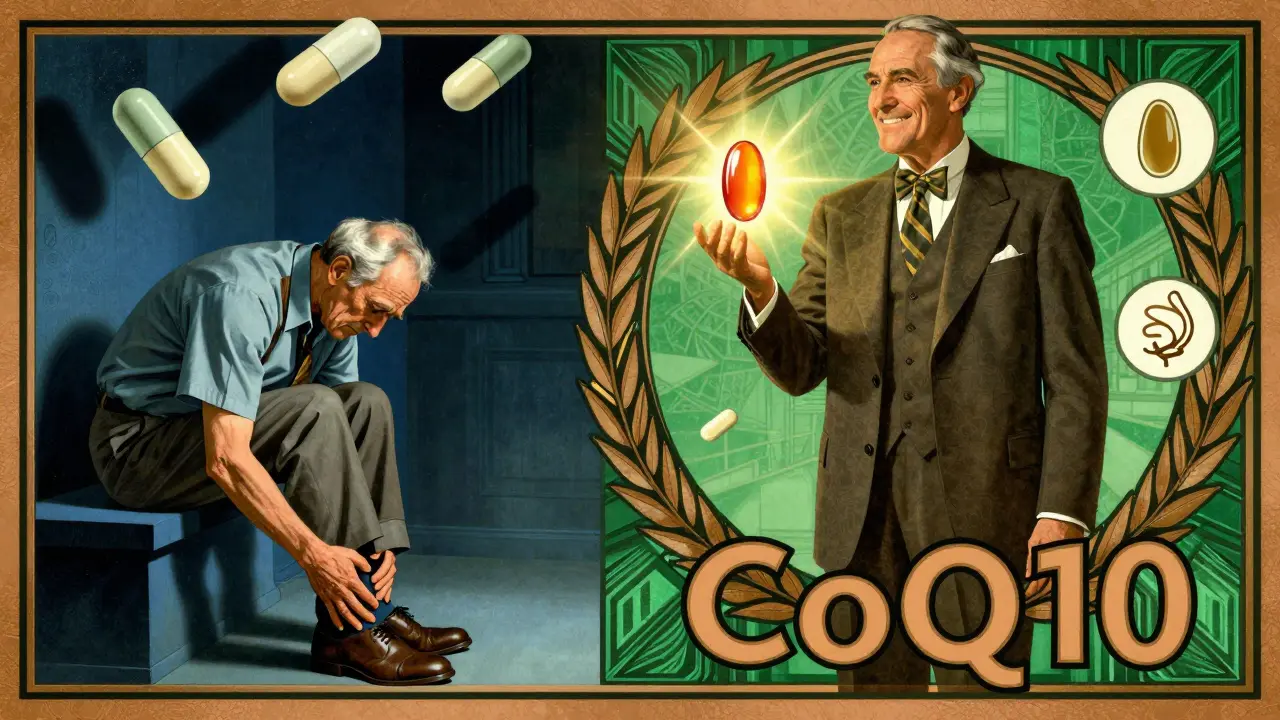
Some people try CoQ10 supplements. The science is mixed. A 2015 review found no clear benefit. But a 2018 study showed 45% of users reported 30% less pain. It’s low-risk, so if you want to try it, go ahead - but don’t expect miracles.
What If You Can’t Tolerate Any Statin?
There are non-statin options - but they’re not perfect.
- Ezetimibe: Lowers LDL by 15-20%. Takes a pill daily. Costs about $30/month generic.
- PCSK9 inhibitors (alirocumab, evolocumab): Injectable shots every 2-4 weeks. Cut LDL by 50-60%. But they cost around $5,000 a year. Insurance often requires proof you’ve tried everything else.
- Lifestyle changes: Diet, exercise, weight loss - these can lower LDL by 20-30% on their own. Not as strong as statins, but safe and effective for many.
Here’s the hard truth: if you’ve had a heart attack or have severe blockages, skipping statins can raise your risk of another event by 25-50% within two years. That’s not a gamble you should take lightly.
Why So Many People Quit - And Why They Shouldn’t
Reddit threads, patient forums, and drug review sites are full of stories. One 68-year-old woman on WebMD wrote: “Started atorvastatin 20 mg. By March, I couldn’t walk without pain. Stopped it. Two weeks later - gone.”
That’s real. But here’s what those stories often miss: 72% of negative reviews on Drugs.com blame muscle pain. Yet a 2018 Circulation study found only 20-25% of people who think statins hurt their muscles actually get pain when retested under blinded conditions. That means most people are misattributing their pain.
That’s why the American College of Cardiology recommends a structured approach: test, pause, rechallenge. Don’t assume. Don’t guess.
And if you’ve been off statins for months? Talk to your doctor about restarting - even at a lower dose. Many people find they can tolerate it better the second time around, especially after correcting things like thyroid function or vitamin D levels.
The Bottom Line
Statins save lives. Muscle pain is real for some, but often exaggerated or misdiagnosed. The key is not to panic - and not to quit without a plan.
If you’re having muscle pain:
- Don’t stop cold turkey.
- Get your CK levels checked.
- Work with your doctor to test if it’s really the statin.
- Try a different statin or lower dose before giving up.
- Consider non-statin options only if all else fails - and only if your heart risk is low enough to justify it.
For most people, the benefits of statins far outweigh the risks. You don’t have to live with pain. But you also don’t have to risk your heart to avoid it. There’s a middle ground - and it starts with smart testing, not stopping.
Can statins cause permanent muscle damage?
In rare cases, yes - but only with rhabdomyolysis, which affects about 0.1 to 0.5 people per 10,000 statin users per year. Most muscle pain from statins is temporary and goes away within weeks of stopping the drug. There’s no evidence that typical statin-related myalgia causes lasting damage.
Is it safe to take CoQ10 with statins?
Yes, it’s safe. CoQ10 doesn’t interact with statins or other medications. Some people report less muscle pain when taking it, but studies haven’t proven it works consistently. If you want to try it, choose a reputable brand and expect to take it for at least 4-6 weeks to see if it helps.
Why do women report more muscle pain from statins than men?
Women tend to start statins later in life, often have smaller body size, and are more likely to have undiagnosed hypothyroidism - all of which increase statin sensitivity. They also report symptoms more openly, and some research suggests hormonal differences may affect how muscles respond to statins.
Can I take statins every other day to avoid side effects?
Some studies, including the 2023 STRENGTH trial, are testing intermittent dosing - like taking statins 3-4 times a week instead of daily. Early results suggest it may cut muscle pain by 40% while still lowering cholesterol enough to protect the heart. But this isn’t standard yet. Talk to your doctor before changing your schedule.
What’s the safest statin for muscle pain?
Pravastatin and fluvastatin have the lowest risk of muscle side effects. Rosuvastatin and atorvastatin are more likely to cause issues, especially at high doses. If you’ve had problems, ask your doctor about switching to one of the gentler options.
How long does it take for muscle pain to go away after stopping statins?
Most people notice improvement within 2-4 weeks. Full recovery usually takes 4-8 weeks. If pain persists beyond two months after stopping, it’s likely not from the statin - and you should see your doctor to check for other causes like arthritis, nerve issues, or vitamin D deficiency.
Can I ever go back on statins after quitting due to muscle pain?
Yes - and many people do. About 80-90% of patients who follow a structured rechallenge plan (testing, pause, restart at lower dose or different statin) can get back on statins without pain. The key is not to quit without a plan. Work with your doctor to find the right approach.
Cassie Widders
January 12, 2026 AT 12:52I started statins last year and my legs felt like concrete for months. Stopped them cold turkey. Pain vanished in two weeks. I don’t care what the studies say - my body knew better.
Amanda Eichstaedt
January 12, 2026 AT 19:04It’s wild how much our brains can trick us. I had zero pain until my doctor said, ‘Watch out for muscle aches.’ Then suddenly - boom - my calves were screaming. Turned out it was just stress and bad sleep. The nocebo effect is real, and it’s scary.
Alex Fortwengler
January 13, 2026 AT 18:20Statins are just Big Pharma’s way of turning healthy people into patients. They don’t even work for most people. My uncle took them for 10 years and still had a heart attack. They’re just selling fear and pills. CoQ10? Yeah right - they don’t want you to know the real fix is diet and fasting.
jordan shiyangeni
January 13, 2026 AT 23:16It’s not just about statins - it’s about the entire medical industrial complex that prioritizes profit over patient autonomy. When you’re told to take a drug for decades based on statistical probabilities rather than individual physiology, you’re not being treated - you’re being managed. The fact that people are suffering from iatrogenic muscle damage and being told it’s ‘in their head’ is not just negligent - it’s immoral.
Abner San Diego
January 14, 2026 AT 18:49Why are we even talking about this? America’s got real problems - like inflation, crime, and illegal immigration. Now we’re worried about muscle pain from pills? Get a grip. If you can’t handle a little soreness, maybe you shouldn’t be eating fast food and sitting on your butt all day.
Eileen Reilly
January 15, 2026 AT 14:44Okay so I took rosuvastatin and my legs felt like they were full of lead. I went to the doc, they checked my CK - it was normal. So they said ‘it’s not the statin.’ But I felt it. I stopped it. Pain went away. End of story. Science can go pound sand. My body doesn’t lie.
Monica Puglia
January 16, 2026 AT 07:01So many people feel this 😔 I was one of them. I tried pravastatin at half dose after a 6-week break - and guess what? No pain. 🙌 CoQ10 didn’t do much for me, but switching statins did. Don’t give up. Talk to your doc. You’re not broken - you just need the right fit.
Lawrence Jung
January 18, 2026 AT 04:35People think pain is always physical but what if it’s spiritual? Maybe your body is telling you to slow down, to stop chasing longevity through chemicals, to reconnect with nature. Statins are a symptom of a culture that wants to fix everything with a pill instead of listening
Alice Elanora Shepherd
January 18, 2026 AT 23:23Important note: If you're experiencing persistent muscle pain, always rule out hypothyroidism and vitamin D deficiency first - both are common, easily tested, and can mimic statin myopathy. I’ve seen too many patients stop statins unnecessarily because these weren’t checked. A simple TSH and 25-OH vitamin D test can save someone from a misdiagnosis.
Christina Widodo
January 19, 2026 AT 11:57Has anyone tried intermittent dosing? Like every other day? I read something about a 2023 trial where it worked for some people. Would love to hear real experiences.
Prachi Chauhan
January 19, 2026 AT 19:31Statins are like the new sugar - a silent poison masked as medicine. The body needs cholesterol, it’s not the enemy. We’re taught to fear what we don’t understand. My grandma lived to 98 without a statin. Maybe we should ask why.
Katherine Carlock
January 21, 2026 AT 05:15I get both sides. I was terrified to stop my statin after my heart attack, but the pain was unbearable. I did the rechallenge thing - switched to pravastatin, lowered the dose, and now I’m fine. It’s not about being anti-medical - it’s about being pro-self-awareness.
Sona Chandra
January 22, 2026 AT 10:29My doctor didn’t even listen when I said my legs hurt. Said ‘it’s just aging.’ I cried in the parking lot. Then I found a functional medicine guy who tested my thyroid - turned out I was hypothyroid. My statin pain disappeared after I started levothyroxine. Why didn’t they check that first? Because they don’t care. They just want you to take the pill.
Jennifer Phelps
January 24, 2026 AT 01:18So if CK is normal and pain goes away after stopping does that mean it was the statin or not? I’m confused. My doc says no if CK is normal but I still feel it
Cassie Widders
January 24, 2026 AT 14:22That’s exactly what mine did. CK was normal too. But the pain vanished when I stopped. That’s all I needed to know.