

Statin Dosing Advisor
Determine Your Optimal Statin Timing
Based on the latest evidence about statin half-life and adherence
For decades, doctors told patients to take their statins at night. The reasoning made sense: your liver makes most of its cholesterol while you sleep. So, if you take a statin at bedtime, it should block that production at its peak. But here’s the truth - that advice doesn’t apply to everyone anymore. And clinging to it might actually be hurting your adherence - and your heart health.
Why Night Was Always Recommended
Back in the 1980s and 90s, the first statins - like simvastatin, lovastatin, and fluvastatin - had short half-lives. That means they didn’t stay in your system very long. Simvastatin, for example, clears out in under 4 hours. Since cholesterol production spikes between midnight and 4 a.m., taking these drugs at night made perfect sense. Studies showed it worked better. One 1995 trial found that taking simvastatin at night lowered LDL cholesterol by 13.4% more than taking it in the morning. That’s not a small difference - it’s the kind of gap that can mean fewer heart attacks over time.The Game-Changer: Long-Acting Statins
But then came the new generation: atorvastatin, rosuvastatin, and pitavastatin. These drugs last 12 to 20 hours in your bloodstream. That means whether you take them at 7 a.m. or 11 p.m., they’re still working just as hard at 3 a.m. when your liver is making cholesterol. A 2017 analysis of 17 clinical trials (over 3,300 people) showed this clearly. For short-acting statins, evening dosing gave an extra 7.3% to 15% drop in LDL. But for long-acting ones? The difference was just 0.5% to 2.5%. That’s not just small - it’s clinically meaningless. The National Lipid Association says a real, meaningful change in cholesterol is at least 5% to 7%. This tiny gap? It’s noise.What About Side Effects?
A lot of people worry that taking statins at night might cause more muscle pain or liver issues. But the data says otherwise. A 2021 review of over 4 million statin prescriptions found no difference in side effects - whether taken in the morning or night. Muscle aches? Liver enzymes? Risk of diabetes? All the same. The FDA’s own adverse event database shows 8.7% of night-takers reported side effects versus 8.9% of morning-takers. That’s not a signal. That’s random variation. The real problem isn’t timing. It’s forgetting to take the pill.
The Real Enemy: Missed Doses
Here’s the part no one talks about enough. In a 2019 study of nearly 12,500 statin users, people told to take their meds at night had worse adherence. Their medication possession ratio (MPR) was 0.87 - meaning they missed about 13% of doses. Those taking them in the morning? MPR was 0.98. That’s 2.1 extra missed doses per month. Why? Because life doesn’t follow a clock. You’re traveling. You’re tired. You forget. You’re on a night shift. You’re not sleeping at the same time every night. If your statin is supposed to be taken at bedtime but you’re still up at 1 a.m. watching TV, you’re not taking it. And if you skip it three times a week, your LDL doesn’t care that you meant to take it at night - it just knows you didn’t take it. One Reddit user wrote: “I kept forgetting my simvastatin at night. My doctor switched me to morning rosuvastatin. My LDL actually improved because now I never miss a dose.” That’s not an anomaly. That’s the new reality.What Should You Do?
If you’re on a short-acting statin - simvastatin, lovastatin, or fluvastatin - evening dosing is still slightly better. But here’s the catch: if you’re missing doses at night, switching to morning is better than sticking to a schedule you can’t keep. A 2020 study found that simvastatin users who took their pill in the morning with a phone reminder had just as good cholesterol results as those taking it at night - because they actually took it. If you’re on a long-acting statin - atorvastatin, rosuvastatin, pitavastatin, or pravastatin - timing doesn’t matter. Period. Take it when you’re most likely to remember. Morning with breakfast? Fine. After dinner? Fine. Right before bed? Fine. It won’t make a measurable difference in your LDL or your risk of heart disease.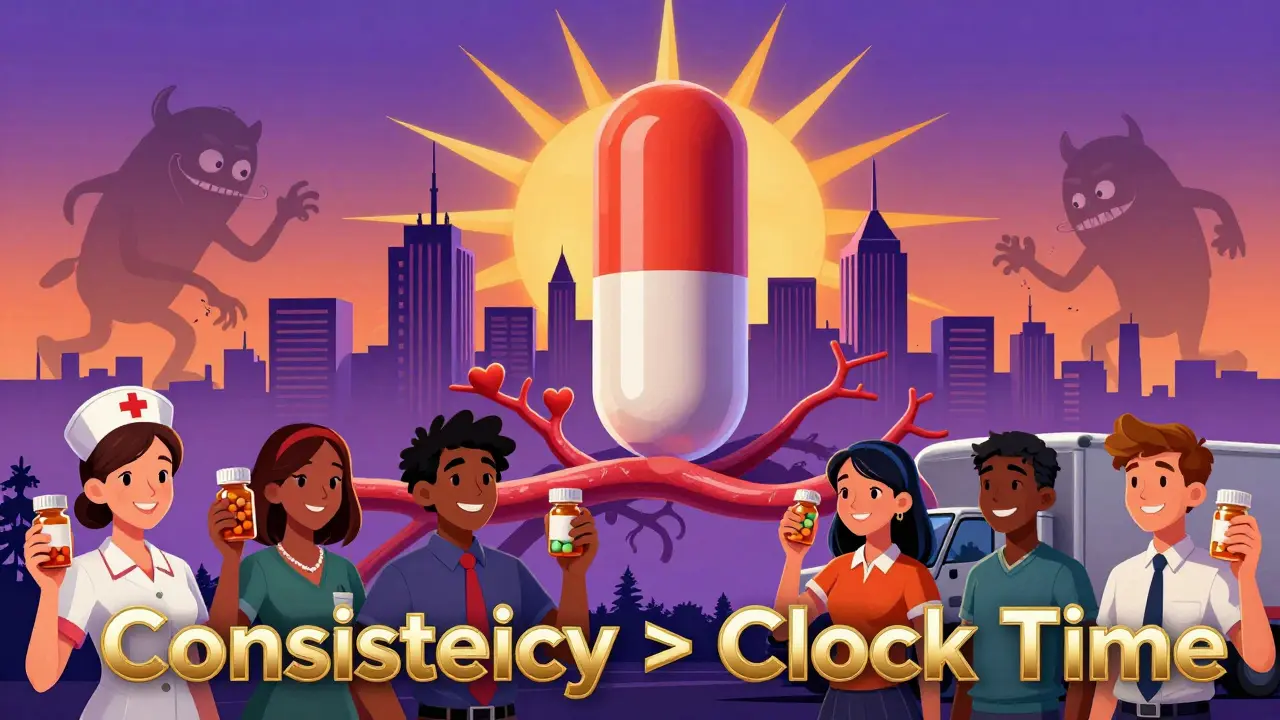
What Doctors Are Doing Now
The American College of Cardiology updated its guidelines in 2022: “Timing should be individualized based on patient preference and lifestyle.” That’s it. No more blanket “take at night” orders. In 2010, nearly 7 out of 10 doctors asked patients about statin timing. By 2022, only 1 in 5 did. Why? Because the evidence changed. And so did prescribing. In 2010, less than half of new statin prescriptions were for long-acting versions. Today? Over 80% are. That’s not an accident. It’s progress. Even the FDA removed “take at night” from the labels of atorvastatin and rosuvastatin in 2015. The European Medicines Agency did the same in 2021. They’re not ignoring science - they’re following it.Practical Advice: What to Do Today
- If you’re on simvastatin, lovastatin, or fluvastatin: Evening dosing is slightly more effective - but only if you take it consistently. If you forget at night, switch to morning. Use a phone alarm. Put the pill next to your toothbrush. Find what sticks.
- If you’re on atorvastatin, rosuvastatin, pitavastatin, or pravastatin: Take it whenever you’ll remember. Morning, noon, or night - it doesn’t matter. Focus on consistency, not clock time.
- If you’re unsure what you’re on: Check your prescription label. Or ask your pharmacist. Most pharmacies now list the half-life on the bottle or in the patient leaflet.
- If you’ve been taking your statin at night for years and it works: Don’t change. There’s no need to fix what isn’t broken.
The Bigger Picture
The night vs. morning debate isn’t about science anymore. It’s about behavior. Statins are one of the most effective drugs ever made - they cut heart attack risk by 25% to 35%. But they only work if you take them. Every missed dose adds up. Every extra pill you take saves lives. The future of statin therapy isn’t better timing. It’s better habits. Better reminders. Better conversations with your doctor - not about what time to take it, but whether you’re actually taking it. A 2023 editorial in Lipid Science and Technology put it perfectly: “The morning versus night statin debate has largely been resolved by pharmacokinetics - what remains is implementing adherence strategies that work for individual patients, recognizing that consistency matters far more than clock time.” You don’t need to be a perfect patient. You just need to be a consistent one.Does taking statins at night really lower cholesterol more?
Only if you’re taking a short-acting statin like simvastatin, lovastatin, or fluvastatin. For these, nighttime dosing can lower LDL by 7-15% more than morning dosing. But for long-acting statins like atorvastatin or rosuvastatin, timing makes no meaningful difference - their effects last all day. The key is not when you take it, but whether you take it every day.
Are statin side effects worse at night?
No. Large studies tracking over 4 million prescriptions show no difference in side effects like muscle pain, liver issues, or diabetes risk based on whether statins are taken in the morning or at night. Side effects are related to the drug itself, not the time of day.
Can I switch my statin from night to morning?
Yes - and you should if it helps you take it regularly. For long-acting statins, switching is safe and effective. For short-acting ones, switching to morning is still better than skipping doses at night. Many patients actually see better cholesterol results after switching because they stop missing doses.
What if I forget my statin at night?
Don’t double up the next day. Just take it when you remember - even if it’s the next morning. For short-acting statins, you’ll lose some benefit, but it’s better than going without. For long-acting statins, missing one dose has minimal impact. The goal is to get back on track, not to stress about one missed pill.
Should I ask my doctor to change my statin timing?
Absolutely. If you’re struggling to remember your dose at night, talk to your doctor about switching to morning. Or ask if you can switch to a long-acting statin like rosuvastatin or atorvastatin - which give you the freedom to take it anytime. Your adherence matters more than the clock.
Is it safe to take statins with food?
Yes. Most statins can be taken with or without food. The only exception is lovastatin - it works better with food. But for the most common statins like atorvastatin and rosuvastatin, food doesn’t affect absorption. Take them when it fits your routine.
Will I need to take statins forever?
For most people with high cholesterol or heart disease risk, yes. Statins are long-term medications. Stopping them increases your risk of heart attack and stroke. But if your cholesterol improves with diet, exercise, or weight loss, your doctor may reassess your need. Never stop without talking to your provider.
Sandeep Jain
December 26, 2025 AT 07:47Man, I’ve been taking rosuvastatin at 7 a.m. with my coffee for two years now. Never missed a day. My LDL dropped from 180 to 92. No muscle pain, no liver weirdness. Why would I change something that just works?
Stop overcomplicating it. Take it when you remember. That’s the whole damn point.
Sophia Daniels
December 27, 2025 AT 06:22Oh honey. You’re telling me the entire medical establishment got this wrong for 40 years because people are lazy? 🤦♀️
Let me guess - next you’ll say ‘sunscreen doesn’t matter if you’re indoors’ or ‘exercise is optional if you’re on a treadmill at work.’
It’s not about adherence. It’s about pharmacokinetics. You’re reducing a complex biological rhythm to a ‘just take it whenever’ meme. That’s not science. That’s capitulation.
Erwin Asilom
December 27, 2025 AT 13:28For anyone reading this: if you’re on a short-acting statin and you’re consistently missing your nighttime dose, switching to morning is absolutely the right move.
Adherence is the single strongest predictor of cardiovascular outcomes - stronger than the exact timing. The data is clear. Don’t let dogma sabotage your health.
Also - if you’re unsure which statin you’re on, check the label. If it says ‘simvastatin’ or ‘lovastatin,’ you’re in the minority now. Most new scripts are long-acting. Ask your pharmacist.
roger dalomba
December 28, 2025 AT 19:06Wow. A whole article about when to take a pill. I’m crying.
Next up: ‘The Great Toilet Paper Debate: Morning vs. Night Unwinding.’
Meanwhile, my cholesterol’s fine. I take it after my third espresso. If I forget? I don’t panic. I live. You all sound like you’re running a clinical trial on your own circadian rhythm.
Nikki Brown
December 28, 2025 AT 23:53So you’re telling me that people who forget to take their meds are now the new heroes? 🤨
Let me get this straight - we’re abandoning evidence-based timing because some folks are ‘too busy’? What’s next? ‘Take your insulin when you feel like it’?
This isn’t ‘individualized care.’ This is medical nihilism dressed up as convenience. You’re not empowering patients. You’re enabling them.
Becky Baker
December 30, 2025 AT 16:27I’m a nurse in Chicago. I’ve seen it a hundred times. Grandma takes her simvastatin at 3 a.m. because she’s awake watching TV. Then she skips it the next night because she’s tired. She thinks she’s doing it right.
Switched her to morning with her vitamins. Now she takes it 95% of the time. Her LDL’s down. She’s happy.
Stop pretending timing matters more than consistency. It doesn’t.
Rajni Jain
January 1, 2026 AT 08:32My mom took simvastatin at night for 8 years. Always forgot. Then switched to morning rosuvastatin - no more guilt, no more panic. Her doctor didn’t even blink. Said, ‘Take it when you eat breakfast.’
She’s 72. Still walks 3 miles a day. No muscle pain. No hospital visits.
Maybe the real villain isn’t the clock. It’s the guilt we attach to forgetting.
Be kind to yourself. Your heart will thank you.
Brittany Fuhs
January 1, 2026 AT 10:59So according to this, we should just let people do whatever they want with life-saving meds? That’s not patient-centered care. That’s American individualism gone rogue.
What’s next? ‘Take your blood pressure med when you remember’? ‘Skip your insulin if you’re not hungry’?
We have guidelines for a reason. Science doesn’t bend to convenience. People do. And then they wonder why they’re in the ER.
Steven Destiny
January 2, 2026 AT 00:09Y’all are overthinking this like it’s rocket science. Statins are not magic. They’re tools. If you take them consistently, you win. If you don’t, you lose.
I used to take mine at night. Now I take it after my morning workout. I’ve never missed one. My numbers are perfect. That’s it.
Stop pretending timing is the issue. It’s discipline. And discipline doesn’t care what time it is.
Sumler Luu
January 3, 2026 AT 18:55I’m a pharmacist. I’ve seen people skip doses because they’re ‘not sleeping yet’ or ‘already took it’ (double-dosing).
For long-acting statins: morning, night, lunchtime - it’s all fine.
For short-acting: if you’re missing doses at night, switching is safer than sticking to a schedule you hate.
Don’t shame people for forgetting. Help them find a routine that fits their life. That’s what medicine is for.
Natasha Sandra
January 4, 2026 AT 06:37OMG YES. 😭 I was taking simvastatin at 11 p.m. and I’m a night owl who doesn’t sleep until 2 a.m. I’d be like, ‘Ugh, I’ll take it tomorrow.’ Then I’d forget. Total mess.
Switched to rosuvastatin in the morning. Took it with my protein shake. Boom. 30 days straight. My doctor was shocked at how much my LDL dropped.
It’s not about the clock. It’s about the habit. 💪
Fabio Raphael
January 4, 2026 AT 19:29This is fascinating. I’m a biochemist. The half-life data is rock solid. Atorvastatin’s half-life is 14–30 hours. Rosuvastatin’s is 19 hours. That means even if you take it at 8 a.m., you still have 80%+ of the drug in your system at 3 a.m.
The 2017 meta-analysis? It’s one of the most robust in lipidology. The 0.5–2.5% difference? Statistically insignificant.
What’s more concerning is how long it took for guidelines to catch up. Medicine moves slow. But when it does? It’s beautiful.
sakshi nagpal
January 6, 2026 AT 15:08As someone from India, I’ve seen both sides. In rural areas, people take meds when they remember - because they don’t have alarms or consistent schedules. In cities, they obsess over timing.
But the outcome? Same. Consistency wins.
Maybe the real lesson isn’t about statins. It’s about how we treat chronic illness. We treat it like a math problem. But it’s a human one.
Design for real life. Not ideal life.
Peter sullen
January 6, 2026 AT 17:33It is imperative to recognize, in the context of contemporary lipidology and pharmacokinetic dynamics, that the temporal administration of statin therapy has undergone a paradigmatic evolution - particularly with respect to the advent of extended-half-life agents such as atorvastatin and rosuvastatin.
Consequently, the historical paradigm of nocturnal dosing - while empirically valid for first-generation agents - is now rendered clinically redundant in the majority of contemporary prescriptions.
Adherence, as a primary endpoint, supersedes chronopharmacological precision. The integration of behavioral nudges - e.g., pill organizers, mobile reminders, and habit-stacking - constitutes the next frontier in preventive cardiology.
Let us not conflate convenience with compliance. Let us optimize for the former to achieve the latter.