

The Danger Zone: Understanding Decibel Limits
We measure sound in decibels (dB), but it's not a linear scale. Because decibels are logarithmic, a small increase in number represents a massive increase in sound energy. To keep things simple, most health organizations use a "weighted" scale called dBA, which mimics how the human ear actually perceives sound. For most of us, the magic number is 85. NIOSH (the National Institute for Occupational Safety and Health) considers 85 dBA as an 8-hour time-weighted average (TWA) to be the threshold where hearing damage begins. This means if you are exposed to 85 dB for a full eight-hour workday, you are at the limit of what is considered safe. But what happens when the volume goes up? This is where the "exchange rate" comes in. NIOSH uses a 3-dB exchange rate. This means every time the noise level increases by just 3 decibels, your safe exposure time is cut in half. If 85 dB is safe for 8 hours, then 88 dB is only safe for 4 hours, and 91 dB is only safe for 2 hours. By the time you hit 100 dB-common at a loud rock concert-you've only got about 15 minutes before you risk permanent damage.Workplace Standards: OSHA vs. NIOSH
If you work in construction, manufacturing, or mining, you've probably seen signs about hearing protection. However, not all regulations are created equal. In the US, there is a significant gap between what is legally required and what is scientifically recommended. OSHA (the Occupational Safety and Health Administration) sets the legal limit at 90 dBA for an 8-hour shift. While this is the law, many experts argue it's too lenient. According to the American College of Occupational and Environmental Medicine, using OSHA's 5-dB exchange rate actually underestimates the risk of hearing loss at higher volumes by up to 700%. In the UK, the approach is slightly different. The Control of Noise at Work Regulations 2005 uses "action values." If noise hits 80 dB, employers must provide information and make ear protection available. Once it hits 85 dB, using that protection becomes mandatory. This proactive approach helps catch the problem before the damage is done.| Organization/Region | Exposure Limit | Exchange Rate | Focus |
|---|---|---|---|
| NIOSH (Recommended) | 85 dBA | 3 dB | Scientific Safety |
| OSHA (Legal PEL) | 90 dBA | 5 dB | Legal Compliance |
| UK Regulations | 87 dBA (Limit Value) | Varies | Action-based Prevention |
| EU Directive | 87 dBA (Upper Limit) | Varies | Standardized Protection |
Protecting Your Ears at Concerts and Festivals
Concerts are essentially "acoustic assault" zones. A typical orchestral performance might hit 90 dB, while a front-row spot at a heavy metal show can easily soar past 110 dB. Since these aren't regulated workplaces, the responsibility falls on you. One of the biggest mistakes people make is using cheap foam earplugs that muffle the sound, making the music sound "muddy." If you want to protect your hearing without sacrificing the experience, look into high-fidelity earplugs. These use acoustic filters to reduce the volume evenly across all frequencies, so the music still sounds clear, just quieter. If you're attending a festival, try these practical tips:- Identify 'Quiet Zones': Many modern festivals now create areas with ambient levels around 70-75 dBA. Use these to give your ears a break.
- Avoid the Speakers: The sound pressure is highest directly in front of the speaker stacks. Moving just 20 feet back can significantly lower your exposure.
- Use an App: While not as accurate as professional meters, smartphone apps can now measure environmental noise with about 92% accuracy. If the app shows you're consistently over 100 dB, it's time to plug in.
The Hierarchy of Hearing Conservation
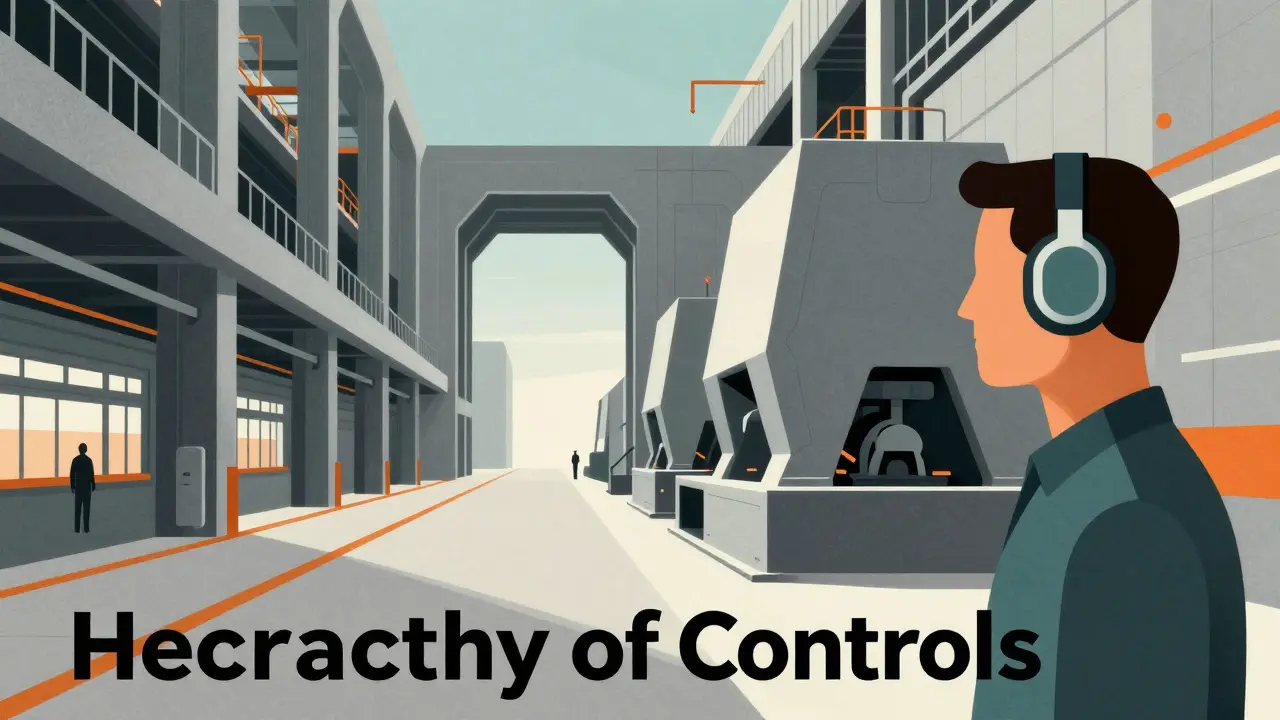
When a company sets up a hearing conservation program, they don't just hand out earplugs and call it a day. There is a specific order of operations called the "Hierarchy of Controls" designed to eliminate the risk entirely. First, they try Elimination or Substitution. Can we replace that screeching old machine with a newer, quieter model? If not, they move to Engineering Controls. This involves building soundproof enclosures around the noise source or adding vibration damping materials to the walls. Next are Administrative Controls. This is all about time management. If a machine is too loud, a manager might rotate workers so that no one person is exposed to the noise for more than four hours a day. Finally, we have Personal Protective Equipment (PPE). This is the last line of defense. Properly fitted earplugs or earmuffs can reduce noise exposure by 15-30 dB. However, they only work if they are worn correctly. Research shows that hands-on training can jump the rate of proper usage from 40% up to 85%.
Signs You've Been Exposed to Too Much Noise
How do you know if you've actually crossed the limit? The most obvious sign is tinnitus-that ringing, buzzing, or hissing sound in the ears. If you experience this after a concert, you've likely suffered a "temporary threshold shift." This means your hearing is dampened for a few hours or days. While it often goes away, every time this happens, you are chipping away at your long-term hearing health. Other red flags include:- Difficulty understanding speech in crowded rooms (the "cocktail party effect").
- Asking people to repeat themselves frequently.
- A feeling of "fullness" or pressure in the ears after a loud event.
Can I recover my hearing after a loud concert?
If you have a temporary threshold shift (muffled hearing or ringing), your hearing may return to normal after a period of quiet. However, if the noise was loud enough to kill the hair cells in the cochlea, that loss is permanent. There is no medical way to "regrow" these cells, which is why prevention is the only cure.
Are foam earplugs better than reusable silicone ones?
Foam plugs often provide higher overall noise reduction (attenuation) if inserted perfectly. However, they block all frequencies, which can make sound feel muffled. Silicone or high-fidelity plugs are better for music and conversations because they lower the volume without distorting the sound quality.
What is a 'time-weighted average' (TWA)?
A TWA is the average sound level exposure over a specific period, usually an 8-hour workday. It accounts for the fact that you might spend some time in a very loud area (like next to a generator) and some time in a quiet area (like a break room), averaging the total noise energy your ears absorb.
Does wearing headphones at a high volume count as noise exposure?
Yes. The World Health Organization suggests limiting personal audio device use to 40 hours per week at 80 dBA. Because earbuds sit closer to the eardrum, they can deliver much higher sound pressure levels than speakers, increasing the risk of hearing loss even at moderate volumes.
What should I do if my employer doesn't provide hearing protection?
Depending on your region, this may be a legal violation. In the US, OSHA requires PPE when noise hits 90 dBA. In the UK, the 2005 Regulations mandate protection at 85 dB. You should document the noise levels (using an app or meter) and request a formal noise assessment from your health and safety officer.