

When your prescription for a generic medication gets denied by your insurance, it’s not just a paperwork hiccup-it’s a real health risk. You might be taking a drug that works for you, and suddenly, your plan says it’s not covered. Even though it’s a generic, it’s not on their list. That’s called a non-formulary generic. And if you don’t know what to do next, you could end up going without your medicine, paying hundreds extra, or switching to something that doesn’t work-and that’s dangerous.
Why your generic isn’t covered
Insurance plans create a list of approved drugs called a formulary. It’s not random. They pick drugs based on cost, safety, and how often they’re prescribed. But here’s the catch: even generic versions of common drugs can be left off that list. Why? Sometimes it’s because the plan only covers one version of a drug, even if others work just as well. Or maybe they have a deal with a specific manufacturer. It doesn’t mean the drug is unsafe. It just means your plan didn’t choose it.For example, you might be on generic mesalamine for ulcerative colitis. Your plan covers one brand, but not the one your doctor prescribed. That doesn’t mean the one you’re on is worse. It just means it’s not on the list. And when that happens, you’re stuck.
The law says you have rights
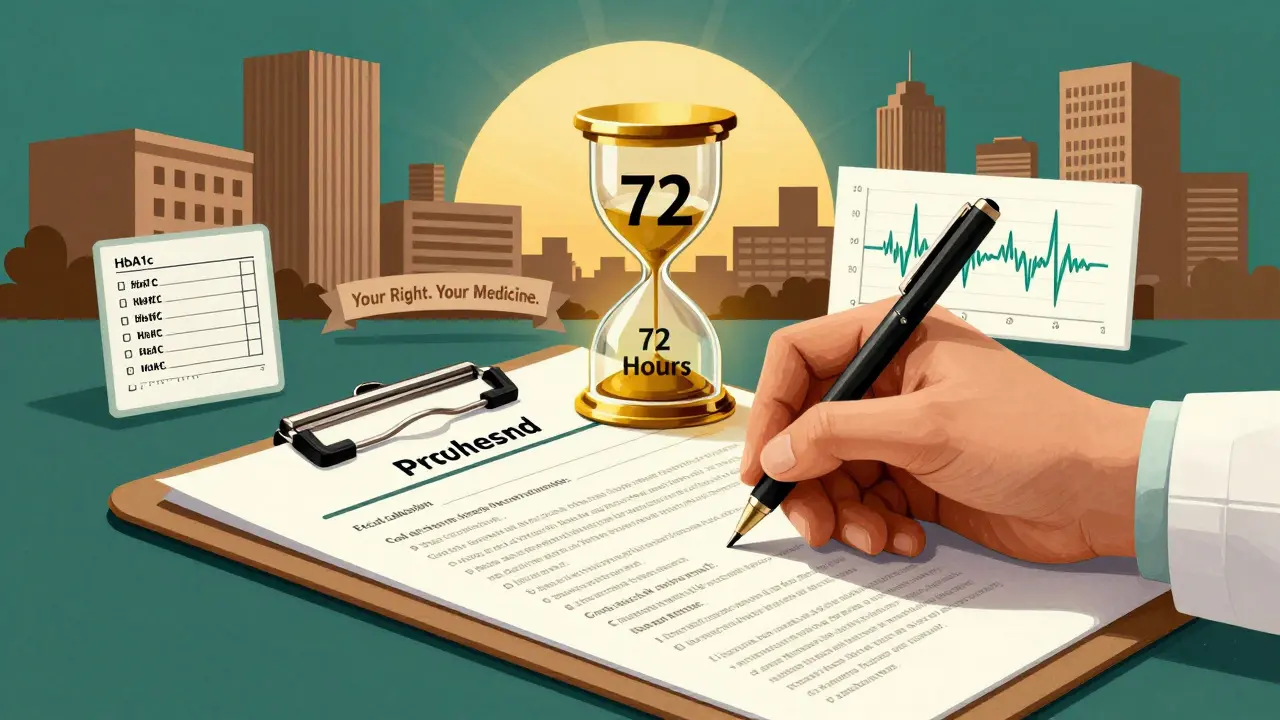
Federal law doesn’t let insurers just say no and walk away. If your drug isn’t on the formulary, they must have a way for you to ask for an exception. This isn’t optional. It’s required. And it’s faster than you think.For urgent cases-like if you’re having a flare-up, or your condition could get worse without the drug-you’re entitled to a decision in 24 hours. For non-urgent cases, it’s 72 hours. That’s not a suggestion. That’s the rule. And if they don’t respond in time? You can escalate it.
Medicare Part D plans must follow this. So do most private insurers. Some states, like California, even require faster turnarounds. If your plan ignores the timeline, you have leverage.
How to get your drug covered
It’s not magic. It’s a process. And if you do it right, you have a very good chance of winning.- Get the denial in writing. The pharmacy should give you a notice explaining why the drug was denied. Keep it. You’ll need it.
- Ask your doctor to file a coverage determination request. This isn’t a form you fill out yourself. Your doctor has to complete it. And it needs details-not just “it works for me.” They have to say why other drugs on the formulary won’t work. For example: “Patient has tried two alternatives. Both caused severe nausea and diarrhea. This drug has been stable for 18 months.”
- Include clinical evidence. The more specific, the better. If you’re on a drug for diabetes, include your last HbA1c level. For Crohn’s, mention fecal calprotectin levels. For epilepsy, list seizure frequency before and after switching. Doctors who include this data have approval rates over 70%.
- Request an expedited review if you need it. If you’re out of medication or your condition is worsening, say so. Call the plan. Ask for an urgent exception. They’re legally required to act fast.
According to the Crohn’s & Colitis Foundation, 58% of denied requests are overturned on appeal. That’s more than half. But only if you appeal.
What to do if you’re denied
If your doctor’s request gets denied, don’t give up. You have two more steps.First, file an internal appeal. You have 60 days from the date of denial. Send it in writing. Include all your medical records, lab results, and any letters from your doctor. Mention that the drug is medically necessary and that alternatives caused side effects.
If that fails, you can ask for an external review. This is an independent third party-like a doctor not paid by your insurer-who looks at your case. They have to make a decision in 14 days. And if they say yes? Your plan has to cover it.
Here’s the kicker: 74% of properly documented requests get approved on the first try. That’s not luck. That’s because people know what to say.
Costs matter-even when covered
Even if you win the exception, you might still pay more. Here’s the trap: some plans will approve the drug but put it on a higher cost tier. That means you pay a lot more out of pocket.For example, a generic metformin ER that normally costs $15 might be priced at $417 if it’s non-formulary. That’s not a mistake. That’s how plans pressure patients into switching.
But here’s what most people don’t know: you can ask for a tier exception separately. If your drug is approved, you can still request to be moved to the lowest cost tier-just like a formulary drug. Many doctors don’t know this. But you can. Ask your doctor to submit a second request: “Please consider placing this approved non-formulary drug on Tier 1.”
SmithRx data shows patients pay 3.7 times more for non-formulary generics. That’s not just inconvenient. It’s a health crisis. Nearly 4 out of 10 patients skip doses or cut pills in half because they can’t afford it.
Real stories, real impact
One patient on Reddit shared that she submitted four appeals for generic mesalamine. Each time, her doctor added more detail: past hospitalizations, lab results, medication history. On the fourth try, it was approved. She saved $1,200 a year.Another man with diabetes paid $417 for 90 days of metformin after his plan denied coverage. He appealed with his HbA1c results showing improvement on that exact formulation. After 18 days, his plan approved it-and moved him to the lowest cost tier.
These aren’t rare cases. They’re common. And they happen because people didn’t quit.
What’s changing in 2026
New rules are coming. In 2024, Medicare started automatically approving exceptions for insulin and naloxone. That’s because they’re life-saving. More drugs are likely to follow.By 2025, CMS plans to connect the exception system directly to electronic health records. That means doctors will be able to submit requests with one click. No more faxes. No more delays. Just data, automatically sent.
But here’s the problem: specialty pharmacies are now handling more generics, especially for hormones and GI drugs. And those aren’t always covered under standard formularies. That’s a new loophole.
What you need to do today
If you’ve been denied:- Don’t stop taking your medication. Talk to your doctor about alternatives or emergency supplies.
- Ask your doctor to file a coverage determination request with clinical evidence.
- Call your insurer. Ask for the exceptions process. Ask for the timeline. Ask for the form.
- If you’re out of meds, ask for a 72-hour emergency supply. They’re legally required to give it.
- Keep every piece of paper, email, and call log.
You’re not asking for a favor. You’re exercising a right. And if you do it right, you’ll get your drug. Not next year. Not next month. But soon.
What if my doctor won’t help me file an appeal?
If your doctor refuses, ask to speak with their office manager or medical assistant. Many practices have staff trained to handle prior authorizations. If they still won’t help, contact your insurance plan’s patient advocacy line. They can often connect you with a nurse or social worker who can guide you. You can also reach out to patient advocacy groups like the Crohn’s & Colitis Foundation or the American Diabetes Association-they offer free templates and help with appeals.
Can I switch to a different generic of the same drug?
Sometimes. But not always. Generics are chemically identical, but they can have different inactive ingredients-fillers, dyes, coatings-that affect how your body absorbs the drug. For conditions like epilepsy, IBD, or thyroid disorders, even small differences can cause flare-ups or side effects. If you’ve tried another generic and it didn’t work, document that. Your doctor can use that history to argue why the original generic is medically necessary.
How long does the entire appeals process take?
For urgent cases: 24 hours for the first decision. If denied, the internal appeal takes up to 14 days. External review adds another 14 days. Total: 28 days max. For non-urgent cases: 72 hours for the first decision, 30 days for internal appeal, 14 days for external review. Total: 45 days. But if you request an expedited review and qualify, the whole process can be done in under 10 days.
Do I have to pay upfront if my drug is denied?
No. You should never be forced to pay full price while waiting for an appeal. If you’re out of medication and your plan denies coverage, ask for a temporary supply. Federal law requires plans to provide at least a 72-hour emergency supply while your request is reviewed. If they refuse, file a complaint with your state’s insurance department or CMS. This is a violation of your rights.
Can I get help from a nonprofit or patient group?
Yes. Many organizations offer free help. The Medicare Rights Center, Patients Rising, and the National Organization for Rare Disorders all have dedicated staff to walk you through appeals. They’ll review your documents, help you write letters, and even call your insurer on your behalf. No cost. No catch. Just support.
Next steps if you’re stuck
If you’ve tried everything and still can’t get your drug:- File a complaint with your state’s insurance commissioner. They can pressure the plan to act.
- Ask your doctor to write a letter to the plan’s medical director. Sometimes, a direct appeal from a physician changes minds.
- Check if your drug is available through a patient assistance program. Many manufacturers offer free or discounted generics to people who qualify.
- Consider switching plans during open enrollment. Some plans have broader formularies. Don’t stay stuck because you’re afraid of change.
Your health isn’t a cost center. It’s your life. And the system is designed so you have to fight for what you need. But you’re not alone. And you’re not powerless.
Divya Mallick
March 3, 2026 AT 02:56This is bullshit. My insurance denied my mesalamine because they ‘preferred’ another generic-same active ingredient, same dosage, same everything. But the fillers? Different. I had a flare-up in three days. Now I’m in the ER again. They don’t care about your gut-they care about their bottom line. And don’t even get me started on how they push you toward ‘cost-effective’ drugs that turn your body into a warzone. I’ve been fighting this for 14 months. I’ve filed six appeals. I’ve emailed my senator. I’ve screamed into the void. And still, they win. But I’m not done. Not yet. Not ever.
Gretchen Rivas
March 3, 2026 AT 19:31Just wanted to add: if your doctor won’t help, ask for the prior auth form directly from the insurer. Many have downloadable templates. Also, HbA1c, fecal calprotectin, and seizure logs are gold. I’ve seen claims approved in 48 hours when clinical data was presented cleanly. No drama. Just facts.
Tobias Mösl
March 3, 2026 AT 19:43Oh wow. So the system is rigged. Shocking. I guess the real conspiracy is that insurance execs are billionaires while you’re choosing between your meds and rent. And guess who’s lobbying to keep this? The same pharma companies that sell the formulary drugs. They’re not ‘choosing’ generics-they’re buying exclusivity deals. You think this is about health? Nah. It’s about monopoly. The FDA doesn’t regulate inactive ingredients. That’s why your ‘generic’ causes migraines. They’re using talc from a mine in Belarus. You’re being poisoned. And they call it ‘cost-saving.’
Ethan Zeeb
March 5, 2026 AT 01:08Everyone’s talking about appeals, but nobody’s talking about the fact that insurers are allowed to deny based on ‘clinical preference’-a loophole that doesn’t exist in any law. I called my insurer’s compliance line. They admitted it. Said, ‘We don’t have to follow the 72-hour rule if we classify it as non-urgent.’ And they classify EVERYTHING as non-urgent. That’s not a glitch. That’s policy. You need to escalate to CMS, not just your doctor. And if they ignore you? File a civil rights complaint under the ADA. Your meds are a disability accommodation.
Darren Torpey
March 6, 2026 AT 15:11Bro. This is the kind of system that turns healthy people into zombies. I was on metformin for 5 years. Then they switched me to a ‘cheaper’ generic. I started having panic attacks. My A1c went from 5.8 to 8.1 in 6 weeks. I called my doc. He said, ‘Just take it.’ I said, ‘I can’t. I feel like I’m dying.’ He shrugged. So I filed. Four times. Sent lab reports. Sent a video of me shaking after missing a dose. On the fifth try? Approved. And guess what? They moved me to Tier 1. Now I pay $12 a month. Not $417. Don’t give up. Your life isn’t a spreadsheet.
Lebogang kekana
March 8, 2026 AT 11:10From South Africa: we don’t have this problem here. Our national health system covers generics automatically. But I get it-US insurance is a horror show. My cousin in Texas lost her thyroid med for 3 months. She had to drive 4 hours to a clinic that gave her samples. That’s not healthcare. That’s survival theater. If you’re fighting this, you’re already winning. Keep going. You’re not alone. We’re all watching.
Jessica Chaloux
March 8, 2026 AT 16:20😭 I cried when my appeal got approved. After 3 months of cutting pills in half. My doctor didn’t even believe me until I showed him my bank statement. 💔 I’m so proud of myself. You got this. 💪
Mariah Carle
March 9, 2026 AT 22:31It’s not about the drug. It’s about the narrative. The system doesn’t deny meds because they’re ‘too expensive.’ It denies them because it wants you to believe you’re unworthy of care. You’re not asking for a privilege. You’re reclaiming your humanity. And every appeal? That’s a revolution in a PDF form. 🌱
Megan Nayak
March 10, 2026 AT 02:34Wait. You’re telling me people actually win these appeals? That’s cute. I’ve seen 87 denials in my medical records. Only 3 were overturned. And all three? The patients had lawyers. Or trust funds. Or both. The 74% approval rate? That’s a lie. That’s the 1% who can afford to fight. Everyone else? They’re just collateral. This isn’t a system. It’s a trap with a website.
Pankaj Gupta
March 11, 2026 AT 03:50As someone from India, I’ve seen how generic drugs are distributed here-strictly regulated, standardized, affordable. The issue isn’t the drug. It’s the corporate structure. Insurance companies in the U.S. are not healthcare providers. They are profit engines with a medical license. The solution isn’t better appeals. It’s systemic reform. But until then, yes-fight. Document. Persist. Your life matters more than their quarterly earnings.
Renee Jackson
March 13, 2026 AT 03:47Thank you for this comprehensive, evidence-based guide. I’ve worked in patient advocacy for 18 years, and this is one of the clearest summaries I’ve seen. For anyone reading this: if your doctor refuses, ask for the prior authorization form directly from the insurer’s website. Many have downloadable templates. And if you’re denied, do not hesitate to contact your state’s insurance commissioner. They have the power to intervene. You are not alone. Your health is not a bargaining chip. Keep going.
Divya Mallick
March 14, 2026 AT 06:05@ReneeJackson I tried that. The form was 17 pages. My doctor’s office refused to fill it out because they said ‘they don’t have time.’ So I did it myself. I printed out my last 12 lab reports. I highlighted every abnormal value. I wrote a cover letter in bold. I sent it certified mail. They denied it again. Said ‘insufficient clinical justification.’ I’m filing again next week. I’ve got 4 more pages of records. I’m not stopping. Not until they approve it. Or until I’m dead.