
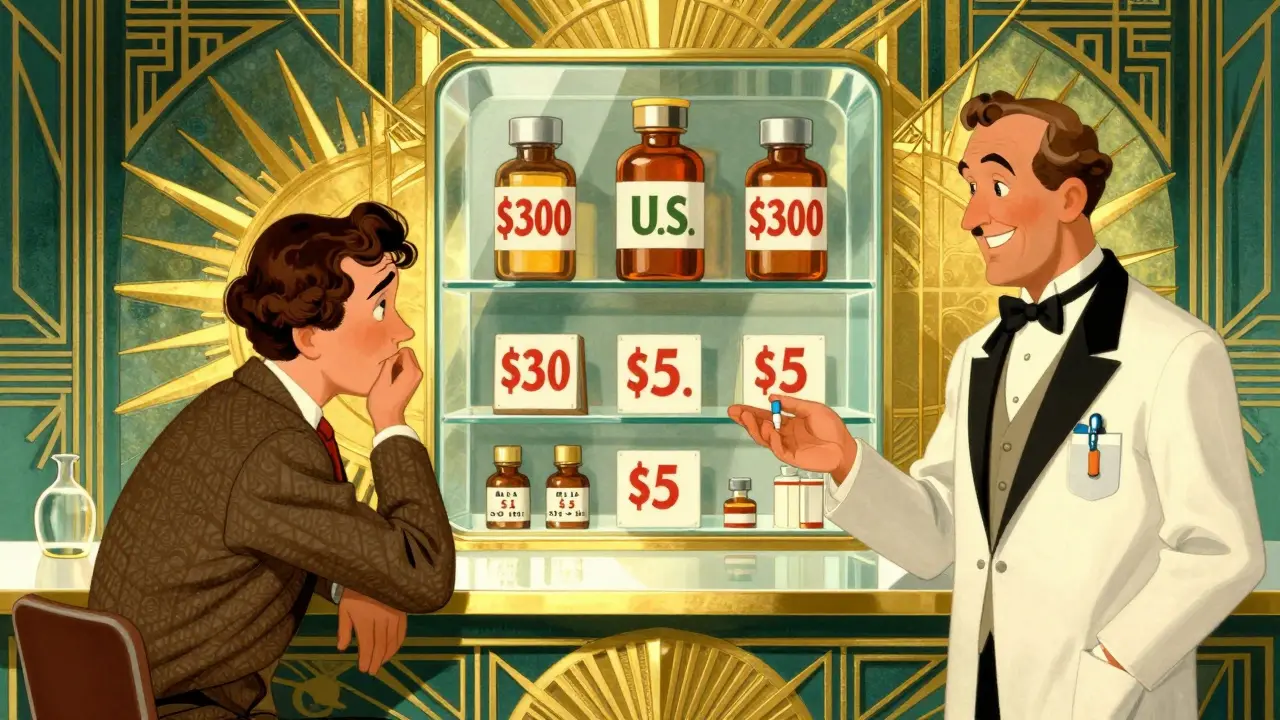
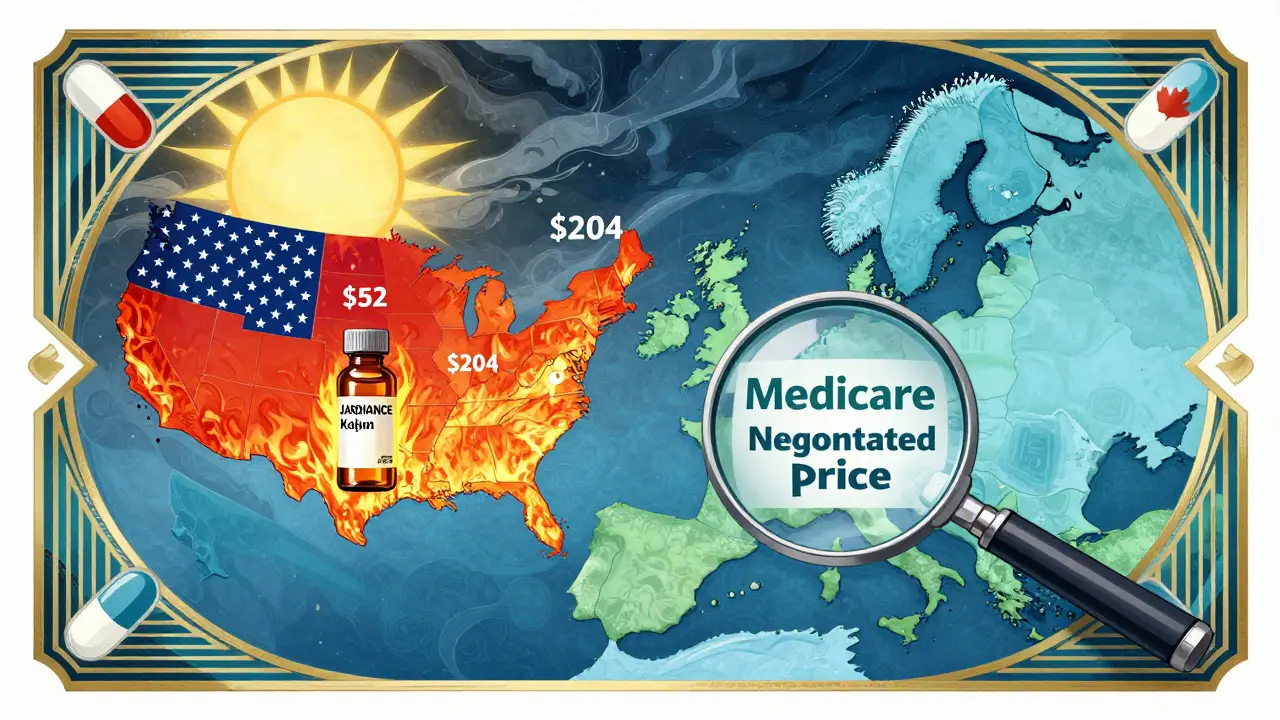
Why does a bottle of insulin cost $30 in Germany but $300 in the U.S.? And why does the same diabetes drug, Jardiance, cost $52 in Japan but $204 under Medicare’s new negotiated price? These aren’t random fluctuations-they’re the result of how each country decides who pays for medicine and how much.
What drives the price differences?
Pharmaceutical prices don’t follow global market rules. Instead, they’re shaped by national policies. In countries like France, Japan, and the UK, governments set limits on what drugmakers can charge. They use tools like reference pricing, where a drug’s price is tied to what it costs in other countries. If a new cancer drug sells for $10,000 in Germany, regulators in France might cap it at $9,000 based on that benchmark. The U.S. doesn’t do this. Until recently, Medicare was legally barred from negotiating drug prices. So drugmakers set their own list prices-often sky-high-knowing insurers and pharmacy benefit managers would negotiate discounts behind the scenes. But those discounts rarely reach patients at the counter. That’s why list prices in the U.S. look outrageous compared to other countries. Here’s the twist: when you look at what’s actually paid after discounts and rebates (net prices), the U.S. isn’t always the most expensive. A 2024 analysis from the University of Chicago found that for all drugs-including generics-the U.S. paid 18% less than Canada, Germany, the UK, France, and Japan on average. How? Because generics are dirt cheap here.Generics: The U.S. Secret Weapon
In the U.S., 90% of prescriptions filled are for generic drugs. In most other developed countries, that number is around 40%. Why? Because American pharmacies and insurers have spent decades pushing generics. They’re often 67% cheaper than the same drugs abroad. Take metformin, the most common diabetes drug. In the U.S., a 30-day supply can cost less than $5. In the UK, it’s about $15. In Germany, it’s $20. In Japan, even with heavy subsidies, it’s still over $10. That’s not because American drugmakers are more generous-it’s because the market is flooded with dozens of generic manufacturers competing on price. This is why U.S. drug spending isn’t as out of control as it looks. The high list prices for brand-name drugs are offset by low generic prices. But here’s the problem: if you need a new, expensive brand-name drug-like Ozempic or Jardiance-you’re stuck with the full price until your insurer negotiates a discount. And even then, you might still pay hundreds per month.Medicare’s New Negotiation Power
In 2022, the Inflation Reduction Act gave Medicare the power to negotiate prices for 10 high-cost drugs starting in 2025. The first 10 were announced in 2023. The results? Medicare’s negotiated prices are still 2.8 times higher than the average in 11 other OECD countries. For example:- Jardiance: Medicare price = $204; Japan = $52
- Stelara: Medicare price = $4,490; UK = $2,822
- Ozempic: Medicare price = $1,080; Canada = $620
Global Price Ranges: It’s Not Just the U.S.
A 2024 study in JAMA Health Forum looked at 549 essential medicines across 72 countries. When adjusted for purchasing power, the differences were staggering:- Lebanon: prices at 18% of Germany’s level
- Argentina: prices 5.8 times higher than Germany’s
- Western Pacific (including Japan, Australia, China): lowest median prices
- Americas (U.S., Canada, Brazil): highest median prices
Who Pays the Most? Who Pays the Least?
Based on data from the U.S. Department of Health and Human Services and the OECD:- Lowest prices: Japan, France, Australia, Germany (for generics and some branded drugs)
- Mid-range: Canada, United Kingdom, Netherlands, Sweden
- Highest prices: United States (for brand-name drugs)
Heather McCubbin
January 23, 2026 AT 00:26So let me get this straight the US pays more for brand drugs but less overall because generics are cheap like $5 for metformin??? That's not a system that's a glitch in the matrix
Dolores Rider
January 24, 2026 AT 13:23they're lying to us again i swear the drug companies own congress and the FDA and the doctors too 😭 i saw a documentary where they said insulin used to be $35 in the 70s now its 300 and they just keep raising it lol
venkatesh karumanchi
January 26, 2026 AT 11:28Interesting perspective. In India, generics are everywhere and affordable but access to newer drugs is still a challenge. Many patients wait months or rely on donations. The system isn't perfect but the cost difference is real. Maybe the US could learn from how India scales supply without sacrificing quality
John McGuirk
January 26, 2026 AT 13:21you think japan has low prices because they're nice? nah they just force pharma to sell cheap or get banned. the usa lets them charge what they want because we're too weak to fight back. this isn't capitalism its corporate feudalism
Michael Camilleri
January 27, 2026 AT 16:35the whole thing is a scam if you need a new drug you're screwed and if you dont you get free stuff its like buying a car where the engine costs 50k but the radio is free and everyone says wow you got such a good deal
lorraine england
January 27, 2026 AT 17:25my mom takes metformin and pays $4 at Walmart. I wish I could say the same for her blood pressure med. That's the real issue not the headline numbers. People forget that not everyone gets the cheap stuff
Darren Links
January 28, 2026 AT 18:09the us is the only country that actually funds medical progress. if we cap prices like europe then no new drugs get made. you want cheap insulin? fine. but then no one will invent the next ozempic. we pay for innovation. you just don't see it because you're too busy crying about list prices
Kat Peterson
January 29, 2026 AT 02:24OMG i just checked my insurance and my Jardiance copay is $200 😭 i thought i was getting a deal?? i feel so used and i'm just trying to live
Izzy Hadala
January 31, 2026 AT 00:55While the data presented is compelling, it is imperative to distinguish between list prices and net prices, as well as to consider the role of third-party payers and rebate structures. The variance in international pricing mechanisms is not merely a function of policy but also of market structure, regulatory enforcement, and pharmaceutical patent regimes. Further comparative analysis incorporating pharmaceutical R&D cost allocation models would provide greater contextual depth.
Elizabeth Cannon
January 31, 2026 AT 12:19so like if you're rich you pay a ton for ozempic but if you're poor you get metformin for 5 bucks? that's not healthcare thats a lottery. and why is it that the companies can charge 10x in the us but sell the same thing cheaper in canada? that's not business thats theft
Marlon Mentolaroc
February 2, 2026 AT 00:14the real story here is that the us system works for insurers not patients. the discounts they negotiate? they keep the savings. you still pay the full list price unless you're on medicaid or have crazy good insurance. so yeah the system looks good on paper but at the counter? you're screwed
Phil Maxwell
February 2, 2026 AT 14:14just wanted to say i live in a small town and my pharmacist knows my name. she told me last week that she sees people skip doses because they can't afford the copay even on generics. this isn't about numbers on a chart. it's about real people choosing between insulin and groceries