

When you pick up a generic pill at the pharmacy, you expect it to work just like the brand-name version. But how do regulators know it’s truly the same? The answer lies in pharmacokinetic studies - the most common, and often misunderstood, method used to prove that a generic drug is bioequivalent to its branded counterpart. These aren’t just paperwork. They’re carefully controlled human trials that measure exactly how your body absorbs, processes, and clears a drug. And while many call them the "gold standard," the truth is more complicated.
What Pharmacokinetic Studies Actually Measure
Pharmacokinetic studies track what happens to a drug inside your body after you take it. The two most important numbers are Cmax and AUC. Cmax tells you the highest concentration the drug reaches in your blood. AUC - area under the curve - shows how much of the drug your body is exposed to over time. Together, they tell regulators if the generic drug gets into your bloodstream at the same rate and to the same extent as the original.
These studies aren’t done on patients. They’re done on healthy volunteers - usually between 24 and 36 people. Each person takes both the brand-name drug and the generic, in random order, with a clean break in between. Blood samples are taken over hours, sometimes days, to build a full picture of how the drug moves through the body. The data is then analyzed using statistical methods like ANOVA to see if the differences fall within acceptable limits.
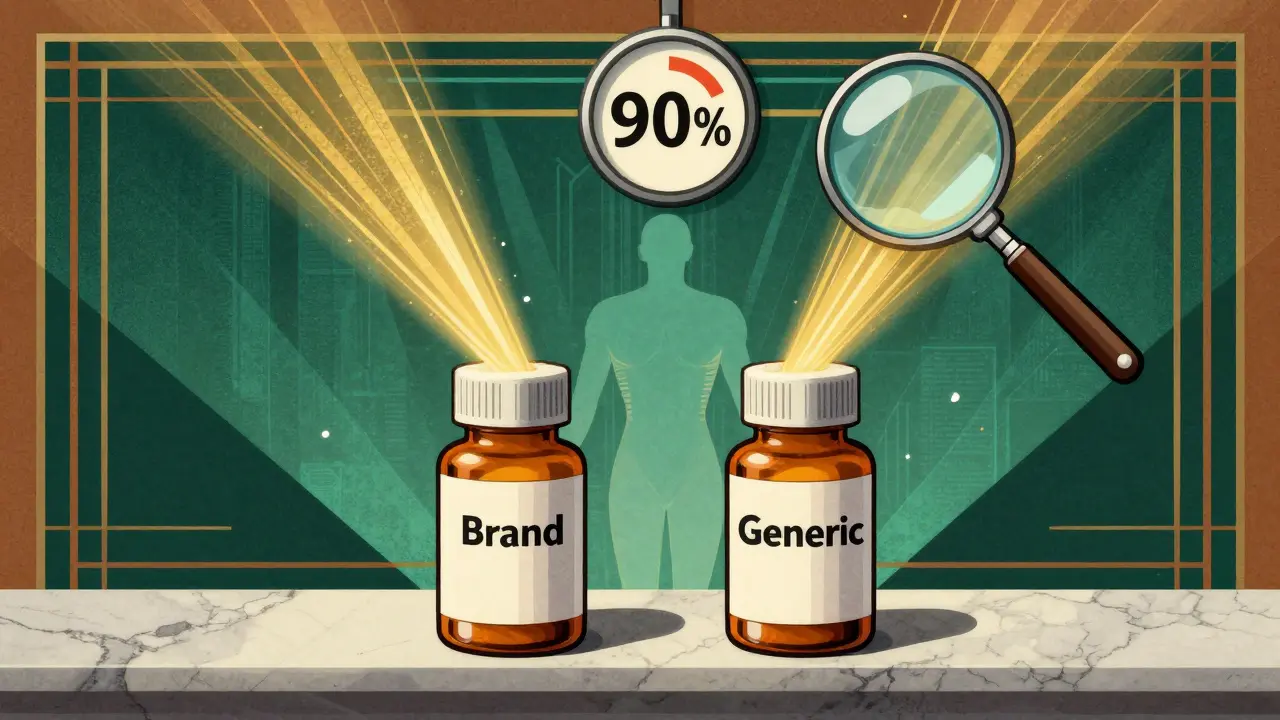
The FDA and other global regulators require that the 90% confidence interval for both Cmax and AUC must fall between 80% and 125%. That means the generic’s absorption can be as low as 80% or as high as 125% of the brand’s and still be considered equivalent. For drugs with a narrow therapeutic index - like warfarin, digoxin, or phenytoin - the bar is higher. The acceptable range tightens to 90-111%. Why? Because even small differences in these drugs can lead to serious side effects or treatment failure.
Why This Isn’t a "Gold Standard" - Even Though Everyone Says It Is
It’s common to hear that pharmacokinetic studies are the "gold standard" for proving generic equivalence. But that’s misleading. The FDA itself says bioequivalence is not a standard - it’s a principle. The real goal is therapeutic equivalence: that the generic works just as well and is just as safe. Pharmacokinetic data is a surrogate. It’s a reliable predictor, but not a perfect one.
Here’s the catch: two drugs can have identical Cmax and AUC values and still behave differently in the body. PLOS ONE published a study in 2010 showing that two generic versions of gentamicin - both meeting all pharmacokinetic and pharmaceutical equivalence tests - produced significantly different clinical outcomes. The active ingredient was the same. The dissolution profile matched. But the body reacted differently. Why? Because bioequivalence doesn’t always capture how a drug interacts with tissues, how excipients affect absorption, or how individual patient metabolism plays a role.
For oral, immediate-release drugs, pharmacokinetic studies work well. Failure rates are under 2% according to FDA post-marketing data. But for topical creams, inhalers, or injectable suspensions? They fall short. You can’t measure drug concentration in the skin or lungs the same way you measure blood levels. That’s why dermatopharmacokinetic methods (DMD) and in vitro permeation testing (IVPT) are now being used for topical products. One study found IVPT using human skin was more accurate than clinical trials.
How Regulatory Agencies Differ - And Why It Matters
The FDA doesn’t treat all drugs the same. It has over 1,857 product-specific guidances as of 2023. Each one outlines exactly how bioequivalence should be tested for that particular drug. For some, dissolution testing alone may be enough. For others, full pharmacokinetic studies are required. The European Medicines Agency (EMA), on the other hand, uses a more rigid, one-size-fits-all approach. This creates headaches for manufacturers trying to sell globally.
Take modified-release tablets. A tiny change in the coating or filler can delay drug release. Two generics might look identical on paper, but one releases the drug too slowly, reducing effectiveness. Pharmacokinetic studies catch this - but only if they’re designed properly. That’s why the FDA now recommends using the Biopharmaceutics Classification System (BCS) early in development. If a drug is highly soluble and highly permeable (BCS Class I), you might be able to skip human studies altogether. Only about 15% of drugs qualify, but for those, it saves millions.
The Hidden Costs and Time Burdens
Running a full pharmacokinetic study isn’t cheap. The average cost ranges from $300,000 to $1 million. The timeline? 12 to 18 months. That includes formulation development, ethics approvals, volunteer recruitment, dosing, blood draws, lab analysis, and statistical reporting. For small manufacturers, this is a massive barrier.
And it’s not just money. The complexity is staggering. A single change in excipients - like switching from lactose to mannitol - can alter bioavailability. Even the shape of the tablet or the coating thickness can matter. That’s why generic manufacturers now hire teams of biopharmaceutics scientists. It’s not just chemistry. It’s physics, physiology, and statistics rolled into one.

What’s Changing - And What’s Next
The field is evolving. The FDA’s Complex Generic Drug Products Initiative has led to 149 new guidances since 2018. For drugs like inhalers and topical creams, regulators are accepting in vitro data, imaging techniques, and even computer modeling.
One of the biggest shifts is the use of physiologically-based pharmacokinetic (PBPK) modeling. Since 2020, the FDA has accepted PBPK models to support bioequivalence waivers for BCS Class I drugs. These models simulate how a drug behaves in the human body based on physiology, drug properties, and formulation. It’s like a digital twin of the human system. If the model predicts equivalent absorption, and the data checks out, human trials might not be needed.
For topical products, dermatopharmacokinetic studies are gaining traction. One 2019 study showed DMD could detect differences between formulations with over 90% accuracy - far better than clinical endpoint trials that require hundreds of patients.
And while pharmacokinetic studies remain the backbone of generic approval - the FDA approved 95% of generics in 2022 using this method - the future is hybrid. A drug might start with in vitro testing, move to PBPK modeling, and only then proceed to human studies if needed. It’s not about replacing pharmacokinetics. It’s about using the right tool for the right drug.
What This Means for You
If you’re taking a generic drug, you can still trust it. The system works. But it’s not perfect. For most drugs - especially common ones like statins, blood pressure pills, or antibiotics - the evidence is overwhelming: generics are just as safe and effective. For high-risk drugs like anticoagulants or epilepsy medications, regulators apply extra scrutiny. And for complex products like inhalers or creams, newer methods are stepping in to fill the gaps.
Don’t assume "same active ingredient" means "same effect." The science behind bioequivalence is far more nuanced than that. The real takeaway? Regulatory agencies aren’t just checking boxes. They’re constantly refining the science to keep patients safe - even when the science itself is still evolving.
Are generic drugs always as effective as brand-name drugs?
For most drugs, yes. Pharmacokinetic studies show that 95% of generics approved by the FDA meet strict bioequivalence standards. But effectiveness can vary for drugs with a narrow therapeutic index - like warfarin or digoxin - where even small differences matter. For these, regulators require tighter limits and sometimes additional testing. Always talk to your doctor if you notice changes in how a medication works after switching to a generic.
Why do some people say generics don’t work as well?
Sometimes, it’s not the drug - it’s the placebo effect, or changes in packaging, pill size, or color that affect perception. But in rare cases, differences in inactive ingredients (excipients) can alter how a drug is absorbed. This is especially true for extended-release formulations. If you feel a difference after switching, report it to your pharmacist or doctor. Regulatory agencies track these reports and may investigate if patterns emerge.
Can a generic drug be approved without human studies?
Yes, but only for certain drugs. If a drug is classified as BCS Class I - meaning it’s highly soluble and highly permeable - regulators may accept in vitro dissolution data and computer modeling (PBPK) instead of human trials. This applies to about 15% of drugs, mostly simple oral medications. For complex products like creams, inhalers, or injectables, human or advanced in vitro testing is still required.
How long does a bioequivalence study take?
A full pharmacokinetic study typically takes 12 to 18 months from start to finish. This includes formulation development, regulatory approvals, recruiting volunteers, conducting dosing sessions, analyzing blood samples, and completing statistical reports. The actual human testing phase lasts a few weeks, but the preparation and data analysis take much longer. Costs range from $300,000 to $1 million, depending on complexity.
Do all countries use the same standards for generic approval?
No. The FDA and EMA have different approaches. The FDA uses product-specific guidances, tailoring requirements for each drug. The EMA uses a more uniform approach. The WHO promotes harmonized standards, and 50 national regulators follow international guidelines. But implementation varies - especially in emerging markets. This is why some generics approved in one country may not be approved in another.
Chris Crosson
March 24, 2026 AT 06:59Man, I love how this breaks down the real science behind generics. I used to think "same active ingredient" meant identical, but now I get why two pills can look the same and act totally different in my body. That PLOS ONE study on gentamicin? Wild. Makes you wonder how many times we’ve just gotten lucky with generics.
Linda Foster
March 26, 2026 AT 06:56Thank you for presenting this information with such clarity and precision. The regulatory distinctions between pharmacokinetic metrics and therapeutic outcomes are critically important for public health policy and clinical decision-making.
Rama Rish
March 26, 2026 AT 09:43sooo many ppl think generic = bad. but like… if the science checks out? why doubt it? 🤷♀️
Chris Farley
March 26, 2026 AT 15:20Let’s be real - this whole "bioequivalence" thing is just Big Pharma’s way of keeping generics expensive. They want you to believe these studies are holy grails. Nah. They’re just a loophole. If it was truly about safety, they’d require clinical trials for every damn drug. But they don’t. Because profit > patients. Always.
James Moreau
March 26, 2026 AT 23:00Great breakdown. I work in global health and see how messy this gets in low-resource settings. The EMA vs FDA thing? Huge. One country approves a generic, another rejects it over a 3% difference in AUC. Patients suffer because of bureaucracy, not science.
J. Murphy
March 27, 2026 AT 06:15bioequivalence is a myth. just sayin.
Jesse Hall
March 27, 2026 AT 13:45This is actually super cool 😊 I had no idea PBPK modeling was a thing. Like… a digital twin of your body? That’s sci-fi becoming real. Kudos to the scientists working on this stuff - we need more innovation, not just more testing.
Sean Bechtelheimer
March 28, 2026 AT 00:37Wait… so you’re telling me the FDA lets companies skip human trials using *computer models*? 🤔 Who’s really running these tests? Are they even real? I bet Big Pharma just runs simulations on a laptop in a basement. Next thing you know, your insulin is being approved by an AI that’s never met a human. 😈
Alex Arcilla
March 28, 2026 AT 16:44Oh wow, so the EMA’s "one-size-fits-all" approach is why my cousin in Germany got a generic that made her dizzy, but the same pill in the US? Fine. Classic. 🤦♂️ We got product-specific guidances because we know regulators aren’t dumb. Europe’s just stuck in 2005. Meanwhile, we’re using AI to simulate drug behavior. Guess who’s saving lives?
Brandon Shatley
March 30, 2026 AT 12:57so i just learned that even the shape of the pill can change how fast it works? wild. i always thought it was just the chemical. guess i was wrong. thanks for explaining this in a way that actually made sense.
Mihir Patel
March 31, 2026 AT 10:36bro this is the most dramatic thing i’ve read all week. like… imagine if your asthma inhaler was approved based on a *simulation*? what if the model is wrong? what if it’s a glitch? what if the AI just… slept? 😭
Elaine Parra
April 1, 2026 AT 04:47Let me guess - this whole post was written by a pharmaceutical lobbyist. You’re trying to make us believe that the FDA is some noble guardian of public health. Wake up. The same agencies that approved opioids are now approving generics with 125% absorption limits. That’s not science. That’s corruption. And you’re just glossing over it.
Natasha Rodríguez Lara
April 1, 2026 AT 11:25Really appreciate the nuance here - especially the part about topical drugs. I’ve been using a generic steroid cream for eczema and noticed it just… didn’t work like the brand. I thought it was me. Turns out, the FDA didn’t even have good testing methods for it until recently. So glad they’re catching up.
peter vencken
April 2, 2026 AT 19:08my buddy works at a generic drug company and said the hardest part isn’t the science - it’s getting the excipients right. like, switching from cornstarch to potato starch can throw off absorption. they spend more time on filler than active ingredient. wild right?