

Imagine shipping ten thousand units of a new product only to find out a week later that a tiny measurement error makes them all useless. That is the nightmare every plant manager faces. In the world of high-volume production, quality control testing isn't just a checkbox for compliance-it is the only thing standing between a profitable quarter and a massive, expensive recall. If you catch a mistake at the raw material stage, it costs pennies; if you catch it after it reaches the customer, it can cost your entire reputation.
Most people think of quality assurance as a final check at the end of the line. But if you wait until the product is finished to find a flaw, you've already wasted the energy, labor, and materials to build a defective item. The goal is to move from "finding mistakes" to "preventing them." By using a structured QA framework, manufacturers can slash scrap and rework costs. In fact, data from the American Society for Quality shows that companies with comprehensive testing see an average reduction in these costs by about 32.7%.
The Core Framework of Manufacturing QA
To get this right, you need a system that doesn't rely on luck. Modern manufacturing generally follows the ISO 9001:2015 international standard for quality management systems. This framework moves the focus toward risk-based thinking. Instead of just checking boxes, you identify where the process is most likely to fail and put your strongest tests there.
Whether you are making circuit boards or medical devices, the process usually breaks down into a few critical phases: checking what comes in, monitoring what's happening during the build, and verifying what goes out. If you skip any of these, you're essentially gambling with your bottom line.
Step 1: Defining Your Quality Standards
You can't test for "good quality" because that is a vague opinion. You need concrete numbers. This first step is about establishing the measurable metrics and acceptable tolerances for every single part. If a part needs to be 10mm wide, does it fail at 10.1mm or 10.05mm?
For a professional setup, this means defining values like:
- Dimensional Accuracy: Setting tolerances from ±0.005mm for high-precision aerospace parts to ±0.5mm for general consumer goods.
- Surface Finish: Using Ra values (typically between 0.8-3.2 μm) to ensure machined parts aren't too rough.
- Visual Consistency: Using the CIELAB scale to ensure colors match, where a ΔE value of less than 2.0 is usually the cutoff for "acceptable."
Step 2: Incoming Material Inspection
Quality starts before your machines even turn on. If your raw materials are garbage, your finished product will be too. This is where you verify that your suppliers are actually sending what you paid for. You don't necessarily check every single bolt or sheet of plastic, but you use a sampling plan.
Many shops use AQL Acceptable Quality Level standards to decide how many samples to pull. For example, if you're in electronics, you might follow the MIL-STD-105E standard, which might allow for a 0.65% major defect rate before you reject the entire shipment from the supplier. This prevents bad materials from ever entering your production stream.
Step 3: In-Process Quality Control (IPQC)
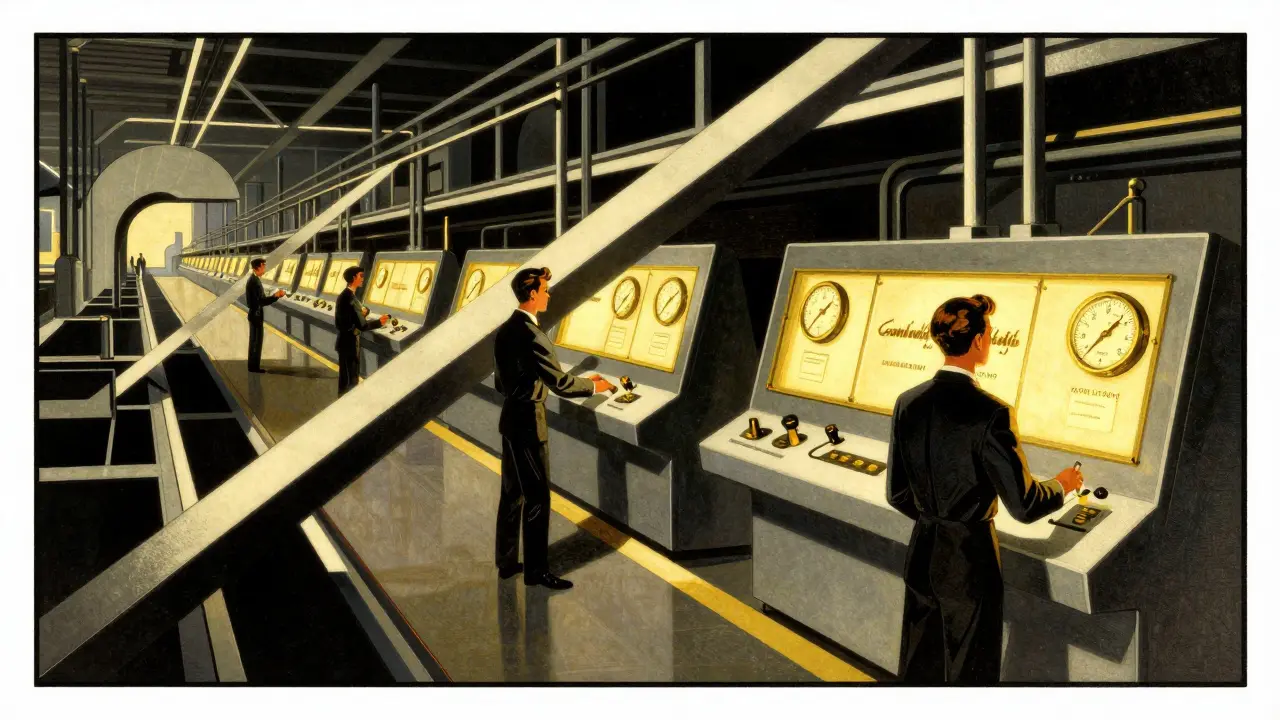
This is where the real magic happens. In-Process Quality Control the practice of testing products during the manufacturing stage rather than only at the end is designed to catch errors the moment they occur. If a machine starts drifting out of alignment, you want to know now, not after you've made 5,000 bad parts.
To do this effectively, engineers use Statistical Process Control a method of quality control which employs statistical methods to monitor and control a process. This involves using X-bar and R charts to monitor variation. If the data points move beyond the 3σ (three-sigma) control limits, the operator stops the line immediately. By implementing real-time automated probing, some companies have managed to reduce their defect escape rates by as much as 63%.
Step 4: Final Quality Control (FQC) and Outgoing Quality Control (OQC)
Even with great IPQC, you need a final safety net. FQC happens as soon as the product is finished, and OQC happens just before it leaves the shipping dock. The intensity of this testing depends on the risk. If you're making a plastic toy, a random sample is fine. If you're making a heart valve under ISO 13485, you perform 100% inspection because a single failure could be fatal.
| Risk Level | Typical Industry | Inspection Strategy | Standard Used |
|---|---|---|---|
| Low | Consumer Goods | Random Sampling | ANSI/ASQ Z1.4 |
| Medium | Electronics | AQL Sampling + IPQC | IPC-A-610 |
| High | Medical/Aerospace | 100% Inspection | ISO 13485 / FDA 21 CFR |
Step 5: Analysis and Corrective Action (CAPA)
Testing is useless if you don't do anything with the data. When a part fails, you don't just throw it in the scrap bin; you find out why it failed. This is called CAPA Corrective and Preventive Action, a regulatory requirement to investigate and fix the root cause of defects.
A standard protocol requires a root cause analysis within 72 hours of a discrepancy. Use software like Minitab or JMP to analyze whether the failure was a one-time fluke or a systemic issue. If the Cpk (process capability index) drops below 1.33, your process is no longer considered "capable," and you need to re-tool or re-train your staff.

The Human Element: Training and Documentation
You can have the most expensive Zeiss metrology equipment in the world, but if your operator doesn't know how to use it, you're just wasting money. Effective QA programs typically allocate 15-20% of total production time to quality activities. This includes specialized training-often between 16 to 40 hours depending on the role-to ensure everyone knows how to spot a defect.
Documentation is the other half of the battle. In regulated industries like pharmaceuticals, you can't just write notes on a napkin. You need pre-numbered bound logbooks and electronic records that comply with 21 CFR Part 11. If it isn't documented, it didn't happen. This audit trail is what protects a company during an FDA or ISO inspection.
The Future of QA: AI and IoT
We are moving away from humans with calipers and toward AI-powered visual inspection. By 2026, it's expected that 65% of manufacturing QC will use real-time IoT sensor data. Instead of checking a part every hour, sensors monitor the machine's vibration and temperature every millisecond. This allows for "predictive quality," where the system tells you a part will be defective before it even happens.
Some leaders are even using "digital twins"-virtual replicas of the production line. Boeing, for example, saw a 31% reduction in assembly defects by simulating the build process digitally before touching a single piece of aluminum. The goal is to merge these high-tech tools with the foundational principles of process prevention established decades ago.
What is the difference between QA and QC?
Quality Assurance (QA) is the broad process of preventing defects by improving the way a product is made. Quality Control (QC) is the specific act of testing the product to find defects that have already happened. Think of QA as the recipe and QC as the taste test.
How often should we perform in-process sampling?
Sampling frequency depends on your AQL (Acceptable Quality Level). High-risk processes require more frequent checks, while stable processes with a Cpk > 1.33 can afford wider intervals. Most electronics manufacturers use a mix of random sampling at critical control points throughout the shift.
What does ISO 9001:2015 actually require?
It requires a documented quality management system that emphasizes risk-based thinking, leadership commitment, and a cycle of continuous improvement. It doesn't tell you exactly how to test your parts, but it requires you to prove that your testing process is consistent and effective.
Can AI completely replace human inspectors?
Not yet. While AI is faster at spotting surface defects, it often lacks the contextual understanding of why a process is varying. Over-reliance on AI without human oversight can lead to higher false-negative rates, where subtle but critical defects are missed because they don't fit the algorithm's pattern.
What is a CAPA and why is it important?
CAPA stands for Corrective and Preventive Action. It is the process of investigating a defect, finding the root cause, and implementing a permanent fix so the mistake never happens again. Without CAPA, you're just treating the symptoms instead of curing the disease.
Next Steps for Your Facility
If you're just starting out, don't try to automate everything on day one. Start by documenting your standards. If you can't define what a "bad" part is, you can't find one. Once your standards are set, implement a basic incoming inspection for your top three most critical components.
For those with established lines, look at your scrap rates. If you're finding most defects at the final stage (FQC), your IPQC is failing. Move your testing points earlier in the process to catch errors where they are cheapest to fix. If you're in a highly regulated field like med-tech or pharma, prioritize your test method validation to avoid the common pitfalls that lead to FDA warning letters.