

You pack your passport, your toothbrush, and that little bottle of Sudafed for the stuffy plane ride. You step through customs in Tokyo or Dubai, and suddenly, you are not a tourist anymore. You are a suspect.
It sounds like a movie plot, but it happens every day. Over-the-counter (OTC) medications that you can buy at any pharmacy in the United States are illegal, controlled, or strictly regulated in many other parts of the world. The difference between a smooth vacation and a prison cell often comes down to one pill in your carry-on bag.
This is not just about prescription drugs. It is about the everyday remedies we keep in our medicine cabinets. If you are traveling internationally in 2026, understanding these hidden legal traps is as important as getting your visa.
The Hidden Legal Trap in Your Medicine Cabinet
We assume that if a drug is legal here, it is legal everywhere. That assumption is dangerous. Pharmaceutical laws vary wildly from country to country. What is considered a harmless decongestant in Ohio might be classified as a precursor chemical for illicit drugs in Japan or the Middle East.
The International Narcotics Control Board (INCB) has tracked these discrepancies since 1961, but comprehensive public resources only became widely available after 2010. Today, 78 countries have submitted their medication regulations to the INCB. However, 42 nations-including major destinations like Indonesia, India, and Pakistan-have not provided official guidance. This creates a blind spot where travelers operate on guesswork rather than fact.
The consequences are real. Between 2010 and 2015, U.S. citizens were detained in 17 different countries specifically for carrying prohibited medications. In 2022 alone, the U.S. Embassy in Japan reported 217 American citizens facing legal issues over medication possession. That was a 37% increase from 2019. These are not rare anomalies; they are a growing trend.
The Most Commonly Banned OTC Medications
Not all pills are created equal in the eyes of foreign customs officers. Some active ingredients trigger immediate alarms. Here are the specific substances you need to watch out for.
| Active Ingredient | Common Brand Names | Key Restrictions | High-Risk Countries |
|---|---|---|---|
| Pseudoephedrine | Sudafed, Drixoral | Often completely prohibited; requires import permit | Japan, Mexico, UAE |
| Diphenhydramine | Benadryl, ZzzQuil | Requires documentation; quantity limits apply | Japan, Zambia, South Korea |
| Codeine | Tylenol PM, Robitussin AC | Strictly controlled; Schedule II substance in many regions | UAE, Japan, Greece, Indonesia |
| Zolpidem | Ambien, Edluar | Banned or requires advance permission | Egypt, Saudi Arabia, France, UAE |
| Amphetamines | Adderall, Vyvanse | Prohibited in many countries; strict ADHD rules | Japan, Sweden, Switzerland |
Pseudoephedrine is the biggest offender. It is the active ingredient in Sudafed, a go-to remedy for congestion. In Japan and Mexico, it is completely prohibited under their respective pharmaceutical laws. In Japan, possessing it without authorization can lead to up to five years in prison. Why? Because pseudoephedrine can be used to manufacture methamphetamine. Customs agents there treat it with extreme suspicion.
Diphenhydramine, found in Benadryl, seems harmless enough. It stops itching and helps you sleep. But in Japan and Zambia, it requires documentation. In 2022, customs officials in Zambia confiscated 1,842 Benadryl-containing products from international travelers. They did not arrest everyone, but they certainly ruined trips.
Codeine appears in many nighttime cold medicines and pain relievers like Tylenol PM. While often sold freely in the U.S., it is a Schedule II controlled substance in places like Greece and the UAE. In the UAE, possessing codeine without proper documentation carries a mandatory sentence of one to three years. Yes, years, for a few pills of cough syrup.
If you take Zolpidem (Ambien) for insomnia, check your destination carefully. It is banned in Egypt, Saudi Arabia, and the UAE. In France, it requires advance permission. In 2022, 83 travelers were detained in France for unauthorized possession of this common sleep aid.
Country-Specific Nightmares: Where Rules Are Strictest
Some countries are more lenient than others. The Philippines, for example, updated its policy in 2023 to allow 30-day supplies of most medications without extensive documentation. But other destinations demand near-perfect compliance.
Japan maintains the world's strictest OTC medication restrictions. Under its Pharmaceutical Affairs Law, Japan prohibits 26 common U.S. medications. This includes pseudoephedrine, lidocaine patches above 4%, and certain herbal supplements containing ephedra. Enforcement statistics show that 94% of prohibited medication cases involving U.S. travelers revolve around Sudafed or Benadryl. Japan does not accept U.S. prescriptions as valid proof. Instead, they require a "Yunyu Kakunin-sho" (import certificate). This process takes four to six weeks to process, and in 2023, only 68% of first-time applicants were approved.
The United Arab Emirates imposes the harshest penalties. Unauthorized possession of codeine or sedatives like Xanax or Valium can result in mandatory prison sentences of two to four years. There is little room for negotiation. If you bring these drugs without explicit prior approval, you risk serious jail time.
Mexico bans pseudoephedrine completely. However, it allows limited quantities of prescription-strength lidocaine if you have documentation. This nuance matters. A traveler bringing Sudafed will get stopped. A traveler bringing prescribed lidocaine patches with a doctor's note might pass through smoothly.
Zambia restricts diphenhydramine. You need a doctor's note if you are carrying more than 30 tablets. For a long safari trip, that limit can be tricky to manage without paperwork.
Greece classifies codeine as a Schedule II controlled substance. You need special permits to enter the country with any codeine-containing product. This catches many tourists off guard because they buy multi-symptom cold meds at the airport duty-free shop, unaware that the codeine inside is now a controlled substance.

The Documentation Protocol: How to Stay Safe
You cannot rely on memory. You must create a paper trail. Experts agree on a specific set of steps to minimize risk.
- Contact the Embassy Early: Reach out to the embassy of your destination country 8 to 12 weeks before your trip. Japan’s import certificate process alone takes 4-6 weeks. Waiting until the last minute guarantees problems.
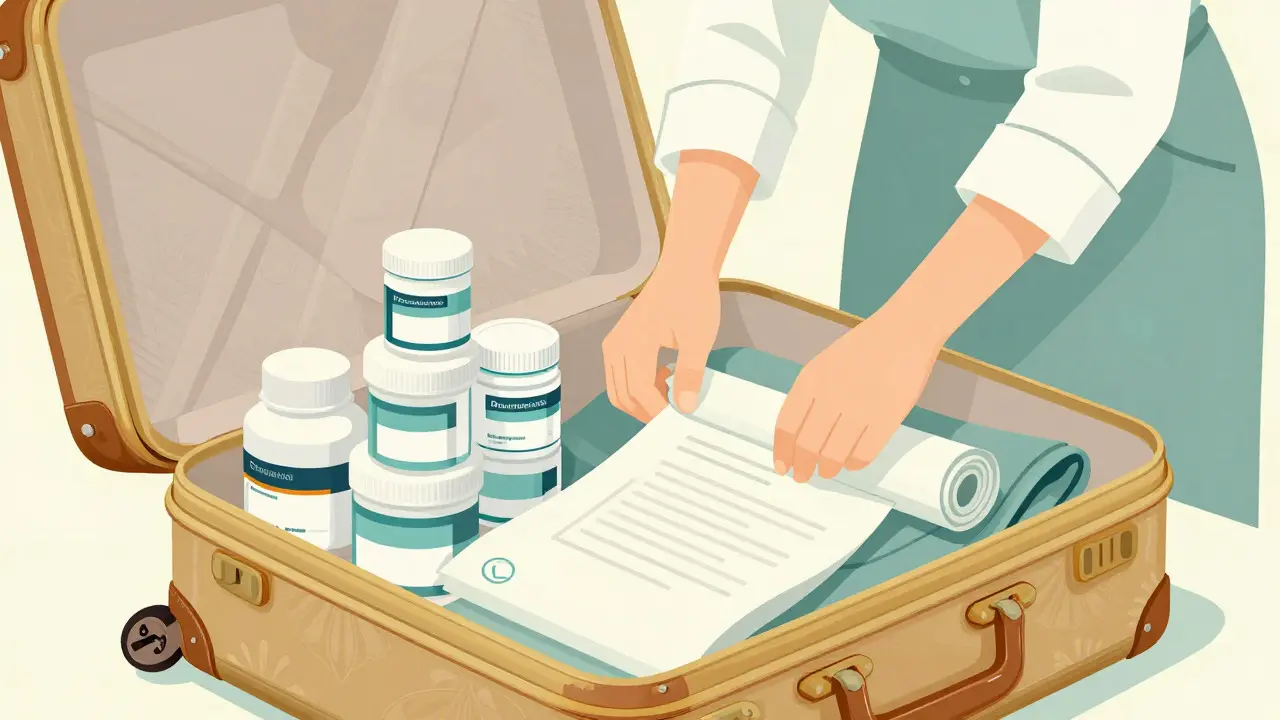
- Keep Original Containers: Never pour pills into generic weekly organizers. Carry medications in their original pharmacy containers. The label must match the name on your passport exactly. This is a requirement enforced by U.S. Customs and Border Protection (CBP Requirement #1444) and mirrored by many international agencies.
- Get a Doctor’s Letter: Obtain a signed letter from your physician. It should detail the medication name, dosage, and medical necessity. Crucially, use the International Nonproprietary Name (INN) rather than brand names. According to a 2022 WHO Medication Safety Report, 78% of medication confusion stems from brand name discrepancies. A doctor’s letter reduces legal complications by 89%, based on 2022 incident data cited by the CDC Yellow Book.
- Check Quantities: Verify how much you are allowed to bring. Japan, for instance, allows a maximum 2-month supply without a special certificate. Bringing three months’ worth could trigger an investigation.
- Email Official Channels: For Japan-specific queries, email [email protected]. The Ministry of Health, Labour and Welfare reports a 72-hour average response time. Having an email confirmation can be your lifeline at customs.
A valid U.S. prescription provides no protection under foreign law. In the first quarter of 2023, Japan detained 17 American citizens despite them having valid prescriptions. The local law overrides your home country’s rules.
Common Mistakes Travelers Make
Analysis of traveler incident reports reveals predictable errors. Avoiding these can save you from detention.
- Assuming OTC Means Safe: 67% of cases involve travelers assuming that because a drug is over-the-counter in the U.S., it is fine abroad. This is the single biggest mistake.
- Failing to Convert Brand Names: 29% of cases involve travelers who do not know the active ingredients in their meds. They see "Cold & Flu Multi-Symptom" and don't realize it contains codeine or pseudoephedrine.
- Using Unmarked Containers: 18% of cases involve pills in unmarked bottles. Without a pharmacy label, customs agents cannot verify what the substance is, leading to confiscation or testing delays.
Another critical area is emergency contraception. Mifepristone is legal in the U.S. but banned in 12 countries, including the UAE. In 2022, 32 travelers were detained for possessing it. If you rely on this method, research your destination thoroughly.
Tools and Resources for 2026
The landscape is changing. More tools are becoming available to help travelers navigate these complexities.
In 2023, 73% of major travel insurance policies began including medication restriction coverage as standard, up from 41% in 2019. Check your policy. If you are detained due to a medication error, some insurers now cover legal fees or repatriation costs.
Digital solutions are emerging. The IATA Travel Pass launched a medication module in Q2 2023, covering 65 destinations. Japan released an app called "MediSafe Japan," which has been downloaded 147,000 times since September 2022. These apps provide real-time updates on restricted substances.
Looking ahead, the INCB plans to launch a Global Medication Travel Registry by 2025. This registry aims to standardize medication approval processes across 100+ countries. Until then, the burden remains on the traveler.
The State Department reports a 200% increase in pre-travel medication inquiries since 2020. Medication restriction checking is now the third most common pre-travel concern, after visas and vaccinations, according to a 2023 Skyscanner survey of 12,000 respondents. Awareness is rising, but gaps remain. Only 28% of travel agencies systematically address medication restrictions, and 61% of travelers remain unaware that common OTC meds face international restrictions.
Final Checklist Before You Fly
Before you pack your bags, run through this final checklist.
- Identify all medications, including vitamins and herbal supplements.
- Look up each active ingredient on the INCB Country Regulations database.
- Contact the destination embassy if the drug is listed as restricted.
- Obtain a doctor’s letter using generic drug names.
- Keep all meds in original packaging.
- Carry only a reasonable personal supply (usually 30 days).
- Save digital copies of all documents in your cloud storage.
Travel should be relaxing, not a legal minefield. By taking these simple steps, you ensure that your health needs don’t become your biggest travel headache.
Can I take Sudafed to Japan?
Generally, no. Pseudoephedrine (the active ingredient in Sudafed) is prohibited in Japan. Possession without an import certificate can lead to imprisonment. You must obtain a Yunyu Kakunin-sho certificate well in advance if you absolutely need it, but approval rates are low for first-time applicants.
Is Benadryl banned in other countries?
Benadryl (diphenhydramine) is not always banned, but it is restricted. In countries like Japan and Zambia, you need documentation such as a doctor's note, especially if carrying more than a small personal supply. In Zambia, quantities exceeding 30 tablets require a doctor's note.
What happens if I get caught with banned medication?
Consequences range from confiscation of the medication to arrest and detention. In countries like the UAE, penalties can include mandatory prison sentences of 2-4 years for unauthorized possession of controlled substances like codeine or sedatives. In Japan, fines and short-term detention are common.
Does a US prescription protect me abroad?
No. A valid U.S. prescription provides no legal protection under foreign law. Many countries, including Japan, have their own classification systems. You must follow the destination country's specific regulations, which may require additional permits or certificates beyond a standard prescription.
How do I find out if my medication is legal in my destination?
Start by checking the International Narcotics Control Board (INCB) Country Regulations database. Then, contact the embassy or consulate of your destination country 8-12 weeks before travel. Use the generic name (INN) of the drug when inquiring, as brand names can cause confusion.
Are herbal supplements safe to travel with?
Not necessarily. Some herbal supplements contain restricted ingredients. For example, ephedra is prohibited in Japan. Always check the active ingredients list of any supplement against the destination country's banned substances list. Do not assume "natural" means "legal" everywhere.
What is the Yunyu Kakunin-sho certificate?
The Yunyu Kakunin-sho is an import certificate required by Japan for travelers carrying medications containing controlled substances. It must be obtained from the Japanese Ministry of Health, Labour and Welfare before arrival. The process takes 4-6 weeks and requires detailed medical documentation.
Which countries have the strictest medication laws?
Japan, the United Arab Emirates (UAE), Saudi Arabia, and Singapore are known for having very strict medication laws. Japan prohibits many common OTC drugs like Sudafed. The UAE imposes heavy prison sentences for unauthorized possession of controlled substances like codeine and sedatives.