
Imagine waking up and realizing a single salad from last night might have accidentally neutralized your medication. For people taking Vitamin K Foods and managing their health with Warfarin, this isn't a hypothetical-it's a daily reality. The relationship between what you eat and how your blood clots is a delicate balancing act. If you eat too much Vitamin K, your blood might clot too easily; too little, and you risk dangerous bleeding. The goal isn't to avoid these nutrients entirely, but to master the art of consistency.
Quick Summary: The Golden Rules of Vitamin K and Warfarin
- Consistency is king: You don't need to stop eating greens; you just need to eat the same amount every day.
- Avoid extremes: Sudden spikes or drops in Vitamin K intake (more than 50% change) are the primary cause of INR instability.
- Know your triggers: Leafy greens like kale and spinach are high-K foods that require careful portion control.
- Track your trends: Using a food log or app helps identify which meals correlate with INR fluctuations.
How Warfarin and Vitamin K Actually Interact
To manage your levels, it helps to understand the chemistry. Warfarin is a coumarin-based anticoagulant that prevents blood clots by blocking the enzyme that recycles Vitamin K. Essentially, Warfarin puts a "roadblock" in the way of Vitamin K, which your liver needs to produce clotting factors II, VII, IX, and X. When Vitamin K is blocked, your blood takes longer to clot, which is exactly what the medication is designed to do.
However, when you eat a large amount of Vitamin K-specifically phylloquinone (Vitamin K1) found in plants-you are essentially providing the body with a "workaround." This extra Vitamin K bypasses the Warfarin roadblock, allowing your liver to produce those clotting factors again. This causes your International Normalized Ratio (INR) to drop, meaning your blood is thicker and your risk of a clot increases.
The INR Target: Why the Numbers Matter
Your doctor monitors your progress using the INR. For most people, the therapeutic target is between 2.0 and 3.0. If you have a mechanical heart valve in the mitral position, that range might be slightly higher, typically 2.5 to 3.5.
When your INR falls below this range, your medication isn't working effectively enough. When it climbs too high (for example, hitting 4.0 or 5.0), you are at a significant risk for internal bleeding or bruising. Research shows that nearly 68% of these stability events are linked directly to dietary changes. It's not about the specific food, but the change in the amount of that food.

Mapping High-Vitamin K Foods
Not all vegetables are created equal. Some have negligible amounts of Vitamin K, while others are concentrated powerhouses. For example, a cup of iceberg lettuce is relatively "safe," while a cup of cooked spinach can be a game-changer for your INR.
| Food Item | Approx. Vitamin K (mcg) | Impact Category |
|---|---|---|
| Cooked Spinach (1 cup) | 889 mcg | Very High |
| Cooked Kale (1 cup) | 547 mcg | Very High |
| Cooked Broccoli (1 cup) | 220 mcg | High |
| Spinach Salad (1 cup raw) | 145 mcg | Moderate |
| Iceberg Lettuce (1 cup) | 17 mcg | Low |
If you love kale, you don't have to give it up. But if you eat one cup of kale on Monday and none for the rest of the week, your INR will likely swing. If you eat half a cup every single day, your doctor can simply adjust your Warfarin dose to account for that constant level of Vitamin K.
Practical Strategies for Daily Stability
Maintaining a stable INR requires a few shifts in how you approach mealtime. The goal is to keep your daily intake within a 10-15% variation range.
1. Master Your Portions
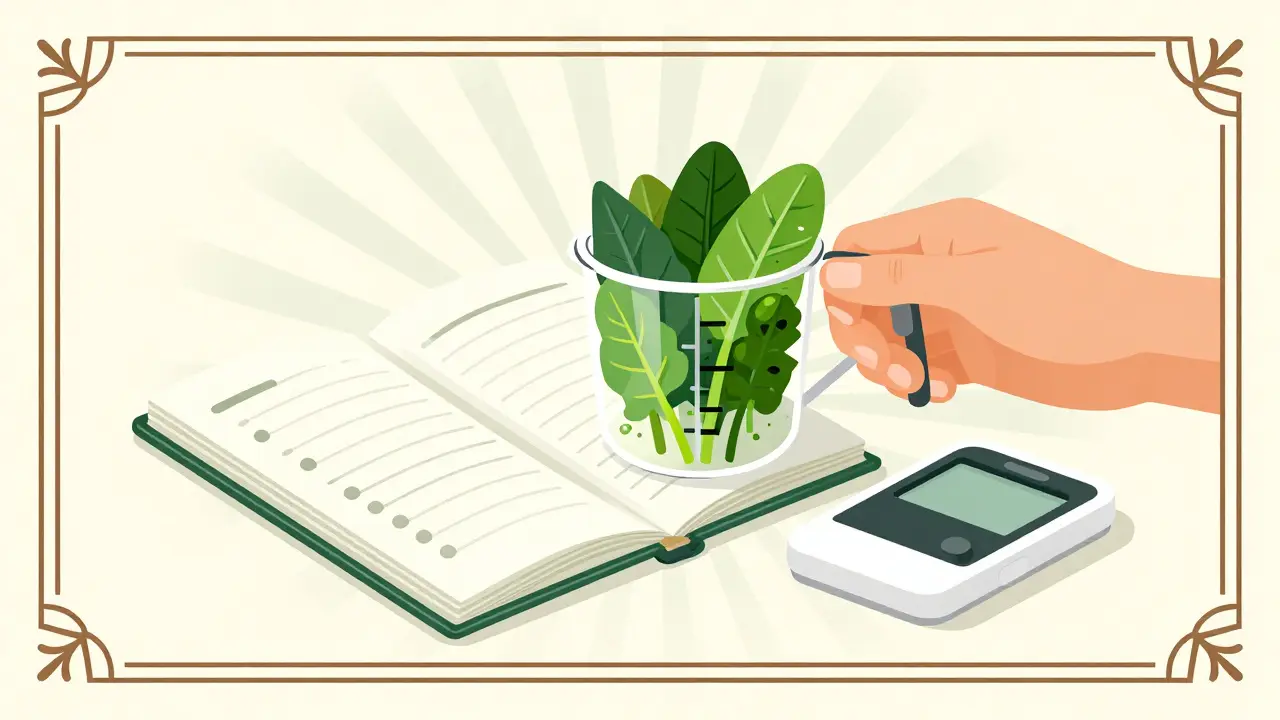
Eye-balling a salad is a recipe for disaster. Use actual measuring cups. There is a massive difference between a "handful" of spinach and a measured cup. By standardizing your portions, you remove the guesswork from your medication's effectiveness.
2. Be Mindful of Cooking Methods
How you prepare your food matters. Interestingly, boiling vegetables can reduce their Vitamin K content by 30% to 50% compared to steaming. If you switch from steaming your broccoli to boiling it, you've suddenly lowered your Vitamin K intake, which could cause your INR to spike.
3. The "Restaurant Trap"
Dining out is one of the biggest risks for INR instability. Restaurants often use larger portions of greens or different oils and preparations than you use at home. When traveling or eating out, try to stick to familiar sides or be very mindful of heavy green salads that you wouldn't normally eat at home.
4. Use Digital Tracking
Apps like CoumaDiet allow you to log your intake and see patterns. If you notice your INR drops every time you visit a specific smoothie shop that uses spinach, you can either stop going or consciously add that "event" to your daily routine so your doctor can adjust your dose.
Troubleshooting Common INR Fluctuations
Even with the best intentions, your numbers might drift. Here is how to handle common scenarios:
- The Sudden Drop: If your INR drops (e.g., from 2.8 to 1.9), look back at your last week. Did you start a new "green juice" habit? Did you eat a large amount of kale or collard greens? You may need a temporary dose increase while you stabilize your diet.
- The Unexpected Spike: If your INR climbs too high (e.g., 4.0+), consider if you've stopped eating your usual greens. Switching from spinach salads to iceberg lettuce can cause a surge in the drug's effect.
- Chronic Instability: For those who struggle with erratic diets, some clinicians recommend a low-dose daily Vitamin K supplement (100-200 mcg). This creates a consistent baseline, making the Warfarin dose easier to manage.
Can I completely stop eating Vitamin K foods?
No, and you shouldn't. Vitamin K is essential for bone health and other bodily functions. The goal is consistency, not restriction. Trying to avoid all greens often leads to "binge eating" them later, which creates even more dangerous INR swings.
Does Vitamin K2 affect Warfarin differently than K1?
Yes. Phylloquinone (K1) from green leafy vegetables has the most significant and immediate impact on Warfarin's effectiveness. Menaquinones (K2), found in fermented foods and animal products, also interact but typically don't cause the same dramatic shifts in INR as K1.
How quickly does a change in diet affect my INR?
Changes can happen quickly. Some users report significant INR drops after just one or two high-K meals. This is why consistent daily habits are more important than weekly averages.
What should I do if I accidentally eat a huge amount of greens?
Don't panic, but do be vigilant. Contact your healthcare provider to let them know about the dietary change. They may suggest an extra INR test or a temporary adjustment to your dose to prevent a clot.
Are there any "safe" greens I can eat?
Foods with less than 35 mcg of Vitamin K per serving, like iceberg lettuce, are generally less likely to cause major fluctuations. However, the same rule of consistency applies-don't suddenly switch from high-K to low-K foods without consulting your doctor.
Next Steps for Long-Term Control
If you are currently struggling with your numbers, start with a one-week food diary. Note every green vegetable, the amount, and the cooking method. Compare this diary with your last few INR test results. You will likely see a pattern.
Work with a registered dietitian who specializes in anticoagulation. They can help you build a meal plan that includes the foods you love while keeping your intake steady. Remember, the objective isn't a perfect diet-it's a predictable one.
Darius Prorok
April 6, 2026 AT 09:40Everyone knows that Warfarin is basically outdated anyway. Most people just switch to DOACs because you don't have to deal with the whole salad drama. It is just basic medicine evolution.
Christopher Cooper
April 7, 2026 AT 09:17It's really fascinating how a simple change in cooking method, like boiling instead of steaming, can shift your INR levels so drastically. I wonder if other fat-soluble vitamins behave similarly when exposed to high heat during the boiling process. It makes you realize how much of our health is just chemistry happening in a pot on the stove.
Grace Lottering
April 8, 2026 AT 15:46Big Pharma loves these guidelines. Keep us obsessed with measuring cups so we don't notice the real issues.
Srikanth Makineni
April 10, 2026 AT 11:53just keep it steady man no need to overthink
Jay Vernon
April 11, 2026 AT 22:56This is super helpful! 🥗 I always forget that iceberg is safer than the fancy stuff. Thanks for the tip! 😊✨
Alexander Idle
April 13, 2026 AT 09:19Imagine the absolute nightmare of having to carry a measuring cup to a fancy restaurant just to eat a side salad... truly tragic. The sheer audacity of a vegetable to mess with my blood chemistry is just too much for me today. I can't even imagine the stress of a 50% change in kale intake. It's practically a medical emergency in my mind. I'm just exhausted thinking about the logistics of this. Why is life so complicated? We just want a salad and a nap. The drama of the INR range is just endless. I simply cannot deal with the pressure of a 2.0 to 3.0 target. It's like living in a constant state of high-stakes gambling with your own veins. I'm basically shaking just thinking about the risks of a sudden spike. Absolute chaos.
Windy Phillips
April 13, 2026 AT 10:06It is simply tragic that some people cannot master the basic discipline of a food log... one would think the stakes are high enough!!! The lack of mindfulness in modern eating is just... appalling...
Jitesh Mohun
April 14, 2026 AT 02:42stop whining and just track your food it aint that hard just do it
Nathan Kreider
April 14, 2026 AT 22:33It's okay to feel overwhelmed by all this. Just take it one meal at a time and you'll get the hang of it.
Rupert McKelvie
April 16, 2026 AT 05:15Consistency really is the key here. Once you find a routine that works, it becomes second nature and much less stressful.
shelley wales
April 17, 2026 AT 00:52I've seen so many people struggle with this. Be patient with yourselves while you learn these patterns.
Ruth Swansburg
April 18, 2026 AT 19:20Consistency is vital. Please follow the guidelines.
Sarabjeet Singh
April 20, 2026 AT 03:15Stay focused on the goal and keep the diet steady. You can do this.