

Warfarin-NSAID Bleeding Risk Calculator
This tool estimates your bleeding risk when combining warfarin and NSAIDs based on key clinical factors. Results are for informational purposes only and do not replace medical advice.
Your Bleeding Risk Assessment
Emergency Warning: If you experience any of these symptoms, stop NSAID immediately and seek emergency care:
- Black/tarry stools or vomiting blood
- Uncontrollable nosebleeds or bleeding gums
- Sudden severe headache, confusion, or dizziness
- Unexplained bruising or weakness
Why mixing warfarin and NSAIDs can be dangerous
If you're taking warfarin to prevent blood clots, adding a common painkiller like ibuprofen or naproxen might seem harmless. After all, millions of people use these drugs for headaches, back pain, or arthritis. But when warfarin and NSAIDs are taken together, the risk of serious bleeding goes up dramatically - sometimes by more than four times. This isn’t just a theoretical concern. It’s a real, documented danger that sends people to the hospital every year.
Warfarin works by blocking vitamin K, which your body needs to make clotting factors. Without enough of these factors, your blood takes longer to clot. That’s the goal - to stop dangerous clots from forming in your heart or legs. But when you add an NSAID - a class of drugs that includes ibuprofen, naproxen, diclofenac, and even aspirin - you’re adding another layer of risk. NSAIDs don’t just relieve pain. They also mess with your platelets, the tiny blood cells that help seal cuts and bruises. They do this by blocking an enzyme called COX-1, which reduces thromboxane A2, a chemical that tells platelets to stick together. So now you’ve got two systems working against clotting: warfarin slowing down the production of clotting proteins, and NSAIDs making platelets less responsive.
This isn’t a simple add-on effect. It’s a synergy. The combination creates a perfect storm. Your blood doesn’t just clot slower - it becomes harder for your body to stop bleeding once it starts. And the most common place this goes wrong? Your gut.
The gut is ground zero for bleeding
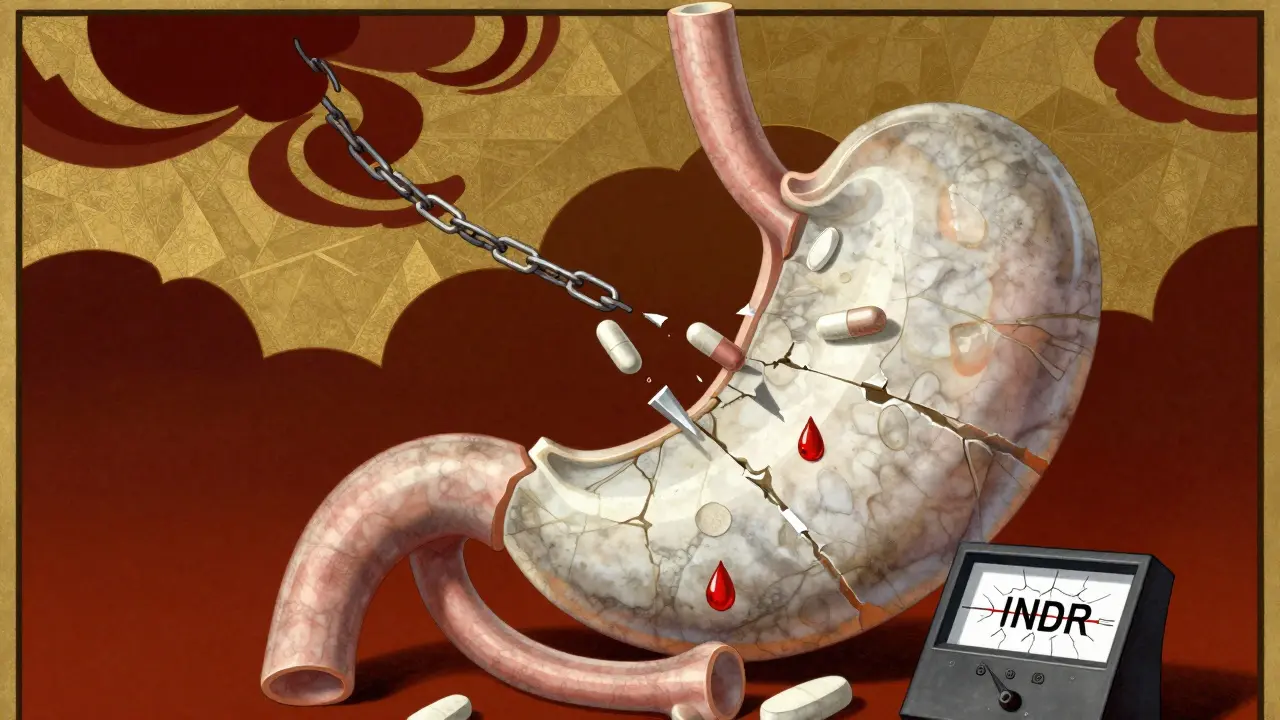
NSAIDs damage the stomach lining by reducing protective prostaglandins. That’s why long-term use can cause ulcers. When you add warfarin to the mix, that damaged lining becomes a ticking time bomb. A 2024 meta-analysis found that people taking both drugs had twice the risk of gastrointestinal bleeding compared to those on warfarin alone. That means black, tarry stools, vomiting blood, or sudden dizziness from blood loss - all signs you need emergency care.
But it’s not just the stomach. Brain bleeds, lung bleeds, and urinary tract bleeds also rise. One major study showed that the risk of intracranial hemorrhage jumped 3.2 times when NSAIDs were added to warfarin. Even minor injuries - a bump on the head, a fall, a nosebleed - can turn serious. And because warfarin’s effects build up over days, you might not notice anything wrong until it’s too late.
Not all NSAIDs are the same
Some NSAIDs are riskier than others. Naproxen carries the highest bleeding risk - nearly four times higher than warfarin alone. Diclofenac isn’t far behind, tripling the risk. Ibuprofen is a bit safer, but still increases bleeding by nearly 80%. Meloxicam, often thought of as a gentler option, was flagged in one study as an independent predictor of dangerous INR spikes. That means even if you’re on a low dose, meloxicam can push your INR up enough to require emergency intervention.
And here’s something most people don’t realize: it’s not just about the dose. Even low-dose aspirin, often taken for heart protection, can interfere with warfarin. It doesn’t matter if you’re taking 81 mg or 325 mg - it still affects platelets. And if you’re taking both, you’re doubling down on risk without doubling down on benefit.
Who’s most at risk?
Some people are more vulnerable than others. If you’re on more than 40 mg of warfarin per week, your body is already struggling to maintain balance. Add an NSAID, and your INR can spike by 15% or more - enough to trigger bleeding. Older adults, especially those over 70, are at higher risk. So are people taking other medications that interact with warfarin, like antibiotics or antifungals. Even something as simple as changing your diet - eating more leafy greens one week, less the next - can throw your INR off. Adding an NSAID on top of that? It’s a recipe for disaster.
Another red flag: low baseline INR. If your INR is usually on the lower end of the target range (say, 2.0), you have less room for error. A small rise from an NSAID can push you into dangerous territory fast. That’s why doctors often avoid NSAIDs entirely in these patients.
What to do instead
You don’t have to suffer in pain. There are safer alternatives. Acetaminophen (paracetamol) is the go-to for most people on warfarin. Up to 3,000 mg a day is generally safe, as long as you don’t have liver disease. Topical creams with menthol or capsaicin can help with joint pain. Heat packs, physical therapy, and even acupuncture can reduce reliance on pills.
If you absolutely need an NSAID - say, after surgery or for severe arthritis - your doctor might prescribe a proton pump inhibitor (PPI) like pantoprazole to protect your stomach. But even then, you’ll need more frequent INR checks. The standard advice is to test your INR within 3 to 5 days after starting the NSAID, then weekly while you’re on both drugs. Don’t assume your last test is still valid.

What the guidelines say
The American College of Chest Physicians and the European Society of Cardiology both warn against combining NSAIDs with warfarin unless there’s no other option. Even then, they recommend the lowest possible dose for the shortest time. Harvard Health and the FDA both include strong warnings in their labeling: “Concomitant use may increase the risk of bleeding.”
And yet, studies show that nearly 3 out of 10 people on warfarin still get prescribed an NSAID. That’s not just a gap in care - it’s a preventable crisis. Many doctors assume patients are taking over-the-counter painkillers and don’t ask. Many patients don’t think to mention them. That’s why it’s on you to speak up.
What to watch for
If you’re on both drugs, know the warning signs of bleeding:
- Unusual bruising, especially without injury
- Bleeding gums when brushing teeth
- Nosebleeds that won’t stop
- Dark, tarry stools or blood in stool
- Red or pink urine
- Sudden severe headache, dizziness, confusion (possible brain bleed)
- Unexplained weakness or fatigue (sign of anemia from blood loss)
If any of these happen, stop the NSAID immediately and call your doctor. Don’t wait. Bleeding from this interaction can be fatal.
Bottom line
Warfarin and NSAIDs don’t play well together. The science is clear, the risks are high, and the consequences can be deadly. Avoiding this combination is the safest move. If pain is keeping you from living your life, talk to your doctor about alternatives. Don’t risk your health for a quick fix. Your body already has enough to manage - don’t make it harder.
Becky M.
February 3, 2026 AT 08:48Just had my grandma on warfarin for 8 years and she never took anything stronger than tylenol. I don't get why people think OTC means harmless. It's not like ibuprofen is a vitamin.
Hannah Gliane
February 4, 2026 AT 03:13Oh wow. So let me get this straight. You're telling me that people who take Advil for their arthritis might accidentally bleed out? 😳 Like, is this some kind of horror movie plot? 🤦♀️
jay patel
February 4, 2026 AT 20:48Man, I've seen this in my clinic back in Delhi - elderly patients on warfarin popping naproxen like candy because their knees hurt. They don’t even know what INR means. The real tragedy? Their kids are overseas and no one’s watching. This isn’t just a medical issue - it’s a social one. We need community health workers, not just doctors, to catch this stuff before it’s too late. And yes, I’ve had patients end up in ICU because they thought ‘aspirin for heart’ meant ‘aspirin for headache’ - same pill, different logic. It’s not ignorance, it’s systemic neglect.
Eli Kiseop
February 5, 2026 AT 04:36so acetaminophen is safe right like no cap
Dan Pearson
February 6, 2026 AT 01:04Oh so now we’re treating people like fragile glass dolls because they took a painkiller? America’s gone soft. Back in my day we popped aspirin with warfarin and didn’t whine. Also, who’s the FDA to tell me what I can take? I’m a free man.
Ellie Norris
February 7, 2026 AT 00:22Just a heads up - even topical NSAIDs like diclofenac gel can raise INR if used over large areas daily. I’ve seen it in my practice. People think ‘topical = safe’ but absorption still happens. Always check with your anticoag clinic if you’re using any NSAID, even cream.
larry keenan
February 8, 2026 AT 20:30The pharmacokinetic interaction between warfarin and NSAIDs is primarily mediated through CYP2C9 inhibition and platelet dysfunction. The synergistic effect on hemostasis significantly elevates the risk of clinically significant hemorrhage, particularly in the gastrointestinal tract. The 2024 meta-analysis referenced demonstrates an odds ratio of 2.1 for GI bleeding with concomitant use, with a 95% CI of 1.8–2.4. This is not anecdotal - it’s evidence-based.
Monica Slypig
February 9, 2026 AT 05:47Why do we even let people take these drugs over the counter? In Germany you need a prescription for naproxen. We’re not a third world country. Why are we letting Americans self-medicate themselves into the ER? Someone should sue the manufacturers for not warning people clearly enough. This is negligence.
Gary Mitts
February 10, 2026 AT 18:53tylenol for win
Brett MacDonald
February 12, 2026 AT 02:35we're all just meat sacks with blood in them trying to avoid death. warfarin slows the clotting, nsaid makes platelets lazy. when they team up? your body forgets how to stop bleeding. like your blood just said 'nah, i'm out' after a stubbed toe. and then you're in the hospital wondering why your stool looks like tar. we're all one ibuprofen away from a tragedy. and yet we still take it. because pain is scary and doctors are busy. and we're all just trying to get through the day.
Marc Durocher
February 12, 2026 AT 06:18My uncle took naproxen for his back pain while on warfarin. Didn’t tell his doctor. Ended up with a GI bleed. Spent three weeks in the hospital. Now he only takes Tylenol and ice packs. He says it’s worth the extra minutes of discomfort. Honestly? I respect that. People think painkillers are free passes. They’re not.
Murarikar Satishwar
February 14, 2026 AT 03:36As a pharmacist in Mumbai, I’ve seen this exact scenario play out too often. Patients come in asking for 'something stronger than paracetamol' because their pain is 'unbearable'. We explain the risk, but many still insist. We often have to call their cardiologist directly to get approval. The real issue isn’t the drugs - it’s the lack of patient education. We need pamphlets in local languages, not just English. And doctors need to ask about OTC meds during every visit - not just when they think it’s relevant.
Sandeep Kumar
February 14, 2026 AT 21:55Warfarin is a relic. Why are we still using this ancient drug? Newer anticoagulants like apixaban don’t interact with NSAIDs the same way. But doctors keep prescribing warfarin because it’s cheap. And patients can’t afford the newer ones. So we’re forcing people to choose between pain and bleeding. That’s not healthcare. That’s capitalism.
Brittany Marioni
February 15, 2026 AT 20:01Just a reminder: if you're on warfarin, keep a daily log - not just INR numbers, but EVERYTHING you take: vitamins, herbs, teas, supplements, even cold medicine. I keep a little notebook. My doctor says it's the most helpful thing I do. Also, never skip your INR appointments - even if you 'feel fine'. Your body doesn't always tell you when it's about to fail.
phara don
February 17, 2026 AT 18:35Does anyone else use a wearable that alerts you if your INR is out of range? I got one last year - it’s like a Fitbit for blood thinners. It syncs with my app and reminds me when to test. Also, it logs all my meds. Life saver. 😎